Jack de Keyzer is a rare figure in Canadian blues music and an artist whose name is not splashed across every billboard, but whose presence is quietly woven into the fabric of the country’s live and recorded blues scene.
For those who may not have heard the name Jack de Keyzer, in short, he is a British‑born guitarist, vocalist, and songwriter currently based in Toronto who has spent more than four decades as one of Canada’s most dependable and decorated bluesmen, piling up miles on the road while earning two Juno Awards, seven Maple Blues Awards, and a reputation as one of the country’s most formidable guitar‑driven live acts.
His story is one of constant motion, with a career built on touring, session work, and a steady stream of albums that blend Chicago‑style blues, soul, rock, and a touch of British‑influenced swagger.
Early Life and Apprenticeship of a Canadian Blues Guitarist
Jack de Keyzer did not arrive fully formed as a top blues guitarist.
His path in music began with teenage immersion in the hard‑scrabble world of live performance. He joined the band of Canadian blues harp legend King Biscuit Boy in his teens in 1974, plunging into cross‑country tours that brought him into smoky clubs, community halls, and rough‑edged venues where the line between showmanship and survival was thin.
That early stretch taught him how to read a room, how to bend sound to suit an audience, and how to trust his instincts on stage.
After his stint with King Biscuit Boy, he moved into the equally demanding world of Ronnie Hawkins’ band, where he spent four years in the late 1970s logging time from polished ballrooms to rowdier biker bars and regional honky‑tonks.
That experience sharpened his sense of showmanship, timing, and stagecraft at a time when Canadian rock and roots bands often doubled as de facto road‑school classrooms.
By the time he stepped out on his own in the late 1980s, Jack de Keyzer was already a seasoned professional.

Jack de Keyzer’s Rockabilly Detour and the Eventual Move to Blues
Before he became known as a bluesman, Jack de Keyzer spent several years in the high‑energy world of rockabilly.
He was a member of the Hamilton‑based band The Bopcats, which released two albums on Attic Records in the 1980s and toured across Canada, fleshing out a sound that leaned on vintage rock and roll, swing, and jump‑style rhythms. That chapter showed a side of him that was less about slow‑burn blues and more about punchy, upbeat performance, which added elasticity to his later style.
After leaving The Bopcats, de Keyzer joined The Rock Angels, a short‑lived project that put out an independent EP in 1983.
Those years were an apprenticeship in band leadership, repertoire‑shaping, and the logistics of touring on a shoestring. By the time he turned toward blues as a primary focus, he was already a seasoned road dog who understood how to build a set, manage a band, and keep an audience engaged.
Solo Career and the Rise of “Hard Working Man”
Jack de Keyzer’s solo career formally began in 1989 with the release of his debut album, Hard Working Man, produced by Stacey Heydon.
The album was a declaration that he intended to be taken seriously as more than a sideman or session player. It delivered a tight, guitar‑driven blend of blues and rock, with a working‑class undercurrent that gave the record its title and its thematic spine.
The record’s singles — particularly “Blue Train,” “That’s the Way,” and “Nothing in the World” — helped establish him in the Canadian blues industry and earned traction on rock‑format radio, with “That’s the Way” reaching No. 13 on Canadian rock radio.
That early success did not catapult him into mainstream pop stardom, but it gave him credibility within the scene. In Canada, where roots and blues audiences often prize authenticity over chart position, de Keyzer’s ability to write songs that felt lived‑in earned respect from fans, critics, and fellow musicians alike.

Earning Awards and Recognition in Blues Across Decades of Music
Jack de Keyzer has not gone unnoticed in local and national music circles in Canada.
Real Blues Magazine named him the Live Act of the Year in 2001 and he’s earned the accolade of Guitarist of the Year twice as well.
Jack de Keyzer is the recipient of two Juno awards, both for Blues Album of the Year: first in 2003 for 6 String Lover, and again in 2010 for The Corktown Sessions.
Beyond the Junos, de Keyzer has received seven Maple Blues Awards, including multiple selections as Guitarist of the Year and has earned a broader recognition as a leading figure in the Canadian blues community.
Jack de Keyzer’s Reputation As A Session Guitarist and Collaborator
Part of Jack de Keyzer’s craftsmanship story lies not in his own albums, but in the sheer volume of recordings he has contributed to as a session guitarist.
He has appeared on hundreds of recordings, backing a wide range of musicians across blues, rock, and roots genres. He has worked with legends such as Etta James, Otis Rush, John Hammond Jr., Ronnie Hawkins, Duke Robillard, Bo Diddley, and Blue Rodeo, among others.
Those collaborations point to a musician trusted by demanding, often opinionated artists and has broadened his own songwriting and playing.
The fact that he has played with such a diverse roster — from classic electric blues exponents to Canadian alt‑country icons — also reflects an ability to adapt his tone and phrasing to different contexts without losing the identity of a classic Jack de Keyzer musical passage.
How Do You Describe the Jack de Keyzer Style, Sound, and Musical Identity?
If you have not seen him live or knowingly heard his recordings, Jack de Keyzer’s sound is best described as guitar‑driven blues, with strong undercurrents of soul, rock, and a touch of British‑influenced blues‑rock.
He is not a purist obsessed with replicating vintage Chicago records.
Instead, he treats blues as a living language, one that can absorb Motown‑style horn arrangements, Memphis‑flavored grooves, and British‑style power‑chord dynamics without breaking its core DNA. His solos are often lean and melodic, favoring feel over sheer speed, and his voice carries a lived‑in, conversational quality that fits comfortably alongside his guitar work.
This stylistic approach has served Jack de Keyzer extremely well in live performance. Onstage, he tends to build shows that move between high‑energy blues‑rock and more soulful, groove‑oriented numbers, creating a dynamic arc that keeps audiences engaged. That balance is one reason he remains a staple of festivals, clubs, and curated blues series across Canada.
Jack de Keyzer’s official biography notes that he has spent roughly 46 years on the road, covering what he wryly describes as “a couple million miles”. He typically plays over 100 shows a year, dividing his time between Canadian venues, border‑crossing runs into the United States, and occasional trips abroad. That kind of touring schedule has kept his sound sharp and his connection to audiences direct and immediate.
For de Keyzer, the road is less a burden than a necessary habitat.
He has said that playing and touring is “his way of life”, and that he feels “most at home when he is moving between cities”, hearing how different rooms and different crowds respond to the same material.
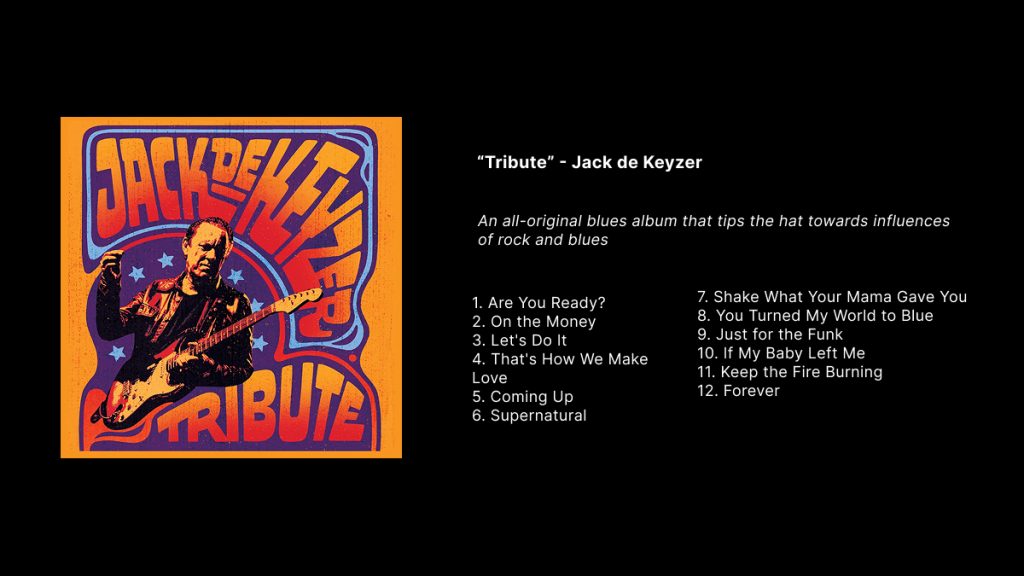
One of Jack de Keyzer’s Most Recent Albums: Introducing 2020’s “Tribute”
While it is an opinion that can be argued, it is sometimes said that a musical artist is only as good as their last record.
If you are familiar with classic Jack de Keyzer from years ago, rest assured that his most recent work proves just as moving. Even as de Keyzer approached his sixth decade as a professional musician, he has continued to add new chapters to his story.
In 2020, he released Tribute, an album that paid homage to the blues and roots tradition while still asserting his own voice.
The record featured 12 tracks designed as a coherent, roots‑forward statement, and it leaned into acoustic textures and ensemble interplay while still allowing space for his signature guitar work. At a time when many artists were forced off the road by the pandemic, the album gave de Keyzer a way to stay musically active and to maintain a connection with listeners through recorded music rather than live shows.
If there’s an album of his that we recommend taking a listen to, Tribute may be it.

Why Jack de Keyzer Matters to Canadian Blues Music
Jack de Keyzer’s embodies a particular kind of Canadian musician: one who has built a national profile without becoming a mass‑market celebrity, who has balanced sideman work with solo artistry, and who has stayed rooted in blues while still allowing room for rock, soul, and even rockabilly influences.
In a country where major‑label attention often skips over roots genres, he has carved out a sustainable career through constant touring, smart recording choices, and a reputation for reliability.
From a fan’s perspective, his music offers a honest, unpretentious kind of blues, with songs about work, relationships, and the texture of everyday life, delivered with a guitarist’s ear for detail and a bandleader’s sense of dynamics.
Jack de Keyzer is, at heart, a blue‑collar bluesman whose career has been built on work. That is, accumulated hours in clubs, studios, and dressing rooms.
In a world that often celebrates the new and the disruptive, de Keyzer’s story is a reminder that continuity and consistency still matter. He is an artist whose music sounds better after you’ve heard it a few times, whose guitar work feels more substantial after you’ve seen him live, and whose career rewards the kind of patient attention that roots and blues have always demanded.
For anyone who wants to understand what Canadian blues can be – tough, smart, and soulful – Jack de Keyzer’s music is a direct line to the heart of the genre.