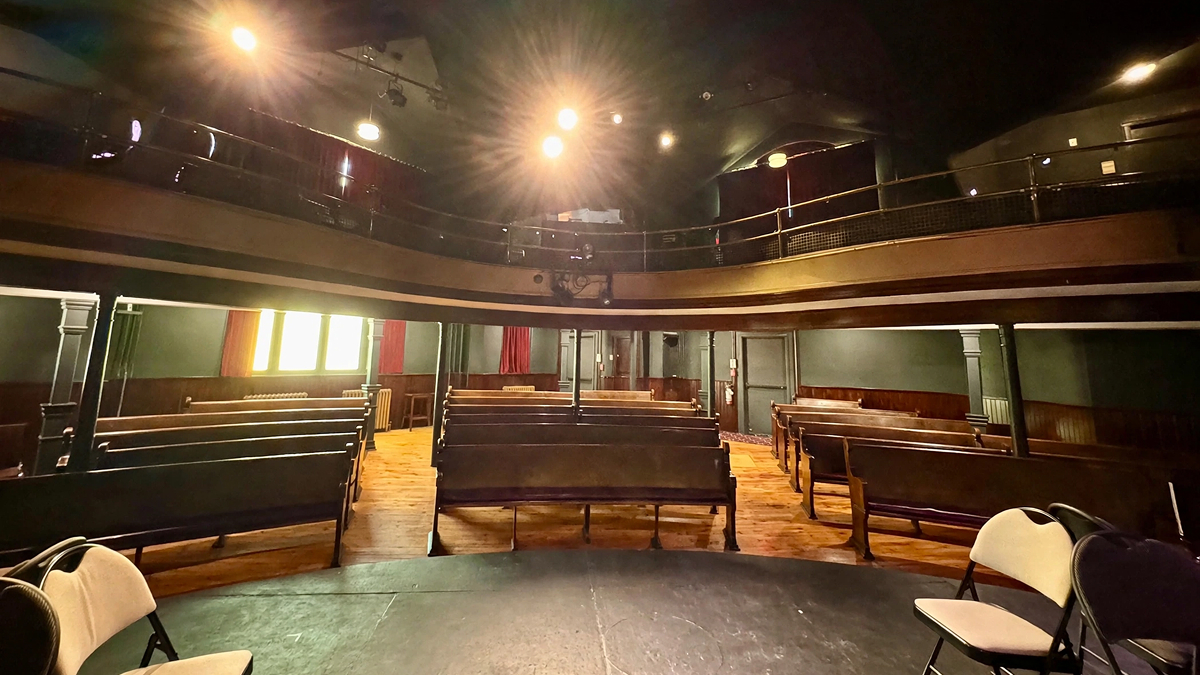
A converted 1907 church on Princess Avenue in St. Thomas, Ontario is about to have its busiest year in recent memory.
The Elgin Theatre Guild has built its 2026-2027 season around four plays that share almost nothing in common on the surface — a razor-edged British feminist classic, a brand-new Canadian love story making its world debut, a generation-swapped Shakespeare tragedy, and the most produced romantic comedy in North American high school theatre.
What ties them together is a volunteer company that has been doing this work, quietly and consistently, for nearly six decades.
For anyone weighing whether to buy a season pass or simply plan a night out in Elgin County, the specifics matter: dates, casting concepts, ticket prices, and the pedigree of the writers behind each script. This guide covers all of it, show by show, along with the history and mechanics of the guild itself.

Meet the Elgin Theatre: A Volunteer-Run Institution With Nearly Six Decades on Princess Avenue
The Elgin Theatre Guild has been staging productions in St. Thomas since 1967, which puts the 2026-2027 season somewhere around its sixtieth year of continuous operation.
The organization is entirely volunteer-run, from the actors and directors down to the board that manages its finances, and it typically mounts four mainstage productions a year that draw more than two thousand patrons through its doors annually.
The guild’s home, the Princess Avenue Playhouse, has its own history worth knowing before opening night.

The building at 40 Princess Ave was constructed in 1907 as a church for the Church of Disciples, designed by architect Neil Darrach with three distinct façades and two towers that still frame the block. The Elgin Theatre Guild purchased the building in 1987 and converted it into a working theatre while preserving much of its original character, including the circular stained-glass windows set into the gable ends of each façade — windows that have since been written into productions like Agnes of God rather than concealed behind a false wall. Observant visitors will also notice the pink-tinted mortar used in the original brickwork, a small architectural detail that has outlasted the building’s century-plus of use.
Beyond its four-show mainstage season, the guild uses the Playhouse to host touring musical acts, funded in part by the Dorothy Palmer Trust.
Past bookings have included Hawksley Workman, Bruce Cockburn, Sloan, Jimmy Rankin, the Ennis Sisters, and Juno Award winner Ian Thomas, alongside more recent bookings like the Devin Cuddy Band and Mudmen.
The guild is also a registered Canadian charity, meaning donations and sponsorships are tax-deductible, and it holds its Annual General Meeting each August, where community members can step into board roles ranging from front-of-house coordination to production management.

What It Costs to Buy A Ticket to An Elgin Theatre Production this Season
The 2026-2027 season runs from a preview performance on September 10, 2026, through the closing weekend of Almost, Maine on May 2, 2027.
Ticket pricing follows a simple structure: preview night on the first Thursday of each production’s run costs $20, general admission for the rest of the run is $25, groups of ten or more pay $20 per ticket, and a season pass covering all four mainstage productions runs $75.
That season pass works out to roughly $19 per show, a meaningful discount compared to buying general admission tickets individually, and it remains one of the most direct ways to support the guild’s year-round operating costs.
Performances follow a consistent weekly rhythm across all four productions: Thursday through Saturday evening shows begin at 7:30 p.m., with a Sunday matinee at 2:00 p.m., and doors opening thirty minutes before curtain in each case.
The Playhouse is wheelchair accessible via a ramp on the side of the building near the parking lot.
Parking itself is informal but plentiful, with patrons directed to side streets around the venue and an unpaved lot across Princess Avenue.
Individual show tickets and the season pass are both sold through the guild’s TicketScene page here, and gift certificates are available directly through the theatre’s office for anyone shopping for a theatre-loving friend or relative.

Top Girls: Caryl Churchill’s Reckoning With Ambition Opens the Season
- September 10-20, 2026
The season opens with Caryl Churchill’s Top Girls, a 1982 play that premiered at London’s Royal Court Theatre under director Max Stafford-Clark and has since become a fixture on lists of the most significant British plays of the twentieth century.
Churchill wrote it in the immediate wake of Margaret Thatcher’s election as Britain’s first female prime minister, and the script uses that political moment as a springboard to ask what a woman actually has to give up to reach the top of a male-dominated industry.
The play centers on Marlene, newly promoted to managing director of the Top Girls employment agency in London, who marks the occasion with a surreal celebratory dinner.
Her guests are a mix of historical and legendary women pulled out of time: nineteenth-century explorer Isabella Bird, thirteenth-century Japanese courtesan-turned-Buddhist-nun Lady Nijo, the legendary female Pope Joan, Chaucer’s endlessly patient Griselda from The Canterbury Tales, and Dull Gret, the armor-clad figure from a Pieter Bruegel painting who leads a band of women into hell.
Each recounts a version of the same story — success bought at enormous personal cost — before the play shifts into Marlene’s actual workplace and, finally, into a confrontation with her sister Joyce and the daughter Marlene left behind to build her career.
Structurally, Top Girls was a genuine innovation for its era. Churchill layered overlapping dialogue throughout the opening dinner scene, breaking from the polite one-speaker-at-a-time convention of most stage writing, and she arranged the three acts out of chronological order so that the audience learns the emotional cost of Marlene’s choices before they fully understand what those choices were. Critics have consistently placed it among the most important feminist plays ever staged in Britain, and it remains a staple of university drama programs precisely because of how much ground it covers — capitalism, class conflict, motherhood, and the specific brand of individualism that Thatcher-era politics rewarded.
The Elgin Theatre Guild’s own season materials describe it as a sharp, funny, and thought-provoking look at ambition and the price of having it all, and the company has noted it as one of the larger-cast productions of the year, consistent with a script that calls for an all-female ensemble taking on multiple roles apiece.

A Stork Club Story: A World Premiere Built on Big Band Nostalgia
- November 5-15, 2026
The second production is the rarest kind of opportunity a community theatre can offer: a world premiere. A Stork Club Story, written by Paul Regan and Brett McCaig, has never been staged anywhere before this run, which means the cast and crew in St. Thomas are the first people ever to bring these characters to life in front of an audience.
Brett McCaig is a Toronto-based playwright with a genuine theatrical track record — he co-wrote Rob Ford the Musical: The Birth of a Ford Nation with lyricist P. Joseph Regan and composer Anthony Bastianon, a satirical stage musical about the late Toronto mayor that ran at Toronto’s Factory Theatre in September 2014 and drew national media coverage during its open casting call, which reportedly attracted hundreds of hopeful actors.
A Stork Club Story marks a sharp tonal departure from that earlier satire into something warmer and more personal.
The new play moves between two timelines: the golden-lit heyday of a 1950s lakeside dance hall called the Stork Club, and the present-day attic of an aging man named Mitch, who is sorting through the remnants of his family home before selling it.
As Mitch digs through the past, the story flashes back to a young, impulsive trumpet player colliding with a sharp-witted coat check girl who may be the love of his life, provided pride, romantic rivals, ambition, and plain bad timing don’t get in the way first. A decades-old letter surfaces partway through the story with the power to change everything the characters — and the audience — think they know.
The production leans into live big band energy and swing-era music as a structural device, using the sound of the era to underscore just how much can shift in a single dance hall night. It is billed as blending rapid-fire comedy with genuine emotional weight, anchored by the central question of what people choose to hold onto once memory itself becomes unreliable — a detail that suggests Mitch’s present-day storyline carries its own quiet reckoning with aging and loss.
For patrons who have followed Canadian playwriting beyond the major festival circuit, seeing an original script premiere in a 120-year-old converted church rather than a Toronto mainstage is exactly the kind of access community theatre exists to provide.

Romeo & Juliet Gets a Generational Twist Inside an Assisted Living Facility
- February 11-21, 2027
By the time Shakespeare’s Romeo and Juliet arrives in February, audiences will already know the underlying story: two teenagers from feuding families fall in love, marry in secret, and lose everything to a chain of miscommunication and violence that neither of them starts.
Written sometime between 1594 and 1596 and first printed in 1597, it remains, alongside Hamlet, one of Shakespeare’s most frequently performed works, adapted over the centuries into ballet, opera, a dozen or more films, and of course West Side Story.
Shakespeare drew the plot from Arthur Brooke’s 1562 narrative poem The Tragicall Historye of Romeus and Juliet, but he compressed Brooke’s nine-month timeline down to five frantic days, which is a large part of why the play still feels so urgent four centuries later.
The Elgin Theatre Guild’s production takes a genuinely unusual approach to that familiar text. Rather than simply casting the play straight, the company is staging it inside a lively assisted living facility with the ages of the cast reversed: elderly actors take on Romeo and Juliet themselves, while younger performers play the parents, authority figures, and caretakers who normally hover around the teenage leads.
The action unfolds through the halls and recreation rooms of the facility rather than the streets and orchards of Verona, and the concept is built to surface fresh comedy in scenes audiences may have watched dozens of times before, while also opening space for a more grounded reflection on dignity, memory, and connection across generations.
This isn’t the first time a director has looked at Romeo and Juliet and seen retirement-community potential — Bristol Old Vic‘s Juliet & Her Romeo cast octogenarians as the title characters inside a nursing home setting in 2010, and the Hudson Valley Shakespeare Festival made headlines in 2022 by casting real-life married couple Kurt Rhoads and Nance Williamson, both longtime company veterans, as the teenage lovers without altering the setting at all.
What sets the Elgin Theatre Guild’s version apart from those precedents is the reversal itself: instead of simply aging up Romeo and Juliet, the production flips the entire generational hierarchy of the play, so the people usually cast as the impulsive, love-struck teenagers are the oldest members of the cast, and the people usually playing world-weary parents and priests are the youngest. It’s a structural choice as much as a casting one, and it changes what every line in the text is actually about.

Almost, Maine Closes the Season With North America’s Most-Produced Love Story
- April 22-May 2, 2027
The season ends on lighter footing with John Cariani’s Almost, Maine, a play that has quietly become one of the most performed scripts in the country since its 2004 premiere at Portland Stage Company in Maine.
Cariani, a Tony nominee for his role as Motel the Tailor in the 2004 Broadway revival of Fiddler on the Roof and later a cast member of Something Rotten! and The Band’s Visit, developed the play at the Cape Cod Theatre Project in 2002 before it opened briefly Off-Broadway at the Daryl Roth Theatre in January 2006.
Dramatists Play Service published the script in 2007, and from there it took off: the play has now logged nearly 100 professional productions and more than 5,000 community, university, and high school stagings, and it overtook Shakespeare’s A Midsummer Night’s Dream to become the single most produced play in North American high schools around 2016 and 2017.
The appeal is built into the structure. Almost, Maine is set on a single clear, moonless winter night in a fictional unorganized township so far north that, as the play itself puts it, it’s almost not in the United States at all. Nine loosely connected vignettes, most of them two-character scenes, follow different residents of the town as they fall in and out of love in ways that bend gently toward magical realism — one character literally returns a box of love to an ex, another discovers her heart has physically broken into pieces.
Cariani has said the simplicity of that format is exactly why high school directors gravitate toward it: with a small, flexible cast that can range from four actors playing nineteen roles up to a much larger ensemble, directors can give real attention to craft rather than logistics, and every scene stands on its own as a self-contained story about the strangeness of romantic connection.
The play has not been without controversy.
One of its nine vignettes, titled “They Fell,” depicts two men realizing they’re in love with each other, and that scene has triggered attempted bans or edits at a handful of American high schools over the past fifteen years, including a widely covered 2011 dispute in Bel Air, Maryland, and a 2014 cancellation at Maiden High School in North Carolina. Cariani, who is gay, has publicly maintained that the scene is about love rather than sexuality and contains no explicit content at all.
None of that controversy has slowed the play’s momentum elsewhere — it was the fourteenth most streamed play during the COVID-19 pandemic, when theatres across North America turned to recorded and livestreamed productions to stay connected with audiences.
For the Elgin Theatre Guild, closing the season with a warm, funny, occasionally magical love story after the heavier emotional terrain of Top Girls and the tragedy of Romeo & Juliet gives the year a shape: it starts hard, takes a swing on something brand new, gets structurally inventive with a classic, and ends on hope.

Get Your Tickets and Mark Your Calendar for the Elgin Theatre Guild’s 2026-2027 Season!
Four productions, four very different demands on an audience: a feminist landmark that rewards close attention, an original Canadian script nobody has ever seen performed before, a Shakespeare tragedy turned inside out through casting alone, and the most reliably crowd-pleasing romantic comedy in the American and Canadian repertoire.
A season pass at $75 covers all four shows and remains available for purchase here, individual tickets can be purchased separately for anyone who only wants to catch one or two productions, and groups of ten or more get a modest discount that makes the Playhouse a sensible option for clubs, workplaces, or extended family outings.
With Top Girls opening in a matter of weeks and A Stork Club Story debuting to the world for the first time in November, the earliest planning window is already closing — but the rest of the season, running clear through the following May, leaves plenty of room to build a night at the theatre into the year ahead.
Get your tickets to the 2026-2027 Elgin Theatre season here! Do not wait as seats are filling up as we speak.