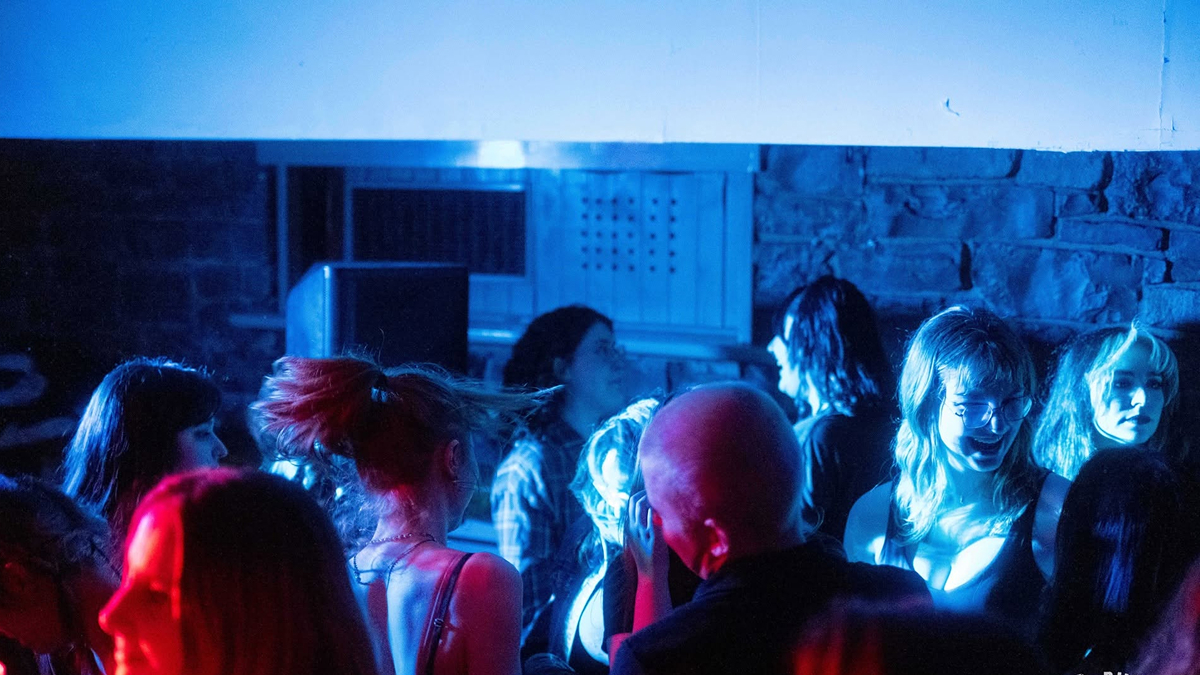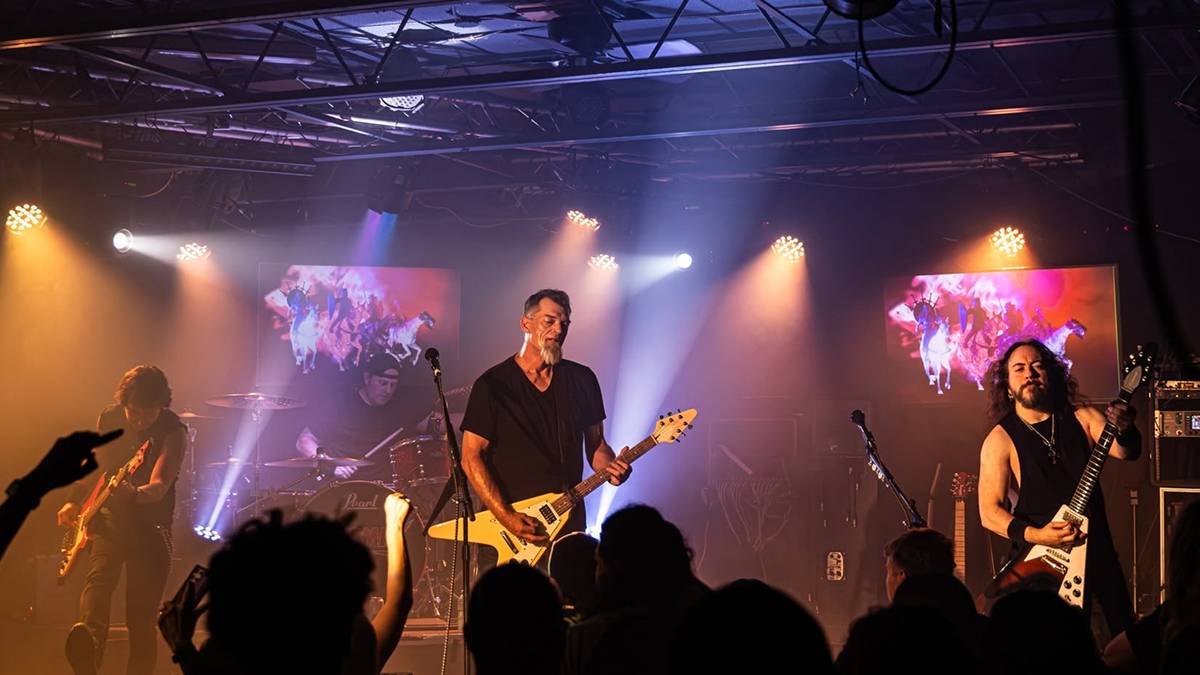
If you have ever wondered what it sounds like when musicians throw out the sheet music entirely and build a song from pure instinct and the musician’s ability to listen and respond, Exit Points #75 will answer that question in real time. On Friday, August 28, 2026, a rotating cast of Toronto-based composers, multi-instrumentalists, and sonic experimenters will gather at Array Space on Walnut Avenue for another edition of one of the city’s longest-running free-improvisation concert series. Whether you are a lifelong fan of experimental music or someone who has never set foot in an avant-garde venue before, this show is built specifically to welcome you.
What Is Exit Points? Understanding the Format
Exit Points is a live music series built entirely around musical improvisation, meaning the performers are not working from a score, a set list of established songs, or even rehearsed arrangements. Instead, small ensembles of musicians drawn from wildly different musical backgrounds, think jazz, electroacoustic composition, noise, modular synthesis, and singer-songwriter traditions, meet on stage and create something spontaneous and unscripted together.
The series is the ongoing project of Michael Palumbo, a Toronto-based musician, concert producer, and instrument designer who serves as its founder and artistic director, and whose own electroacoustic performances on modular synthesizer have been presented at venues including Toronto’s Music Gallery, the Jay Pritzker Pavilion in Chicago’s Millennium Park, and SUNY Buffalo. That kind of curatorial pedigree matters for an event built on trust: audiences are essentially agreeing to watch musicians make something out of nothing, and they need to believe the person assembling the lineup knows what they are doing.
What separates Exit Points from a typical open-mic jam session is the structure and intentionality behind the evening. Every show opens with simple listening strategies, brief, plain-language guidance meant to help first-timers feel oriented rather than lost amid sounds that might initially seem chaotic or formless.
From there, the audience hears two short sets performed by small ensembles, each running roughly thirty to thirty-five minutes and each pairing musicians who often have not played together in that exact configuration before. This deliberate mixing of personnel is part of the point. It forces genuine spontaneity rather than well-worn habits, and it means no two Exit Points nights, and certainly no two editions numbered seventy-five apart, ever sound the same.
The evening closes with a segment the series calls “Switchemups,” and it is arguably the most distinctive part of the format.
During this closing stretch, the performers rearrange themselves into new, smaller groupings for a series of short pieces, typically five to ten minutes each, and audience members are explicitly invited to step on stage and improvise alongside the professionals if they want to. Participation is entirely optional, so anyone content to simply watch and listen can do exactly that, but the option itself changes the emotional tone of the room. It transforms the concert from a one-directional performance into something closer to a shared experiment, which is precisely the atmosphere Exit Points has built its reputation on.
Every performance is also professionally recorded across multiple tracks and later mixed into a spatialized format for release on the Exit Points record label, so what happens in that room on August 28 has a genuine chance of becoming a permanent artifact of Toronto’s experimental music history.
Exit Points #75: How to Buy Your Tickets for August 28th
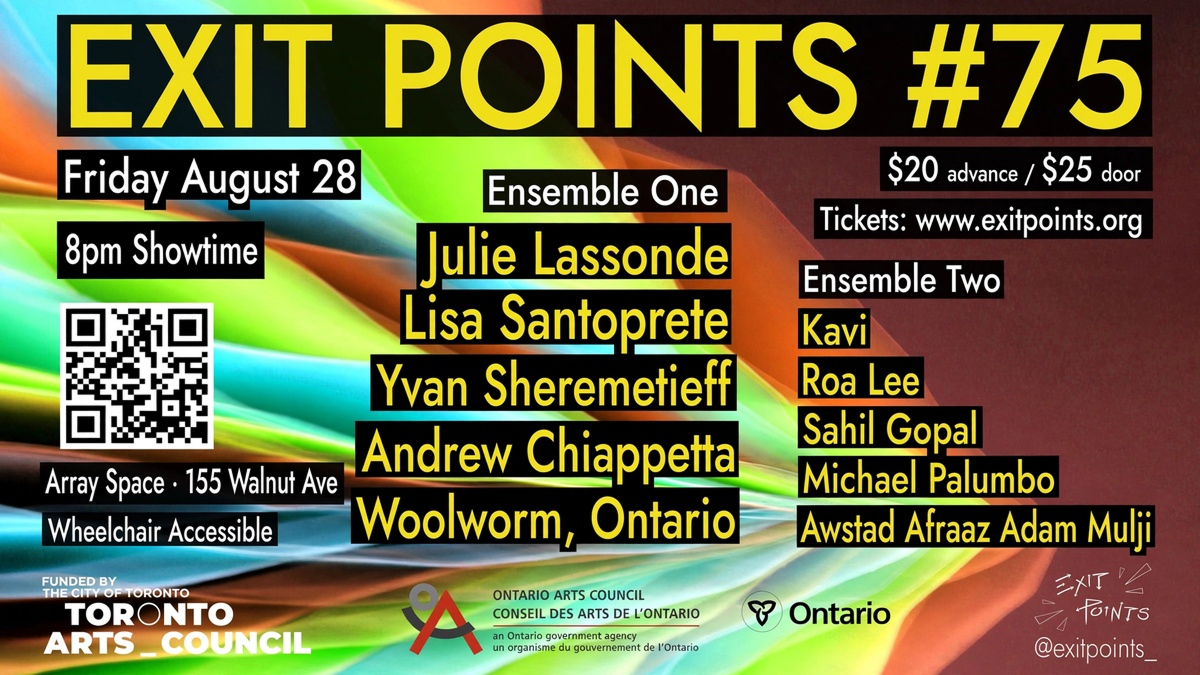
- Exit Points #75 takes place on Friday, August 28, 2026, at Array Space, located at 151 Walnut Ave in Toronto, Ontario.
- Doors open at 7:30 PM, the performance itself runs from 8:00 PM to 10:30 PM, and the event is listed as all ages.
- Tickets for Exit Points #75 are sold directly through Ticketscene and can be purchased here.
Advance tickets are priced at $20 CAD plus fees, while general admission at the door is priced at $25 CAD plus fees, so buying ahead of time saves a meaningful five dollars per ticket on top of avoiding the risk of a sellout.
Given that the venue’s total capacity for this event is capped at just 60 attendees, that risk is not theoretical; small-room improvised music shows in Toronto routinely sell out well before doors, and this room is smaller than many. Because the room is small, the sound is close and unamplified in the way a stadium show never could be, and audience members are typically seated within a few feet of the performers rather than watching from a distant tier.
The lineup for this specific installment draws together eleven names spanning composition, songwriting, and sound design, and the ensembles will be organized and announced from the stage on the night itself, consistent with how the series has always operated.
Because Exit Points intentionally avoids locking performers into fixed, rehearsed bands, part of the appeal of attending in person, rather than simply streaming a recording afterward, is watching those combinations take shape live and hearing how the musicians negotiate a shared musical language in real time.
Meet the Artists Featured at Exit Points #75
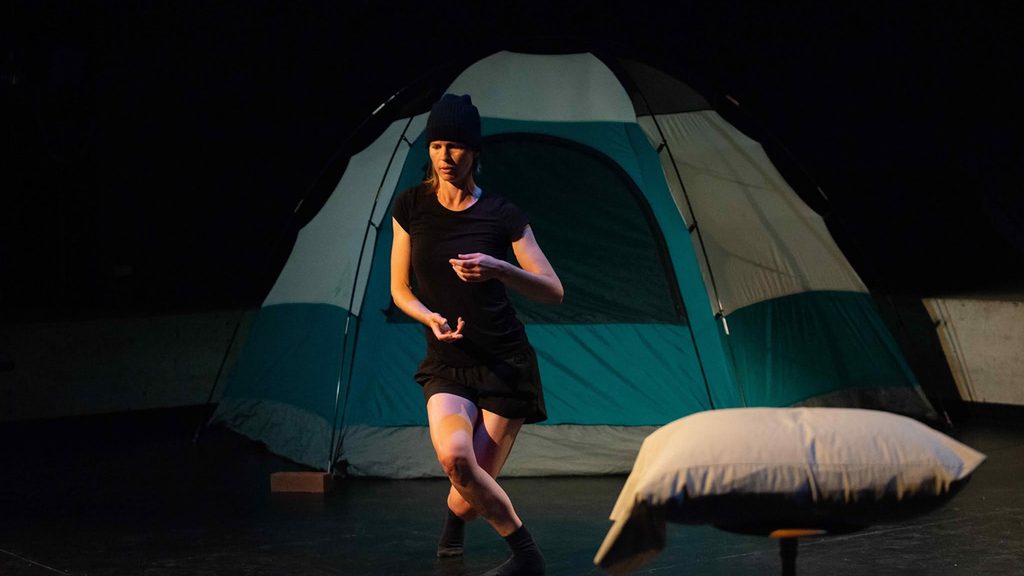
Julie Lassonde: The Lawyer-Turned-Performance-Artist Bridging Movement, Sound, and Justice
Julie Lassonde is a Montreal-born, Toronto-based interdisciplinary performance artist whose work sits at the intersection of physical theatre, sound improvisation, and legal scholarship. Before devoting herself full-time to performance, Lassonde trained in corporeal mime, the demanding physical-theatre discipline pioneered by Étienne Decroux, and studied law at McGill University, later becoming a member of both the Law Society of Ontario and the Barreau du Québec. That dual foundation shapes nearly everything she makes: her performances return again and again to themes of gender, intimacy, consent, and the socio-legal norms that quietly govern daily life, using the body itself as a site to question them. She holds an interdisciplinary master’s degree in law and visual arts from the University of Victoria, has presented work from Toronto and Montreal to Berkeley and Edinburgh, served as Osgoode Hall Law School’s Artist in Residence, and performed at Toronto’s long-running 7a*11d International Festival of Performance Art. Most recently, she has led a monthly residency at the Tranzac Club pairing her original movement scores with live percussion, voice, and electronics. At Exit Points #75, she brings that same instinct for building trust inside spontaneity to a room full of musicians working toward the same unscripted goal.
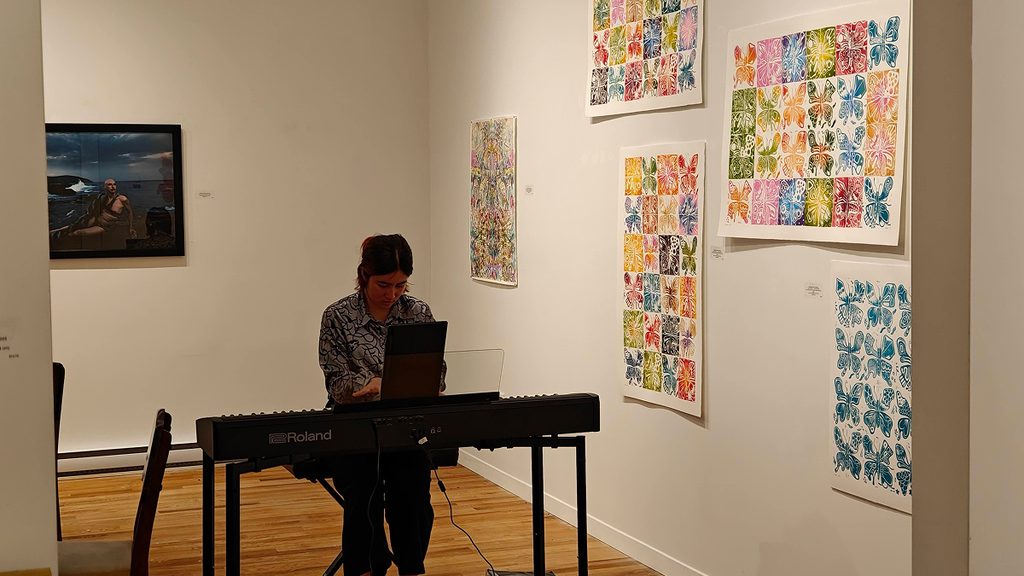
Lisa Santoprete: The Classically Trained Pianist Bringing Concert-Hall Precision to Free Improvisation
Lisa Santoprete is a Waterloo, Ontario-born pianist whose formal training reads like a classical music résumé rather than an experimental one, making her a striking addition to an improv-focused lineup. She holds a Bachelor of Music in Piano Performance and a Diploma in Chamber Music from Wilfrid Laurier University, where she studied with Anya Alexeyev, along with an Associate Diploma (ARCT) in Piano Performance from the Royal Conservatory of Music. She is currently pursuing a Master of Music in Piano Performance at the University of Toronto under Lydia Wong, where she also performs regularly as a chamber and collaborative pianist who premieres new works by Canadian composers. Her competition record is substantial: first prize at the Crescendo International Piano Competition, which carried a performance at Carnegie Hall, first prize at the Wilfrid Laurier Concerto Competition as soloist with the Laurier Symphony Orchestra, the Contemporary Music Prize at Markham’s International Music Festival and Competition, and a National Finalist placement at the Canadian Music Competition. She was also named a 2026 Performance Fellow at the Cortona Sessions for New Music. At Exit Points #75, Santoprete’s rigorous classical foundation and deep experience championing new Canadian repertoire offer a distinct counterpoint to the room, proof that structured virtuosity and spontaneous invention can share the same stage.

Yvan Sheremetieff: The Toronto Psychiatrist Turning Clinical Insight into Genre-Defying Music
Yvan Sheremetieff is a Toronto-based composer, multi-instrumentalist, and practicing psychiatrist whose two careers openly inform each other. Before going solo, he served as vocalist and songwriter for the progressive rock bands The Boudoirs and Bobby Heaven, but his own work under his name abandons genre entirely in favor of capturing unfiltered thought, oscillating between lush instrumentation and raw voice-memo intimacy. Drawing directly on his clinical background, he returns again and again to themes of madness, authenticity, and humanity’s relationship to nature, treating composition less as songwriting and more as a form of open-ended psychoanalytic inquiry. That approach reached its fullest expression on The Interpretation of Voices, a six-episode audio serial released through People Places Records that blends podcast, concept album, field recording, and art manifesto as it follows Sheremetieff and collaborator XSQ through a year of parallel creation in the UK. Earlier releases like Voice Memos and Introduction to Tangentiality, along with an early experiment composing alongside OpenAI’s Jukebox AI, show the same restless curiosity for unconventional production methods. At Exit Points #75, that same willingness to sit with uncertainty and let meaning emerge in real time makes him a natural fit for a stage built entirely around musical instinct rather than rehearsal.

Andrew Chiappetta: The Songwriter Building Toronto’s Indie Folk Scene One Circle at a Time
Andrew Chiappetta is a Toronto-based guitarist, multi-instrumentalist, singer-songwriter, and educator who has spent recent years quietly becoming a connective hub for the city’s young indie folk community. He writes, performs, and teaches across folk, jazz, and several other styles, work that shows up both in his own recordings and in the guitar and bass lessons he gives around the city. His debut EP, Lamplight, released independently on Bandcamp and streaming platforms, established his songwriting voice, but Chiappetta’s larger contribution to Toronto’s music scene may be Andrew Chiappetta’s Songwriter’s Circle, a recurring showcase he curates and hosts at the Tranzac Club’s Southern Cross Lounge. The series regularly brings together a rotating cast of the city’s emerging singer-songwriters, past lineups have featured names like Justin Orok, Jessica Spurrell, Audrey Mae, and Melissa Paju, giving younger folk artists a stage and a built-in audience they might not otherwise have. That same community-building instinct, pulling together disparate voices and letting them play off one another in real time, makes him a natural fit for Exit Points, even coming from a more song-based tradition than most of the night’s improvisers. At Exit Points #75, expect Chiappetta to bring a folk musician’s ear for melody and lyric into a room built on pure spontaneity.

Woolworm, Ontario: The Laptop Noise Project Turning Field Recordings Into Ritual
Woolworm, Ontario is the solo experimental electronic project of Toronto-area sound artist Lucas Dvorsky, and the deliberately specific name exists mainly to distinguish it from the unrelated Vancouver indie-rock band that shares half its title. Working primarily through Ableton, an Octatrack sampler, a field recorder, a turntable, and even a Walkman, Dvorsky builds psychedelic, texture-driven soundscapes that sit closer to noise and ambient improvisation than anything resembling a conventional song. His Bandcamp catalog, releases like Scrying, No Wind/Black Water, Lost Island, and ritual, reads more like a series of sonic environments than a discography of tracks, each one built from layered field recordings, degraded tape sources, and live laptop manipulation rather than fixed compositions. That process-driven, in-the-moment approach to building sound has made Dvorsky a familiar presence in Toronto’s experimental and improvisational music scene, with performances at venues including the Tranzac Club and Arraymusic putting him in direct dialogue with the same community of improvisers behind Exit Points. At Exit Points #75, Woolworm, Ontario brings a genuinely different sonic palette to the stage: where most of the night’s performers improvise on traditional instruments, Dvorsky improvises with machines, treating laptops and samplers as instruments capable of the same spontaneity and risk as a saxophone or a modular synth.

Kavi: The Scarborough-Raised Beatmaker Bringing Hip-Hop Production Instincts to the Stage
Kavi, born Kavian Salehi, is a Toronto-based record producer and hip-hop beatmaker who was raised in Scarborough and started making music as far back as elementary school. His production career has grown well beyond local circles, with credits alongside major names in contemporary rap and hip-hop including Ken Carson, LUCKI, Yeat, and Lil Tecca, placing him inside some of the genre’s most closely watched current rosters. Where most producers in that world build tracks alone in a studio, layering and refining beats in isolation before an artist ever hears them, Kavi’s background is built on a different kind of instinct: constructing rhythm, texture, and mood from scratch, often reacting to a vocalist or collaborator in real time rather than working from a finished blueprint. That instinct for building something compelling out of a blank canvas, quickly and under pressure, is a skill that translates directly to the free-improvisation format Exit Points is built around, even though the two genres rarely share a stage. His catalog, available on Bandcamp and Genius, reflects a beatmaker still very much in motion, releasing new work regularly while continuing to build his profile within Toronto’s hip-hop production scene. At Exit Points #75, Kavi represents the series’ commitment to pulling collaborators from outside its usual genre lanes entirely, testing whether a producer’s rhythmic sensibility can hold its own in a room built for total spontaneity.

Roa Lee: The Gayageum Master Redefining a 1,500-Year-Old Instrument
Roa Lee is a South Korean-born, Toronto-based composer and gayageum player, master of the traditional 12-string Korean zither, who moved to Canada specifically to push the centuries-old instrument into new contemporary and world-music contexts. As artistic director of the Labyrinth Ensemble, she performs alongside fellow modal-music specialists like Aysel Taghi-Zada and Sasan Salaseli, building repertoire that threads gayageum through modal jazz, loop-station textures, and Middle Eastern and Central Asian modal traditions rather than keeping it confined to traditional Korean forms. That cross-cultural fusion work has landed her performances at some of Toronto’s most respected cultural institutions, including the Aga Khan Museum, the Canadian Music Centre, the Bata Shoe Museum, and Harbourfront Centre’s long-running Summer Music in the Garden series. Her solo EP, The First Step, was supported by the Ontario Arts Council, further establishing her as a serious voice in the city’s intercultural and new-music communities rather than simply a specialist performer of traditional repertoire. Lee has described her ongoing project as breaking through the perceived barrier between traditional and contemporary music, treating the gayageum less as a museum-piece instrument and more as a living tool for improvisation and collaboration across genres. At Exit Points #75, that philosophy fits naturally: an instrument built for centuries-old Korean court and folk music, reimagined in real time alongside modular synths, guitars, and hip-hop production, is exactly the kind of unlikely combination the series exists to create.
Sahil Gopal: The 12-String Songwriter Also Anchoring Toronto’s Indie Rock Underground
Sahil Gopal is a Toronto-based singer-songwriter and multi-instrumentalist who moves comfortably between solo acoustic material and full-band indie rock. His original songwriting favors the intimacy of 12-string acoustic guitar, showcased in tracks like “Sleepless Dreams,” a stripped-down original that leans into the richer, chiming texture the 12-string is known for rather than a standard six-string setup. Beyond his solo work, Gopal also plays bass for Service Animals, a Canadian indie rock band, giving him regular experience holding down rhythm section duties in a full-band context rather than working purely as a frontperson. That dual identity, reflective solo songwriter on one hand, functional band member locking in with drums and guitars on the other, gives him a versatile musical toolkit that few single-genre performers bring to a stage. It also makes him a fitting addition to Exit Points, where musicians are regularly asked to shift roles and contexts on the fly rather than stick to one fixed identity. At Exit Points #75, Gopal joins a lineup that spans hip-hop production, traditional Korean strings, and modular synthesis, adding his own grounding in acoustic songwriting and full-band rock sensibility to the night’s collaborative mix.
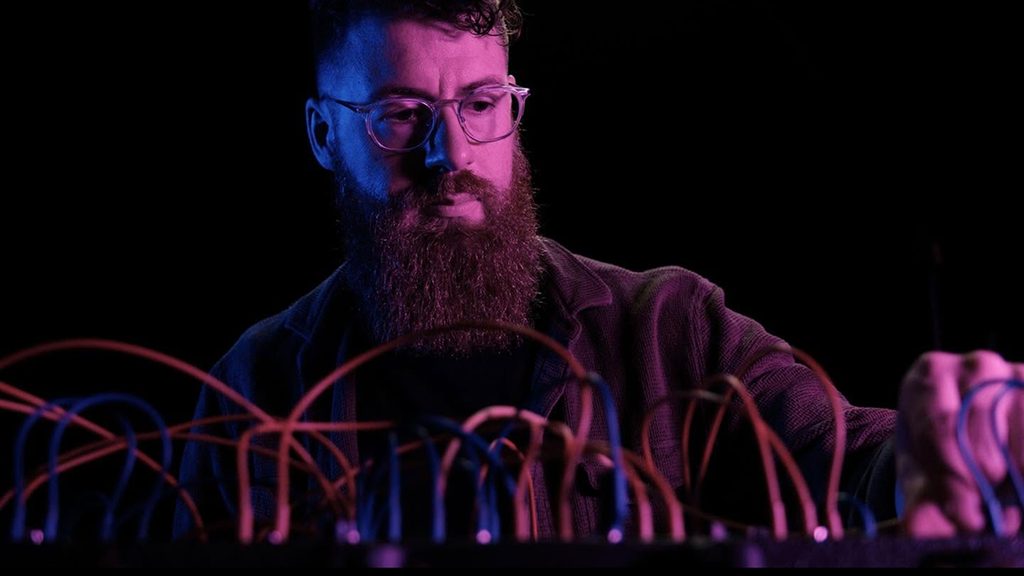
Michael Palumbo: The Sound Artist and Researcher Who Built a Stage for Toronto’s Improvisers
Michael Palumbo is the Toronto-based musician, sound artist, and researcher behind Exit Points itself, founding the series out of a desire to build a performance space rooted in the openness and generosity he found within Toronto’s improvising community. Born and raised in Toronto with an Italian background, he started piano lessons at age eight, and a teacher’s early recognition of his musical gift set him on a path that would eventually span performance, technology, and community organizing. As mentioned earlier this article, as a performer, Palumbo works primarily on modular synthesizer, and his electroacoustic compositions have been presented at notable venues including Toronto’s Music Gallery, the Jay Pritzker Pavilion in Chicago’s Millennium Park, and SUNY Buffalo. His work extends well beyond the stage: through his research with the DisPerSion Lab, he explores networked performance, systems thinking, and self-organization, treating musical collaboration as a kind of living system worth studying as much as performing. That dual lens, artist and researcher, shows up directly in how Exit Points is structured, with its emphasis on unscripted ensembles, audience participation, and recordings that document each night’s unrepeatable collaboration. At Exit Points #75, Palumbo performs alongside the very community he built the series to support, both curating the night’s spontaneity from behind the scenes and stepping into it himself as a working improviser.

Afraaz Adam Mulji: The Polymath Multi-Instrumentalist Bridging East, West, and Everything Between
Afraaz Adam Mulji, often credited by the honorific “Ostad” (an Urdu and Persian title denoting mastery), is a Toronto-based multi-instrumentalist and composer whose work is built entirely around blending musical traditions from across the globe. Born in Tanzania and performing under the name Maestro Mi as a teenage prodigy before eventually settling in Toronto, Mulji plays an extraordinary range of instruments, among them piano, organ, harpsichord, synthesizers, Hammond B3, flute, theremin, tabla, and a wide array of hand percussion including djembe, dumbak, and ghatam, giving him fluency across Western classical, jazz, and multiple non-Western musical systems. His compositional approach draws explicitly on a polymathic set of influences spanning Bach, the medieval Persian polymath al-Farabi, composer Alexander Scriabin, and mathematician Srinivasa Ramanujan, treating music as a lens for exploring quantum and mathematical structure as much as emotional expression. He has presented work through Toronto’s Aga Khan Museum, including an original piano composition inspired by a 16th-century music manuscript, and performed with Toronto’s Small World Music in a program exploring the Sufi concept of Fana and Daoist ideas of formlessness. He also holds a role as composer within the Aga Khan Development Network, reflecting a career that moves fluidly between concert performance and cultural institution work. At Exit Points #75, Mulji’s genuinely rare combination of instrumental range and cross-traditional fluency makes him one of the night’s most unpredictable collaborators, equally capable of anchoring a piece on tabla, synthesizer, or piano depending on where the improvisation leads.

Why Array Space Is the Right Room for Exit Points
Array Space is not a commercial concert venue in the traditional sense; it is the performance and rehearsal studio operated by Arraymusic, a non-profit organization founded in 1972 dedicated to championing Canadian composers and contemporary sound art, with its resident Array Ensemble performing since 1976.
The space occupies roughly 1,200 square feet on the second floor of a converted industrial building in Toronto’s Trinity Bellwoods and West Queen West neighborhood, just west of Niagara Street between Adelaide and Richmond, and it is outfitted with hardwood floors, exposed brick, a full lighting board, a professional PA system, and even two baby grand pianos left over from its life as a rehearsal studio for contemporary classical musicians.
This is a room where the Array Ensemble has spent decades workshopping new Canadian compositions, where touring musicians from around the world stop in at odd hours to rehearse, and where the walls are lined with stacks of vinyl and decades of concert posters rather than beer branding.
It has also been recognized publicly for its role in the city’s experimental music landscape, having been ranked among Toronto’s top experimental venues by local outlets not long after opening. The venue has been renovated for accessibility as well, with a wheelchair ramp and elevator access added in recent years, which is worth knowing if mobility is a consideration for you or someone you are bringing along.
Why Exit Points #75 Is Worth Your Friday Night and A Ticket in Toronto
Exit Points #75 is not a passive night of background music, and it is not a show built around a single headliner’s greatest hits. It is a live experiment in real-time collaboration, staged in one of Toronto’s most historically significant experimental music rooms, and structured deliberately to make first-time listeners feel as welcome as longtime devotees of free improvisation.
If the format, small ensembles building something from nothing, a closing segment that invites the audience on stage, and a recording that may live on long after the night ends, sounds like your kind of evening, the smartest next step is simple: grab an advance ticket for $20 CAD plus fees through Ticketscene before the room’s sixty-person cap fills up, and arrive by 7:30 PM on Friday, August 28, to catch the full experience from the opening listening strategies through the final Switchemups improvisation.
Few concerts in the city offer this much genuine unpredictability for the price of a couple of drinks, and even fewer will make you feel this welcome the first time you walk through the door. Get your tickets to Exit Points #75 today.