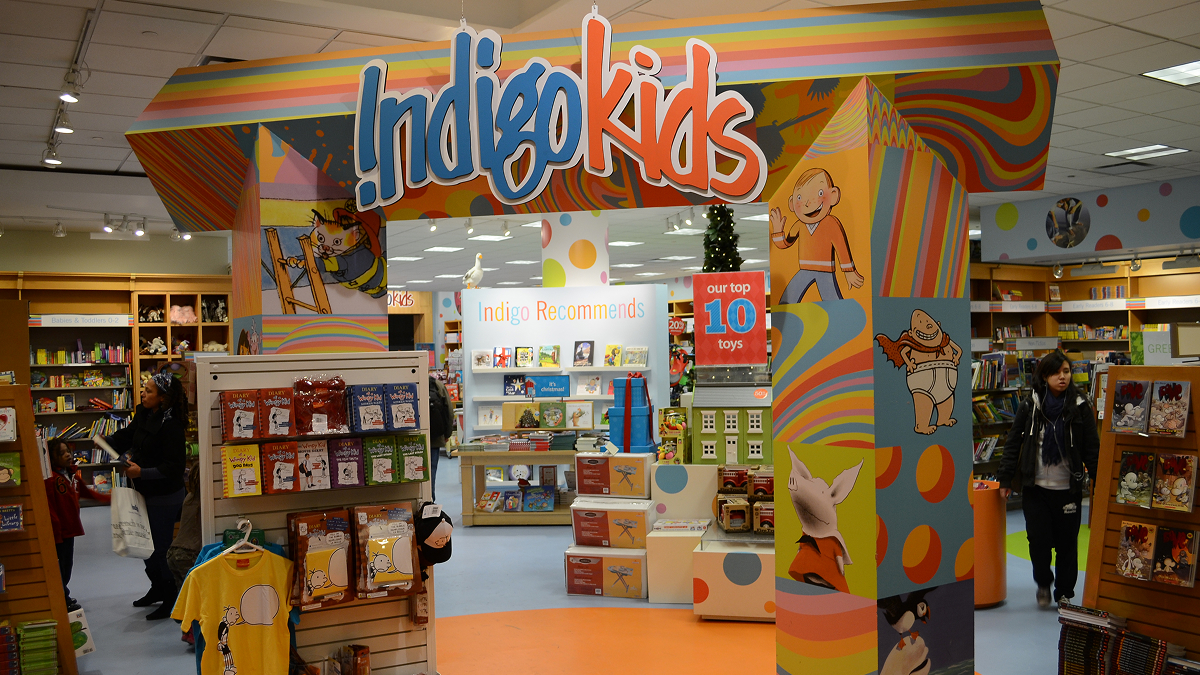
Most Canadians think of Indigo as the place they buy a novel, a candle, or a birthday gift in a pinch.
Far fewer realize that on any given Saturday, dozens of Indigo and Chapters locations across the country are quietly running full slates of IndigoKids events, including storytime, craft-making, LEGO builds, and hands-on play sessions designed specifically for children and the grown-ups who love them.
Weekend event listings across Canada for Indigo, Chapters, and Indigo-affiliated stores turn up more than eighty scheduled kids’ sessions in cities from Charlottetown to Victoria, most of them free to browse and just a few dollars to reserve. For parents hunting for something to do with restless kids that isn’t a screen and isn’t a $40 admission ticket, this is one of the best-kept secrets in Canadian family events.
This guide breaks down exactly what Indigo’s children’s programming looks like, how often it runs, what it costs, and how to find and book a session near you.

What Is IndigoKids, and Why Has It Become a Family Destination?
IndigoKids is the umbrella name for the recurring calendar of in-store children’s programming that runs at participating Indigo and Chapters locations across Canada, and it typically includes storytime, guided crafts, and brand-tied play activities scheduled on a rotating basis throughout the year.
That “specialty kids’ retailer” positioning is not just marketing language; it reflects a genuine, decades-long investment in dedicated children’s departments, toy curation, and now, live programming built around that inventory.
Few retail brands can offer the same event, on the same weekend, in so many different provinces simultaneously, which is part of what makes IndigoKids feel like a genuine national institution for family entertainment.

Inside the Weekly Lineup: Make It Real, Magna-Tiles, and Toddler Tuesdays
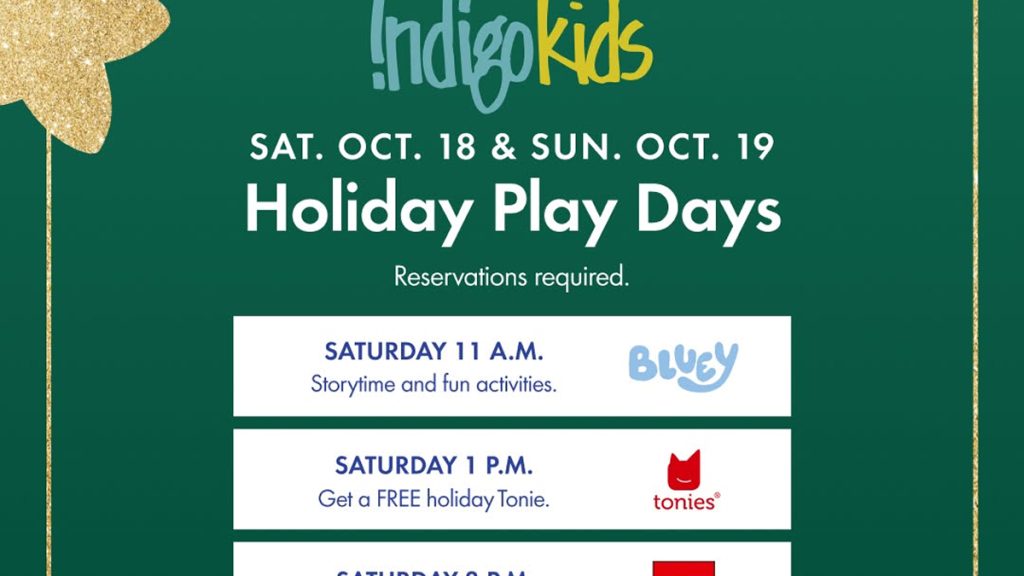
The backbone of Indigo’s children’s calendar is a rotating set of branded activity sessions, most running twice on the same day, once at 11:00 a.m. and again at 1:00 p.m., so families can pick whichever slot fits nap schedules or soccer practice.
One of the most frequently recurring formats is the Make It Real craft session, in which kids design and take home a piece of jewellery or accessory tied to a seasonal theme; a recent summer edition invited children to build a candy-themed bracelet recommended for ages four and up, paired with Bluey-branded stickers and activity sheets.
On alternating weekends, the featured brand shifts to MAGNA-TILES, where a themed storytime leads into open-ended magnetic building play, with young builders recommended at age three and older and sent home with a small figure as a keepsake.
Beyond the big craft-and-build sessions, individual stores run standing weekly programs tailored to younger children. Toddler Tuesdays, for instance, is a recurring storytime slot aimed squarely at the under-five crowd, giving caregivers a predictable, low-stakes outing that doesn’t require advance planning the way a themed Saturday event does.
Several locations also run Tonies Storytime, tied to the popular Tonies audio-figurine brand, giving kids a hands-on tie-in to characters they already listen to at home. Indigo itself describes the broader initiative simply: free storytime and activities every day at participating Indigo and Chapters locations, which is a useful reminder that the flashier ticketed Saturday sessions sit on top of an even larger base of everyday, no-cost programming.

Signature Seasonal Events: March Break, Spring Play Days, and Summer Play Days
Indigo’s programming intensifies around the calendar’s natural family-travel windows, and this is where the brand’s retail muscle really shows.
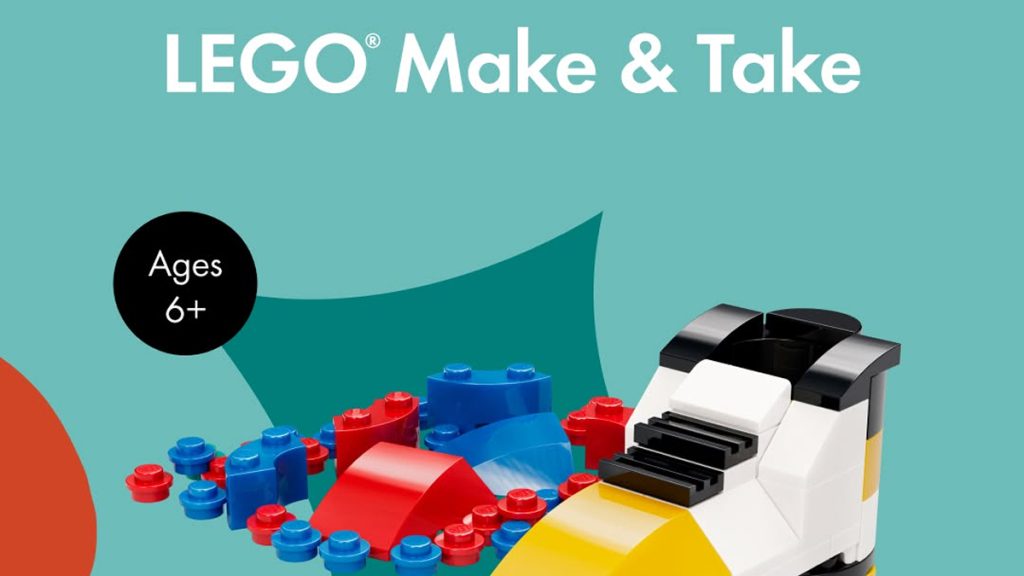
During March Break, the company runs a full week of themed daily activities under the IndigoKids banner, with a new event each day featuring popular brands and characters including LEGO, MAGNA-TILES, Klutz, Tonies, Our Generation, The World of Munsch, Wonder Co. painting kits, Make It Real, and Pet the Cat.
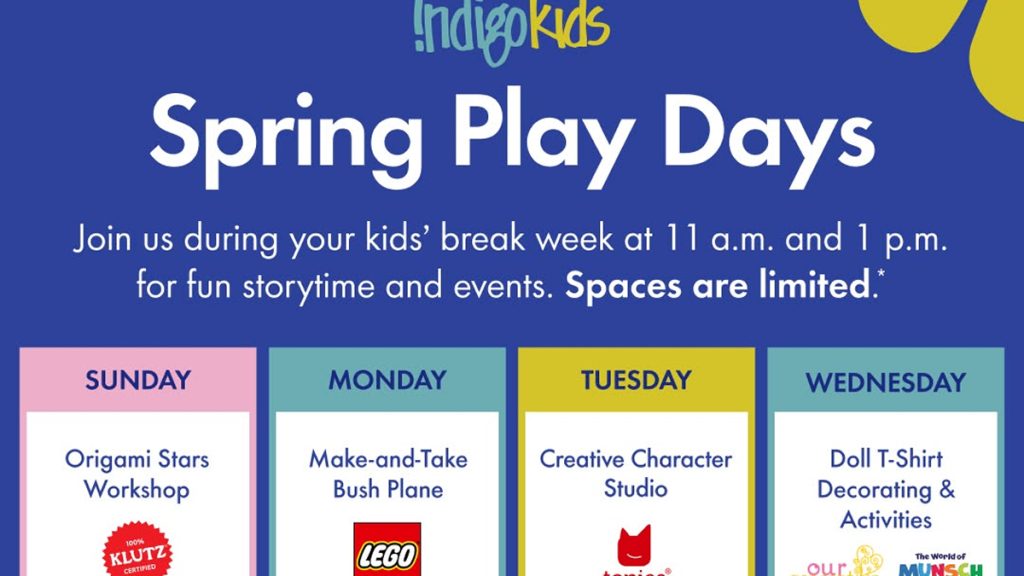
Spring Break programming follows a similar template under the name Spring Play Days, and the day-by-day breakdown reveals just how specific the curation gets.
One recent edition ran an Origami Stars Workshop paired with storytime, a Make-and-Take LEGO Bush Plane session, a Tonies Creative Character Studio where kids painted and decorated their own DIY figurine, an Our Generation doll t-shirt design session paired with a Robert Munsch read-aloud, and a Pete the Cat sensory bead bracelet event, all running at 11:00 a.m. or 1:00 p.m. daily with online registration required at five dollars per child, which includes a five-dollar gift card redeemable in-store.

That gift-card mechanic is a smart piece of retail design worth noting for anyone analyzing the program from a strategy angle: the “cost” of attending is effectively refunded.
Summer brings the highest-frequency version of the program, Summer Play Days, which runs on Saturdays throughout July and August with two time slots to choose from, 11 a.m. and 1 p.m., built around themes ranging from Dog Man and Babysitter’s Club to Pokémon and LEGO.
City-specific calendars show just how varied the weekly themes get; one store in Calgary’s schedule alone rotated through a Summer Reading Launch Party, a Building Friendships and Bracelets session, a Pokémon Trainers Trading Event, a Groovy Creative Club, a Disney Castle Make & Take, a Beads & Bracelet Party, and a Build, Play & Explore session across a single two-month stretch.
For families who treat summer as a marathon of “what do we do today,” having eight or nine weeks of pre-planned, low-cost activity in a single, familiar location is a genuinely useful planning shortcut.

The Research Behind Why Storytime and Hands-On Play Actually Matter
It would be easy to dismiss a mall storytime as pure convenience programming, but the underlying activity — reading aloud to young children — is one of the most well-documented interventions in early childhood development.
The American Academy of Pediatrics‘ policy statement on literacy promotion states plainly that reading with children from infancy through the preschool years is associated with higher language skills at school entry and improved childhood literacy, and that reading aloud increases both the richness of vocabulary and the complexity of syntax children are exposed to.
The vocabulary gap this creates compounds quickly. Research shows that by around age three, children from book-reading families had heard more than twenty million more words than children in homes without regular reading — a gap that shows up later as measurable differences in reading readiness and classroom confidence.
None of this means a single Saturday storytime at a bookstore replaces daily reading at home, but it does mean that low-barrier, repeated exposure to shared reading and guided play in a community setting is doing real developmental work, not just filling an afternoon.
For parents evaluating whether a $5 craft-and-storytime session is “worth it,” the research suggests the honest answer is closer to “worth it and then some,” particularly when it’s paired with the modelling effect of seeing other kids engaged and excited about books.
Beyond Kids’ Corner: Indigo’s Broader Community Calendar
While children’s programming is the anchor, it sits inside a much wider calendar that gives whole families a reason to keep coming back as kids grow older.
The same weekly listings that carry Toddler Tuesdays and Magna-Tiles events also include author talks, book club meetings, and in-person conversations with recognizable Canadian names, giving parents their own reason to linger while older siblings browse the young-adult shelves. It’s a structure that effectively extends “family programming” well past early childhood, covering tweens and teens through book clubs and author signings rather than aging them out of the in-store experience entirely.
This layering is a genuinely smart piece of community-retail design, because it means a single family with kids of different ages can often find something relevant to each of them on the same visit, rather than one child being entertained while everyone else waits around.
A store hosting a preschool storytime at 11:00 a.m. might run a teen or adult book event later that same evening, meaning the “children’s events” umbrella really functions as one strand within a much broader, multigenerational community calendar that most competitors don’t attempt to replicate at this scale.
How to Find and Buy Tickets to Indigo Family Events Near You
Because programming varies by individual store and changes weekly, the most reliable way to find what’s running near you is to check a live, location-filtered events listing rather than relying on a general web search, since national retailers rarely keep every local page perfectly updated in real time.
Ticketscene’s continuously updated Indigo events listing aggregates sessions across dozens of Canadian cities — including Toronto, Ottawa, Calgary, Vancouver, Halifax, Winnipeg, and smaller markets — and lets you filter by date and location to see exactly which storytime, craft session, or author event is running closest to you this weekend.
It’s also worth following your specific local store rather than the brand generally, since many locations maintain their own dedicated social media pages where last-minute schedule changes and additional pop-up sessions get posted ahead of the official calendar.
Given how frequently popular Saturday slots show as sold out, booking a spot two to three days in advance — rather than the morning of — meaningfully improves your odds of getting into the specific time slot your family wants, particularly for high-demand markets like downtown Toronto or Vancouver.

Come Down to IndigoKids This Weekend to Check Out Some of Canada’s Best Family Events
Indigo’s children’s events program is easy to overlook precisely because it doesn’t market itself with the same fanfare as a theme park or a ticketed festival, yet it delivers a genuinely well-run, research-backed, and remarkably affordable form of family entertainment on a near-weekly basis in cities across the country.
Between recurring formats like Make It Real, MAGNA-TILES storytime, and Toddler Tuesdays, seasonal pushes during March Break, Spring Play Days, and Summer Play Days, and the surrounding calendar of author talks and book clubs for older kids and parents alike, there’s a legitimate case that Indigo has quietly become one of Canada’s most consistent family-event operators.
The next rainy Saturday or Sunday, before defaulting to a screen or an expensive indoor playground, it’s worth checking whether your local Indigo already has a table set up and waiting.