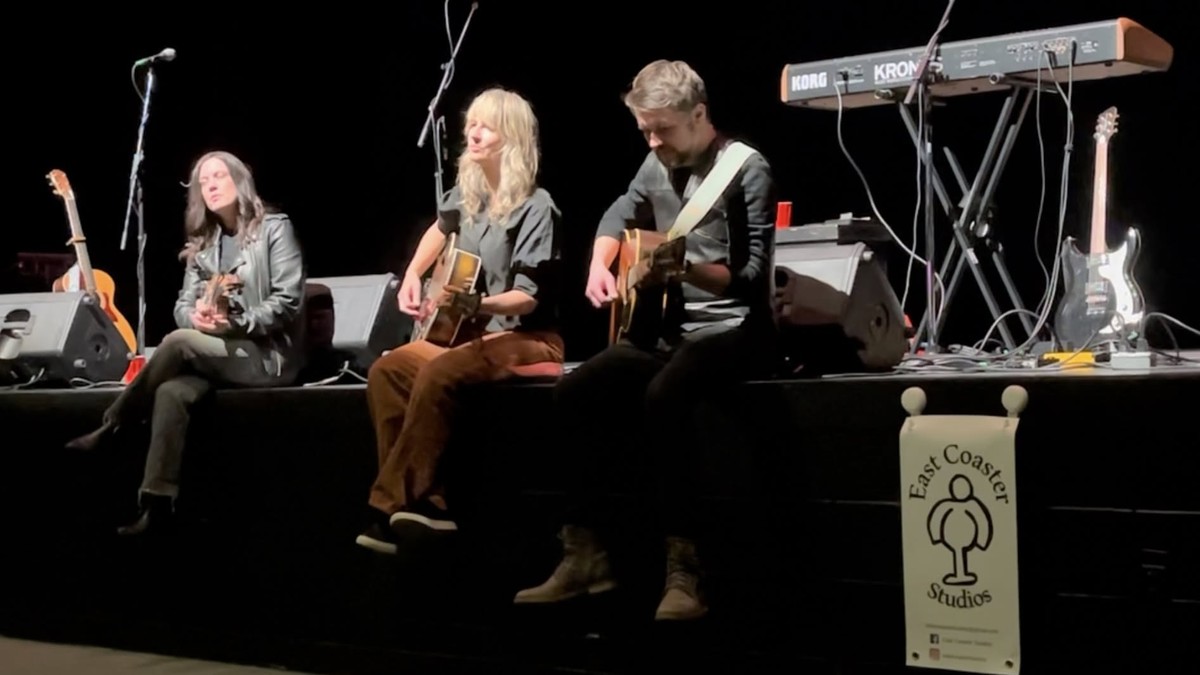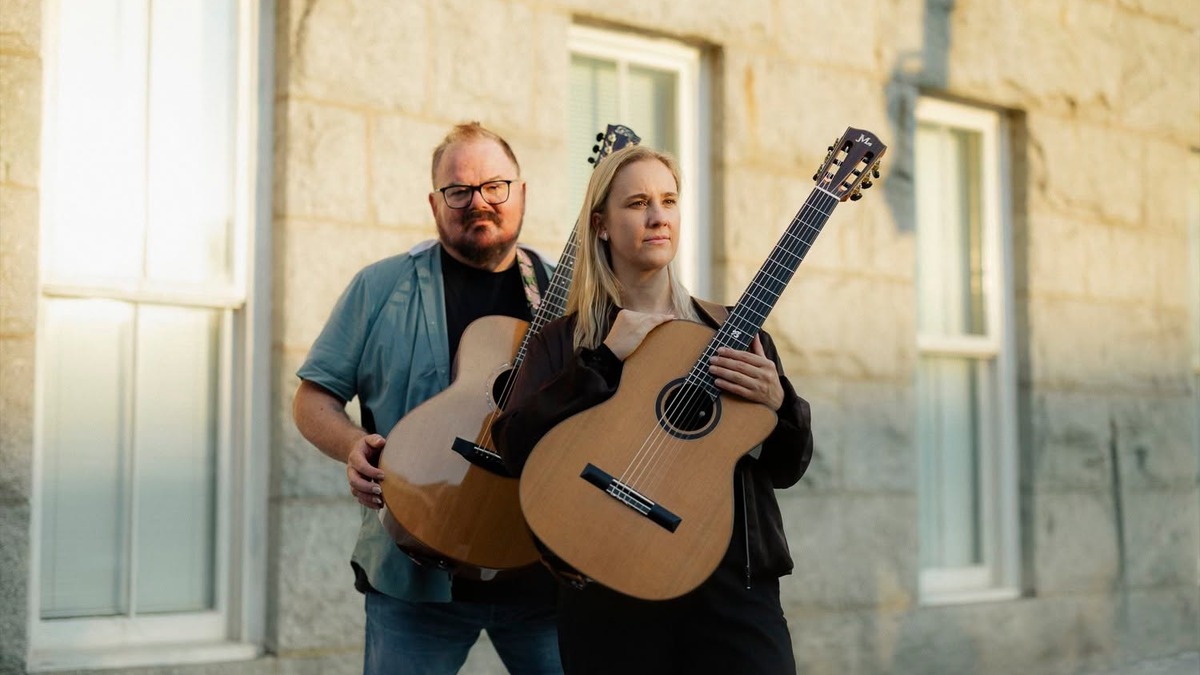
A Dresden coffee roastery is the setting for Don Ross and Julie Malía’s video for Annie and Martin.
The piece had been Ross’s to play. Now there are two guitarists in the frame, and the small decisions that go into sharing a tune are visible in the hands of the people making them.
Don Ross and Julie Malía are a Canadian and German acoustic guitar duo who bring instrumental fingerstyle, original songs and two singing voices to their joint concerts.
They came to the partnership with solo careers that required them to make a guitar sound complete on its own. The extra instrument lets either musician stop carrying a part the other can take. That can be as subtle as a bass note moving across the space between them, or as clear as a voice coming in where you might have expected more guitar.
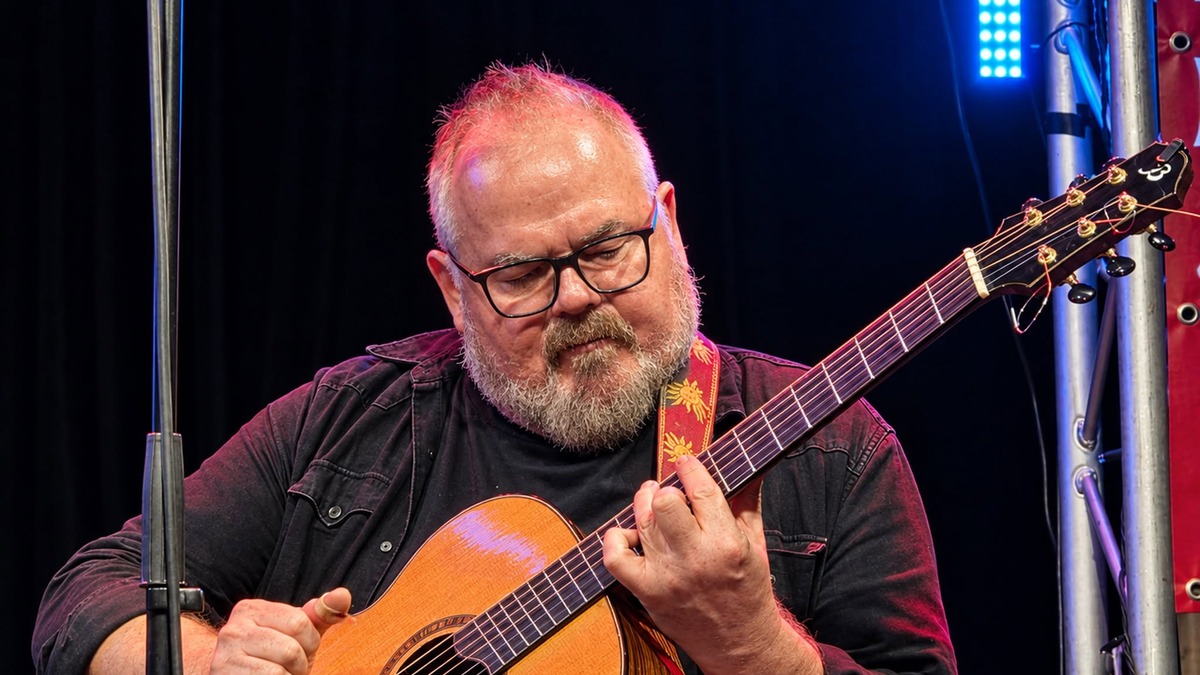
Don Ross Takes a Long Way Back to Singing
Ross grew up in Montreal with a Mi’kmaw mother and a Scottish immigrant father. His father had trained as an opera singer.
In the Ross household, the children heard him practising voice exercises, along with classical records and, when he brought them out, the bagpipes. The idea that a house could hold several kinds of music at once came to Don early.
He started on piano before he took up guitar. As a teenager, he began experimenting with different tunings.
Change the pitch of a few open strings and you give the same hand a different set of possibilities. Some shapes that were difficult become easy to reach, and a bass note can keep ringing while the fingers make another decision at the other end of the instrument.
At Toronto’s York University, Ross concentrated on composition, electronic music and recording. He earned a BFA in music and imagined working on orchestral pieces, electronic compositions or scores. Those possibilities are audible later in his recordings, where a guitar part can sound as though somebody has thought about which other instruments would be playing if they were in the room.
His path to a solo career included a spell teaching in Kehewin, Alberta. In 1986 he made and distributed a cassette called Kehewin, named for the place where he wrote its title piece.
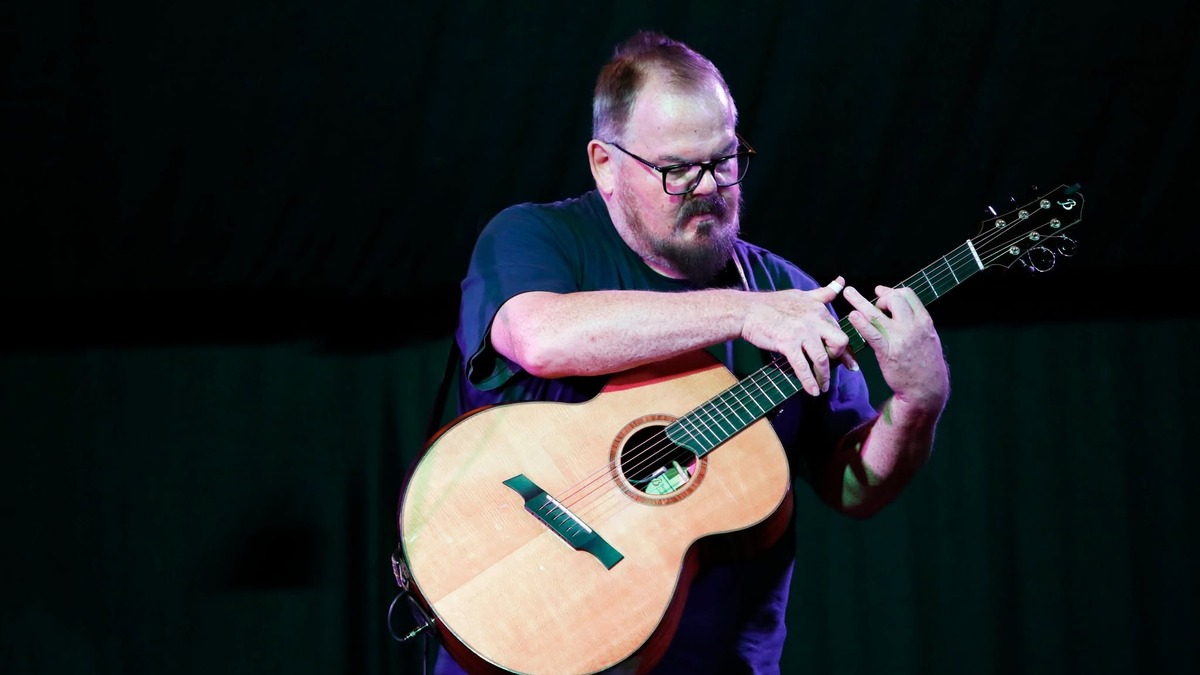
A contemporary account of his early career also places him in the Harbord Trio, playing Canadian and British traditional music. He was learning how an instrumental idea could travel in several settings before a label put his name on a solo album.
That same year, he went to the Walnut Valley Festival in Winfield, Kansas, to compete. He came back in 1987 and placed third.
In 1988, on his third try, he won the U.S. National Fingerpick Guitar Championship with a set of his own compositions. He would win again in 1996, becoming the first guitarist to take the championship twice.
Ross was already working with other players in that first winning year. Eye Music, his quartet, played the Montreux Jazz Festival in Switzerland.
At one point in his early career he could be found on a folk festival stage with the Harbord Trio, on a stage with Eye Music or playing pieces he had made for his own hands. The guitar contest gave him a way to be heard in the last of those roles.
His breakthrough as a recording artist took that flexibility with it. By his third album for Duke Street Records, he was recording vocals and full-band material alongside solo guitar. Then came more releases, and in 1999, Passion Session, with pieces such as Michael, Michael, Michael, The First Ride and an arrangement of David Essig’s Berkley Springs.
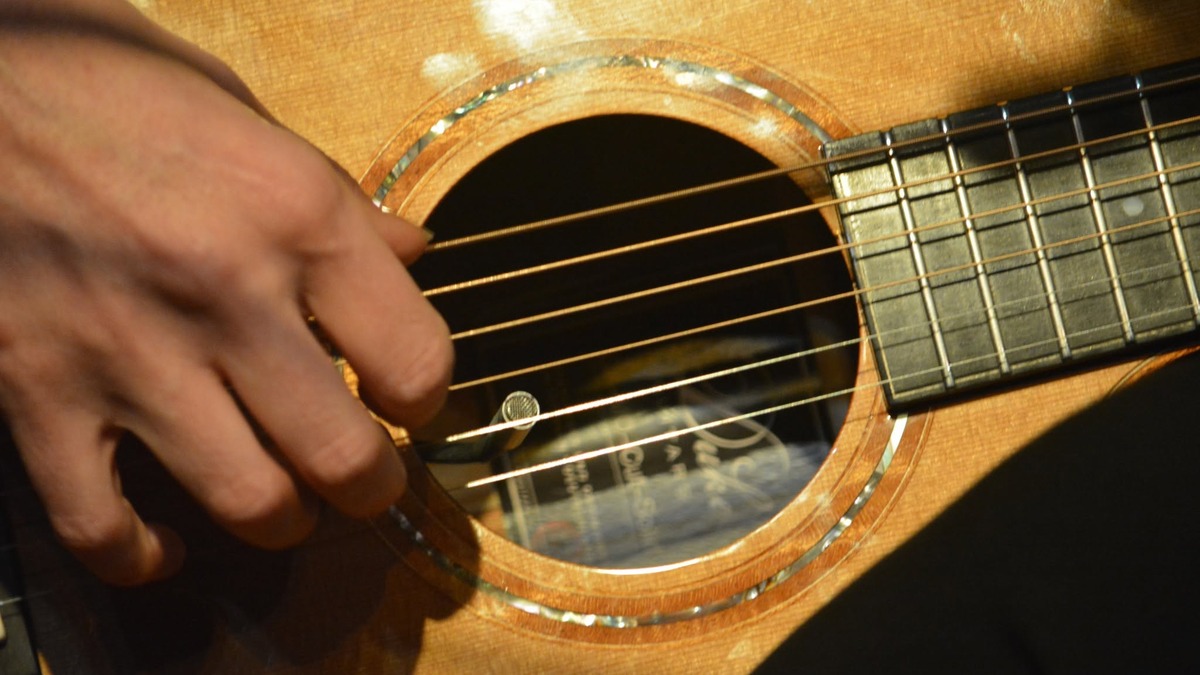
His early-2000s recordings took him into other territory.
Robot Monster brought electronic music into the picture, including work with Berlin-based composer Christoph Bendel.
In 2005, he became CandyRat Records‘ first signed artist and released Music for Vacuuming. Later projects for the label included recordings with Andy McKee and Calum Graham, other guitarists with their own ideas about how to divide up the instrument.
He eventually went back to school for some of the music he had thought he might make when he left York. Ross completed a master’s in orchestration through the University of Chichester and ThinkSpace Education in 2021. He started working on scores for games, film and television, and that year the Canada Council for the Arts awarded him the Walter Carsen Prize for Excellence in the Performing Arts.
There is a scene from the making of Water, his 2023 record, that shows the practical side of those interests. Ross went to Bruce Cockburn‘s home in San Francisco to record Stained Glass, a piece the two had played at a festival workshop in Alberta.
Cockburn told him he tended to accelerate through it. They set up a click so that later additions would have a steady part to work against.
Ross recorded Cockburn singing and playing guitar, then brought the recording back to Prince Edward Island, where he added guitar, bass and a keyboard layer.
His account of hearing back from Cockburn conveys how much the exchange mattered to him. He had spent years learning how to arrange a piece, and now one of the musicians whose work had helped send him in that direction had heard what Ross could make around his playing.
Water also has the City of Prague Philharmonic Orchestra, the Atlantic String Machine and an appearance by fretless bassist Michael Manring. An album with that cast can still be heard in much the same way as one of Ross’s solo guitar recordings.
The cover is by Mi’kmaw artist Alan Syliboy of Millbrook First Nation.
Ross had moved to Prince Edward Island by the time he was making the record, and the work he was doing there had ties to several different places at once.
The Cockburn recording had to get from a house in California to a room on the Island. The artwork brought in an artist from Nova Scotia. Ross could hear those places as part of one project without assigning them all the same sound.
A few years later, Malía was the one asking him to think about his own singing. He sang at concerts and had made vocal records before, but his last full-length vocal album had been in 2009. In the notes to Songs That Found Me, he credits her with pushing him to do another.
Released in 2026, the album lets Ross sing through pieces by writers including Joni Mitchell, Stephen Fearing and Bruce Cockburn. It also reaches back to Did I Fool You, a song he wrote with Norman Wolfson, with a recording history that goes back to 1981.
Malía sings on the album. The colleague who asked him to use his voice more ended up in the sound of the answer.
There’s a further detail in the credits for the new vocal album. Ross sang, played a range of instruments, orchestrated the material and did the mixing and mastering.
When he went to record Malía’s part, he worked with her in Dresden. Most of his own instruments were recorded back in Windsor, Nova Scotia. Years after the household practice sessions in Montreal, he was making a record from rooms on opposite sides of the Atlantic, with a voice at the centre of the arrangement.
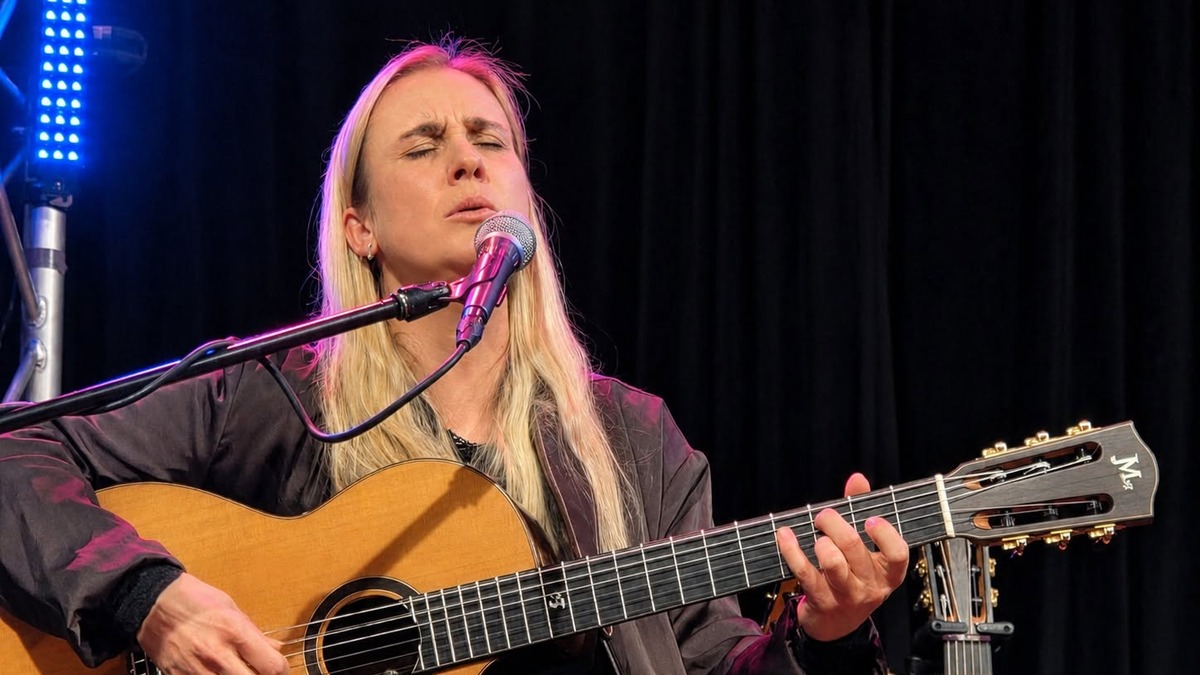
Julie Malía Lets the Voice Into Her Guitar Playing
Julie Malía was eight when she started playing guitar and seventeen when she began to sing. She was still known as Jule Malischke.
In her account of how the two parts of her work came together, her teacher and mentor Willi Geyer asked her to sing along one day. By then, her fingers had already spent years learning where to go.
Malía grew up in the Heidenheim area of southern Germany, with roots in nearby Söhnstetten. In Augsburg she trained to teach sport and music, then studied classical guitar at the Leopold Mozart Centre.
She went on to Dresden’s Carl Maria von Weber University of Music for a master’s in acoustic guitar, with a focus on jazz, rock and pop. The move gave her a formal place to pursue sounds that lay beyond the first repertoire she had learned.
Her training gave her some of the same choices that occupied Ross when he was working out what the guitar could do for his compositions. A thumb can keep up a pattern while the fingers pick out a high line.
A hand hitting the body can supply the accent a drummer might otherwise make. Each idea leaves her with a decision about how much of the guitar the voice will need behind it.
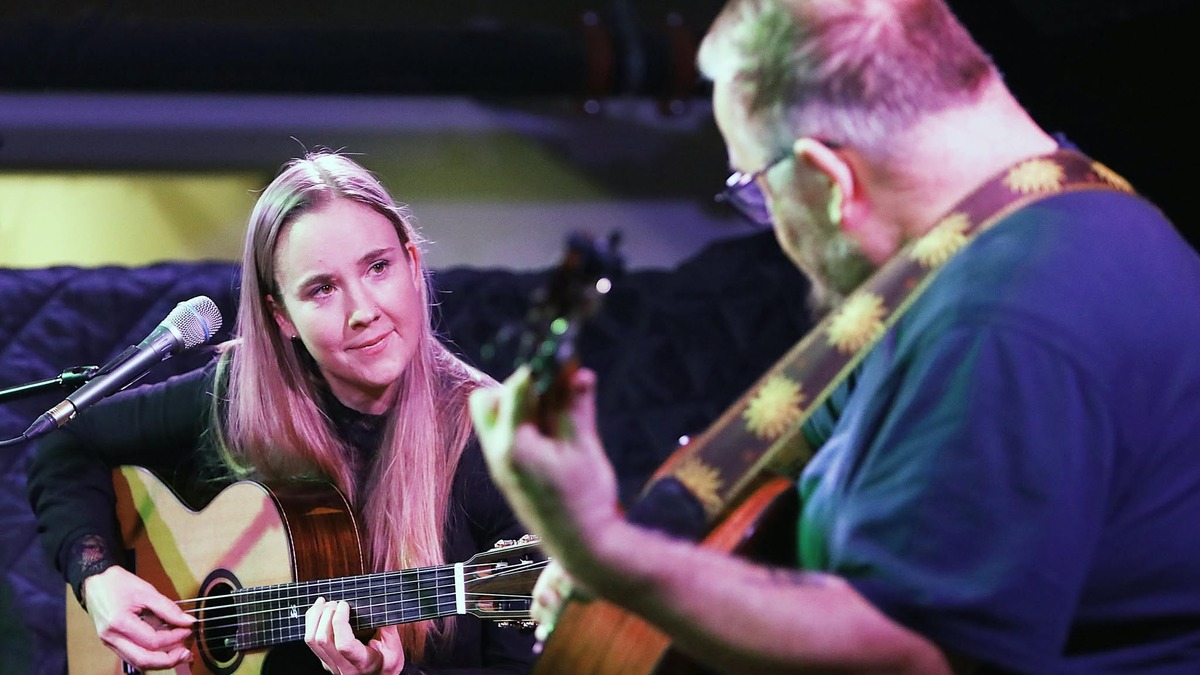
She had spent years playing predominantly classical pieces before her debut, Whatever May Happen. By then the music was already moving between guitar traditions. Malía brought techniques such as percussion and backbeat to arrangements of pop songs and kept enough of the classical vocabulary in her playing to let a melodic line lead the ear even when she wasn’t singing.
The guitar she helped develop with Duke Guitars puts that crossover into a physical object. It’s a signature nylon-string instrument.
Nylon still gives her a sound she can use for the classical side of her work, while the instrument is designed with the rest of her repertoire in mind. You can follow the choices she made as a student all the way into the kind of guitar she wanted in her hands.
She has also returned to some of that material as a teacher. Malía has lectured in guitar in Dresden since 2015 and has led a guitar class in the university’s teacher-training programme since 2021.
As artistic director of the Giengen Guitar Festival, she works on another kind of invitation. People can come to hear a guitarist and leave having found some other way the instrument can be played.
A festival in Scotland gave her a story for a song. During visits to the guitar festival in Ullapool, she met Richard and Colleen.
In the account Malía tells alongside He Waited, the two met at a time when the life they wanted together wasn’t available to them. Richard chose to wait. The length of a wait can be difficult to convey in a song, and there is a difference between singing about a decision and making it sound as if there was ever any guarantee.
He Waited opens Seagull, her independently released 2024 album. Malía wrote, played and produced the song, and Ross mixed and mastered it.
It gives you a way to hear the partnership before the two people are playing the same guitar piece. One musician found the story, worked it into a song and decided how to perform it. Another worked with the recorded sound of that performance.
The next single from the record takes Malía back to the teacher who asked her to sing. She dedicated Soulfriend to Willi Geyer, who had died by the time she released it.
The guitar she chose was a nylon-string baritone made by Daniel Stark. It let the lower notes sit in a register she felt suited the song and gave the voice somewhere quiet to be.
An octave guitar played by Stephan Bormann gave her a sound higher up. Ross again mixed and mastered.
You can read the two guitar parts as a small arrangement of a feeling that is otherwise hard to state. A song addressed to somebody who has died can still have another sound in it that answers the singer.
Bormann had also been a teacher to Malía in Dresden. By 2016, they were sharing concerts as guitarists, and she turned up to a show at the Bad Hersfeld Buchcafé with three guitars. By the time she and Ross were making recordings together, she already knew what could happen when a relationship that started in lessons was given a place on a stage or in an arrangement.
Seagull still carries the name Jule Malischke. That matters for anyone tracing her work, because the names can otherwise send a new listener to two different versions of an artist page without making it clear who made the record. It also leaves a visible mark of something that happened when her music travelled farther from home.
On her website, she remembers people at North American shows working their way through the pronunciation of Jule Malischke. At a festival, two listeners brought notepads and asked her to write the name down in block letters.
They had heard the music. The problem came afterward, when they wanted to know how to find the person who played it.
She began using Julie Malia internationally, then added the accent now used in Julie Malía. The song about Richard and Colleen and the playing on Seagull are still a place to begin with her. Now you can go from those recordings to a bill with Ross and recognize whose ear for a song you’re hearing.
The exchange with her old teacher has a counterpart in the way she talks to Ross about singing. Malía knows something about having developed a musical identity with one instrument before giving another part of herself room to be heard. When she encouraged Ross to record another vocal album, it was advice from someone whose own work changed when a teacher asked her to open her mouth.
An Old Tune Finds a Second Pair of Hands
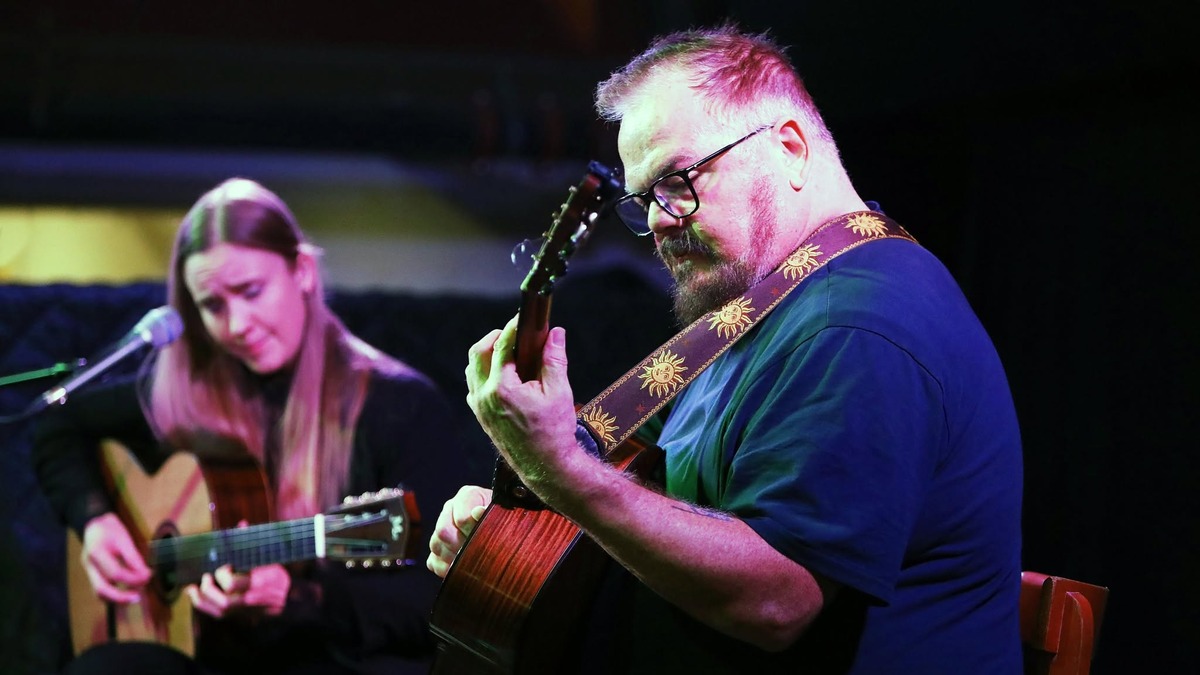
Ross wrote Wave From Your Window in Berlin in 1997. For the version released in February 2025, he and Malía played guitar and sang, produced it together, and Ross engineered the recording.
The composition had already had years to settle into the hands of the man who wrote it. Recording it with somebody else meant hearing some of its familiar movement come from another direction.
They had begun playing double bills in the fall of 2023, and the first years of the project took them to clubs and festivals on both sides of the Atlantic. Their solo work continued beside it. They could play a piece together and return the next evening to the problem of making a piece with the resources of one person.
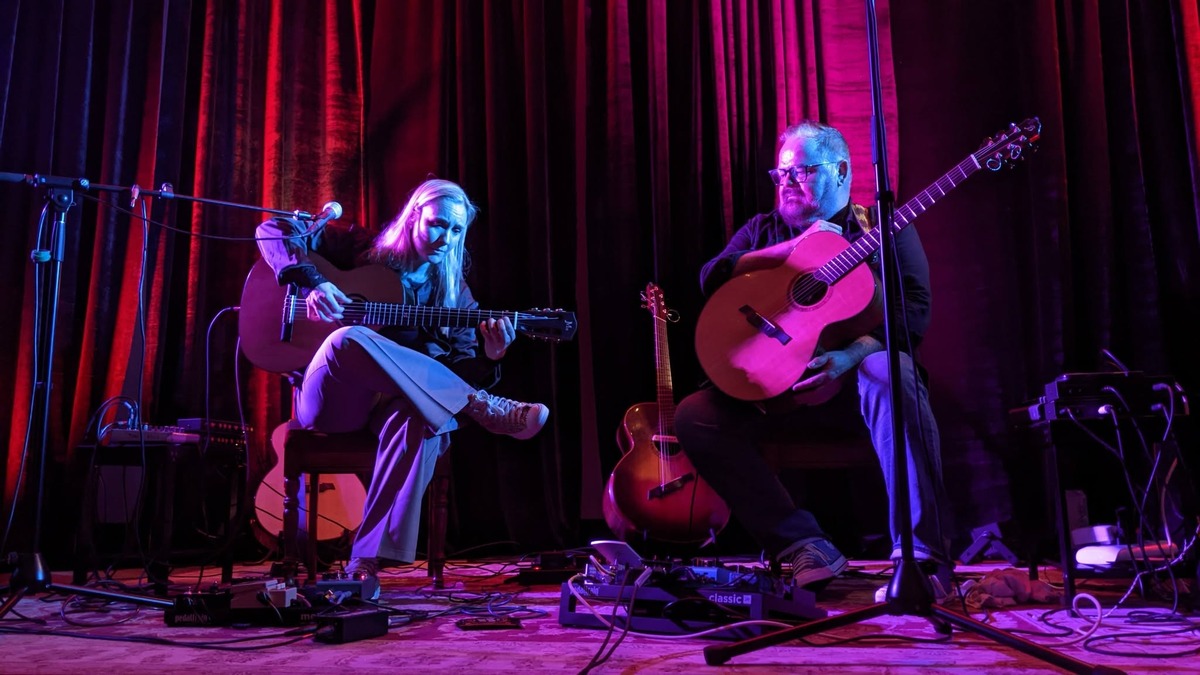
A double bill puts the artists’ separate sound worlds in sequence. A duet puts them in the same bar of music.
The work has developed into an album of their own, Same Sky, slated for early 2027. They had made a new version of one of Ross’s late-1990s pieces, played dozens of shows, put out another duet and worked on each other’s solo recordings.
The album comes after enough time onstage for an arrangement to change in ways a few days of rehearsal might never reveal.
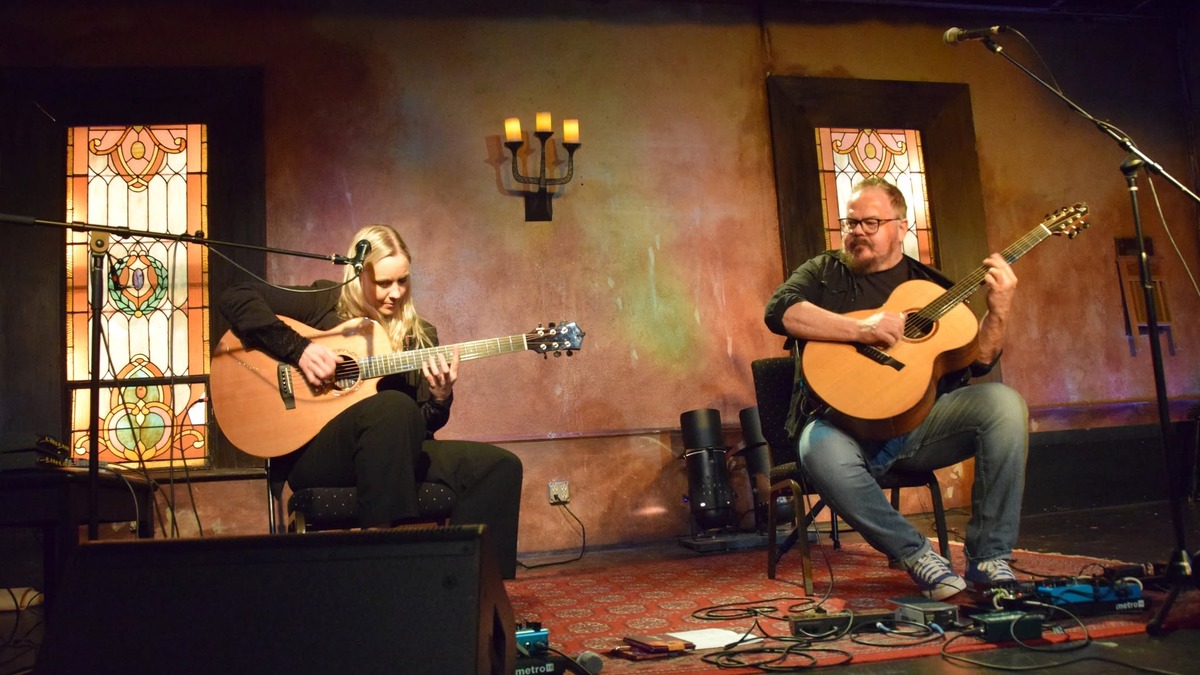
See Don Ross and Julie Malia in Kingston at the Broom Factory on Feb. 5
Don Ross brought a guitar piece he’d written in Berlin into a partnership with a musician who had been playing her way from classical music into songs of her own. Julie Malía brought him a recording to mix and, at another point in the friendship, an idea about a record he could make.
By the time they share the stage in Kingston, they will have spent years hearing one another and leaving space for what the other has to play.
KPP Concerts presents Don Ross and Julie Malía for an all-ages, licensed acoustic concert at the Broom Factory in Kingston, Ontario, on Friday, February 5, 2027. Doors open at 7 p.m. and the show starts at 7:30 p.m.