From guerrilla YTV broadcasts and the gentle backyard world of Nanalan’ to the deep-fried body horror of Mr. Meaty, the Toronto creator has spent three decades refusing to sanitize handmade television.
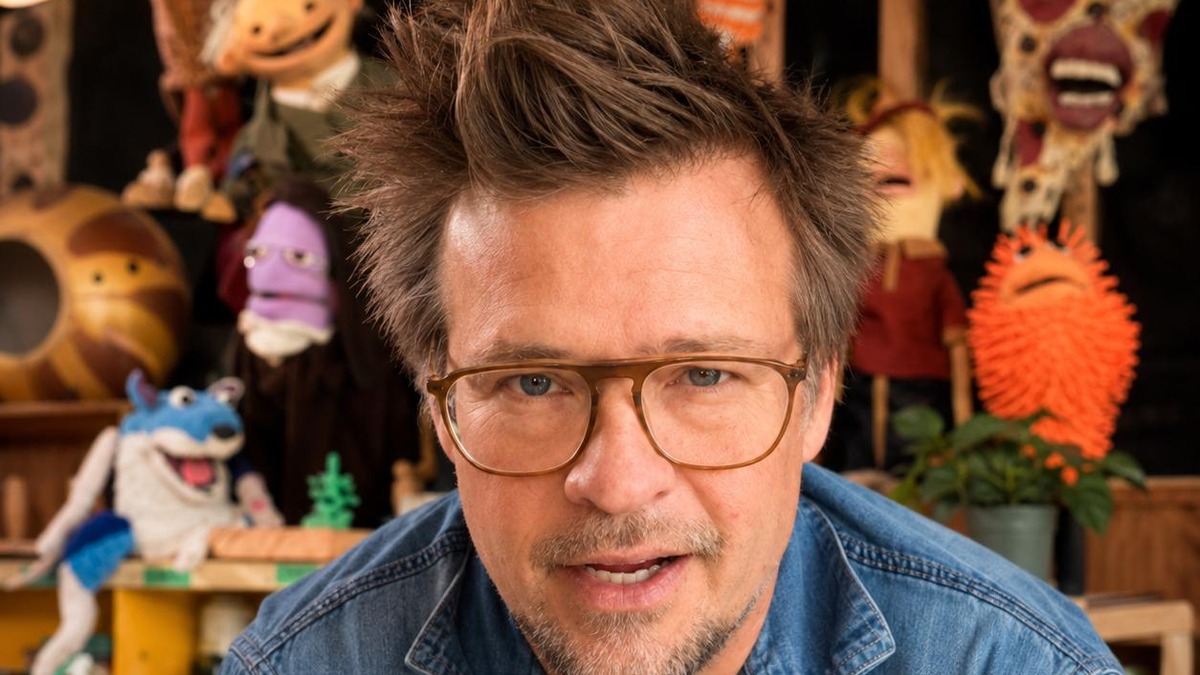
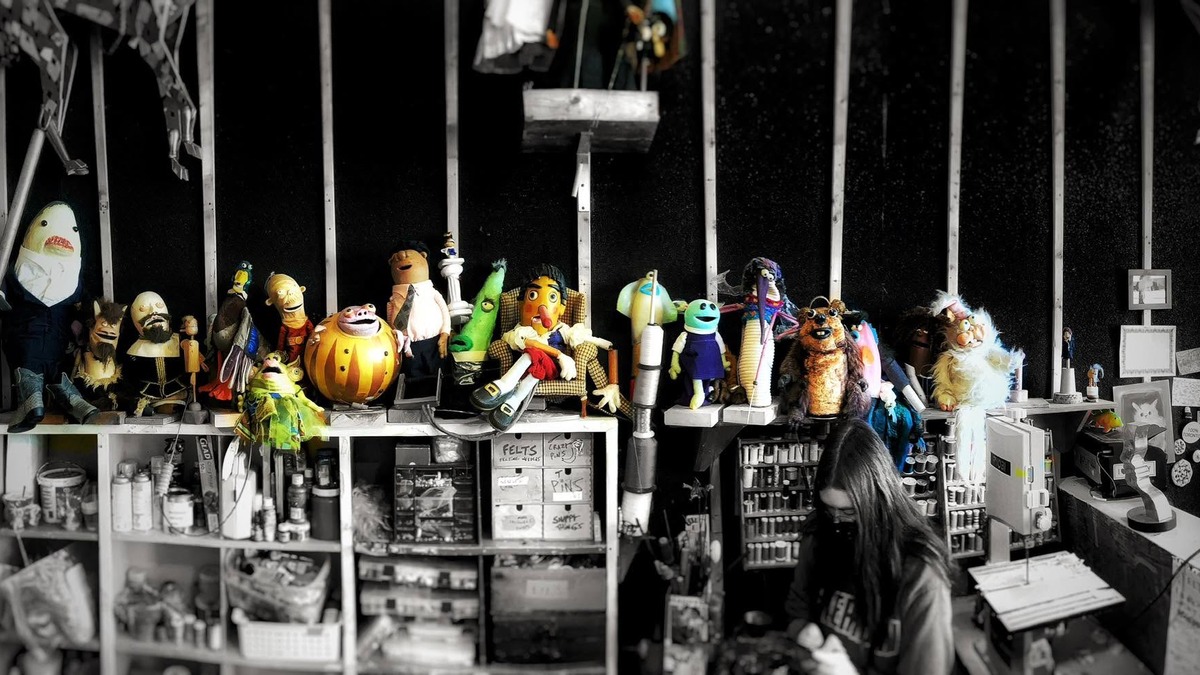
Inside Jamie Shannon’s studio on the Toronto Islands, the boundary between childhood comfort and fever-dream absurdity is measured in inches.
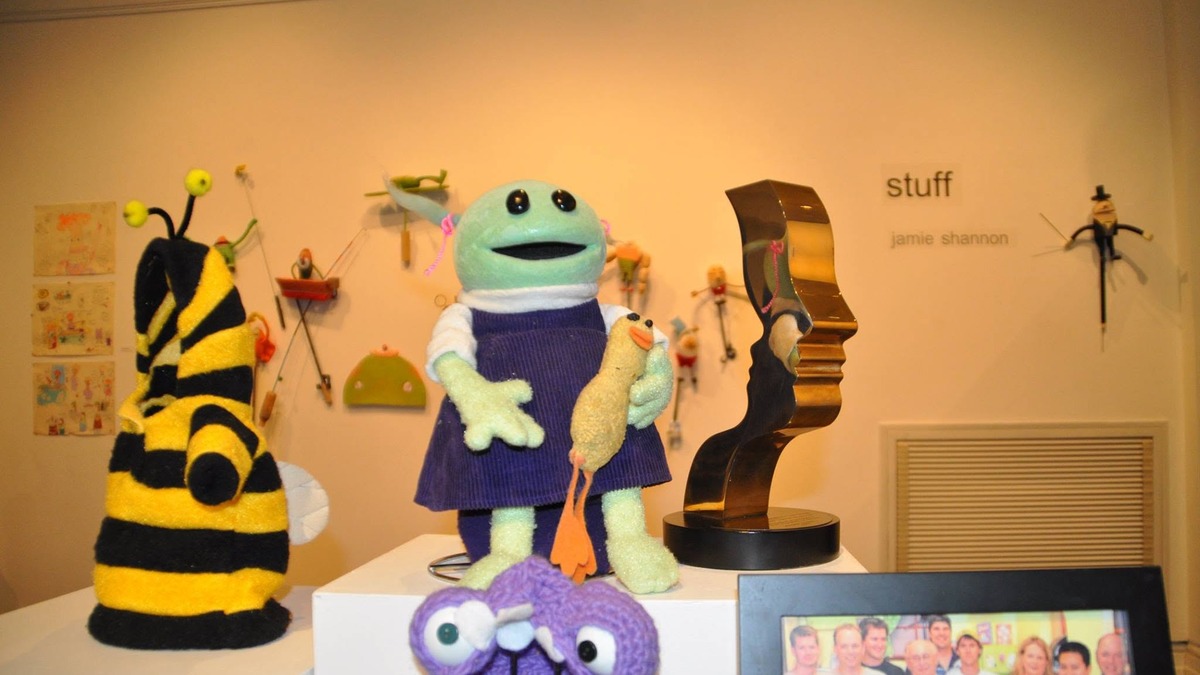
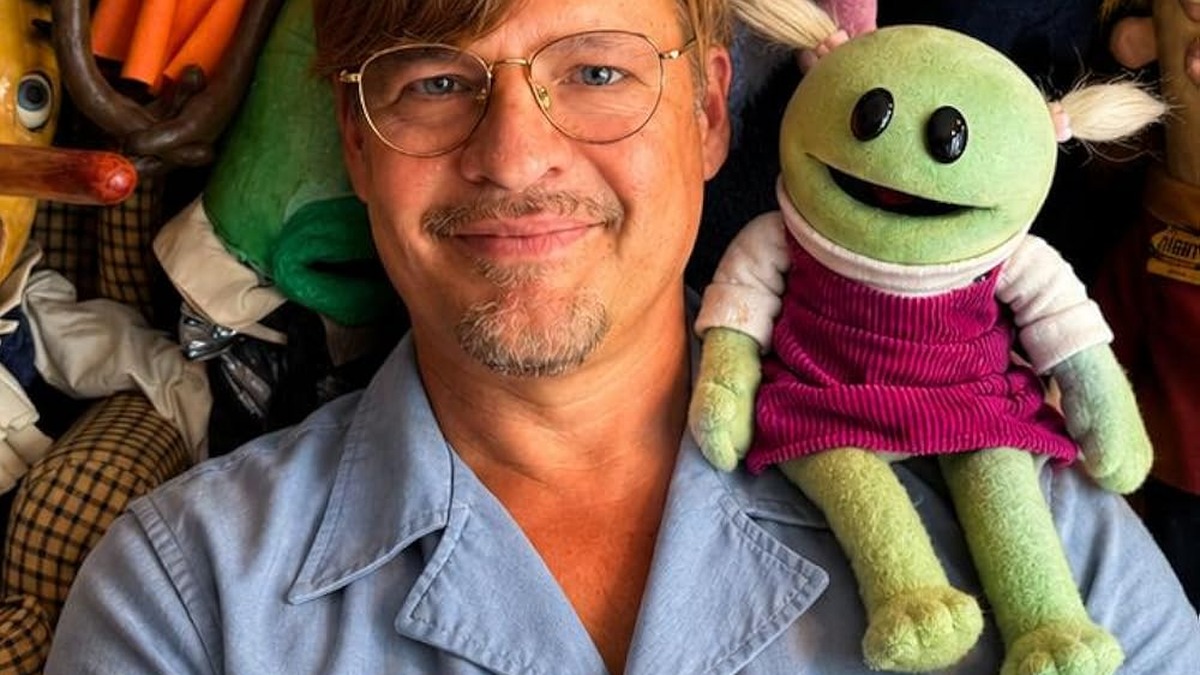
On one workbench sits Mona, a spherical, lime-green three-year-old with bean-shaped eyes and yarn pigtails who spent the early 2000s marvelling at pea pods and dandelions in her grandmother’s backyard.
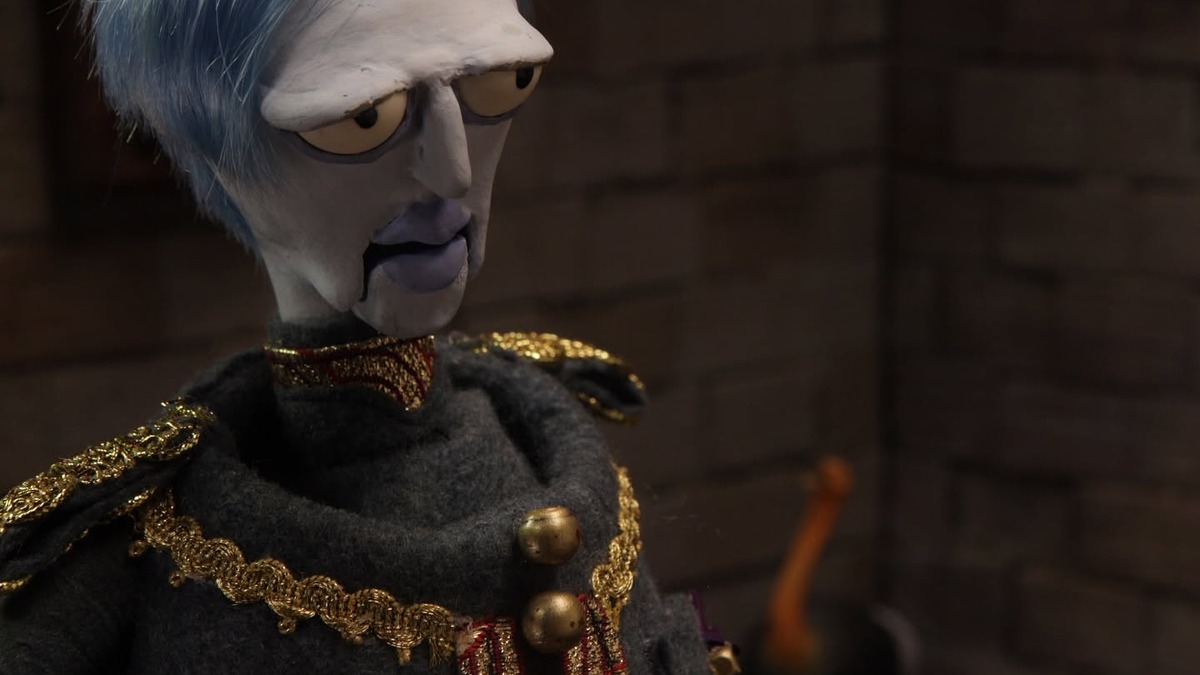
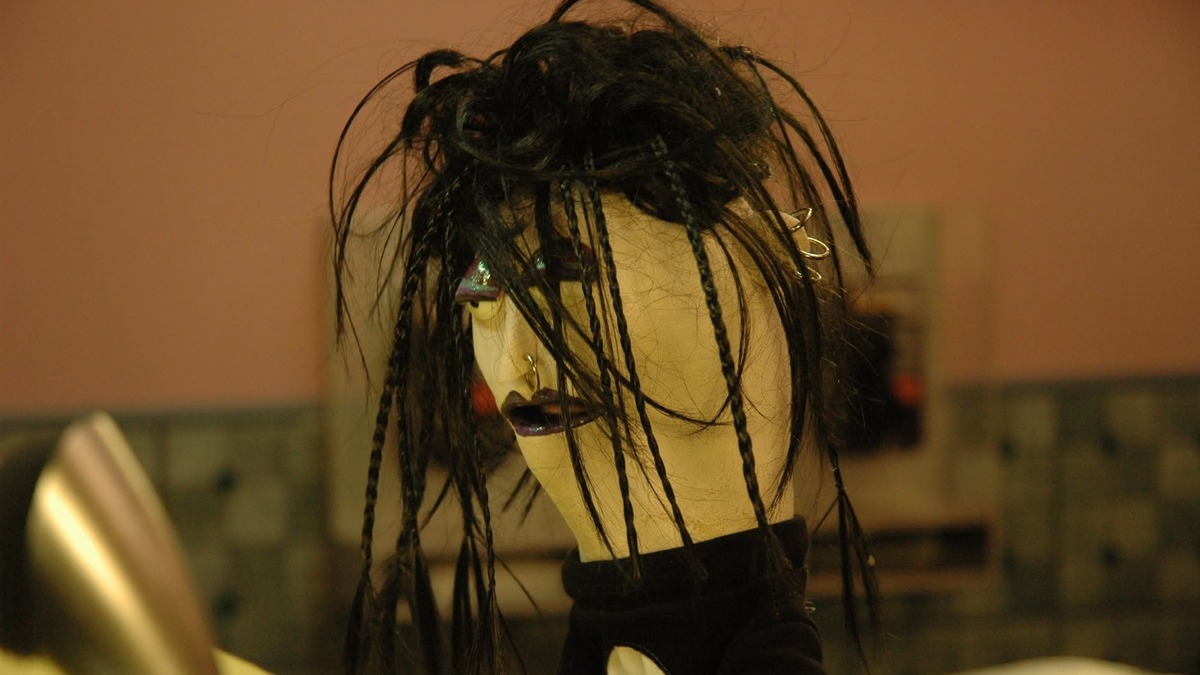
Nearby rest figures built from an entirely different artistic impulse: a foam-and-latex rendering of the Russian mystic Grigori Rasputin, grotesque fast-food teenagers with exaggerated pores and crooked teeth, and monsters engineered to unsettle network television audiences.
Most puppeteers spend their careers mastering a single register. Following the blueprint established by Jim Henson and the Children’s Television Workshop, North American television puppetry has historically gravitated toward either polished, aspirational warmth for preschoolers or slick, broad satire for adults.
Over more than thirty years as a performer, builder, writer, and director, Jamie Shannon has repeatedly refused to choose between the two. Working largely out of Toronto, he has treated foam, fleece, and rod mechanics not as rigid genres, but as raw sculptural mediums capable of holding both radical innocence and unapologetic revulsion.
That duality is why Shannon occupies such an unusual place in Canadian pop culture.
To one generation of viewers, he is the gentle, high-pitched voice of toddler curiosity—a creator whose work became an unexpected emotional balm on social media more than two decades after it first aired. To another generation, he is the architect of Mr. Meaty, a Nickelodeon sitcom so weird, tactile, and unsparing in its body horror that thousands of millennials still jokingly credit it with scarring their childhoods.
Understanding how one artist produced both requires tracing a path that began not in a network boardroom, but in the hallways of a Toronto university, a guerrilla takeover of Canadian youth television, and a stubborn refusal to hand over the rights to his own creations.
Leaving the Classroom for the Monster Shop
Born in Canada on February 26, 1972, Shannon grew up in an era when Canadian television was fiercely carving out its own identity distinct from American syndication.
Before he ever stepped behind a studio monitor with a puppet on his arm, he worked in front of the camera as a teenage actor in Toronto’s burgeoning film and television production scene.
In the late 1980s and early 1990s, he picked up small roles on Canadian-shot series and films—playing Micky in an episode of the Mr. T vehicle T. and T. in 1988, Young Bill Smith in the sci-fi feature Millennium in 1989, and a teenage heckler in the Bette Midler drama Stella in 1990.
Those early sets offered a ground-level education in how television is assembled, yet conventional screen acting was never going to contain Shannon’s sensibility.
At York University in Toronto, he crossed paths with Jason Hopley, a fellow creative spirit who shared an obsession with character design, offbeat comedy, and tactile world-building. Rather than waiting until graduation to test their ideas, Shannon and Hopley made a decision that would define the next two decades of their lives: they left York University to pursue puppetry full-time.
In 1992, alongside Jack Bayley, Shannon and Hopley founded a Toronto puppet troupe called The Grogs—formally operating under Three J’s Productions and Grogs Inc. At the time, YTV—Canada’s youth-oriented specialty channel—was building a reputation for anarchic, low-budget interstitial programming hosted by on-air personalities known as Program Jockeys, or PJs.
Shannon and Hopley didn’t wait for an open casting call. They showed up at YTV as unpaid volunteers, hauling handmade creatures into the building and demonstrating what their puppets could do on live television.
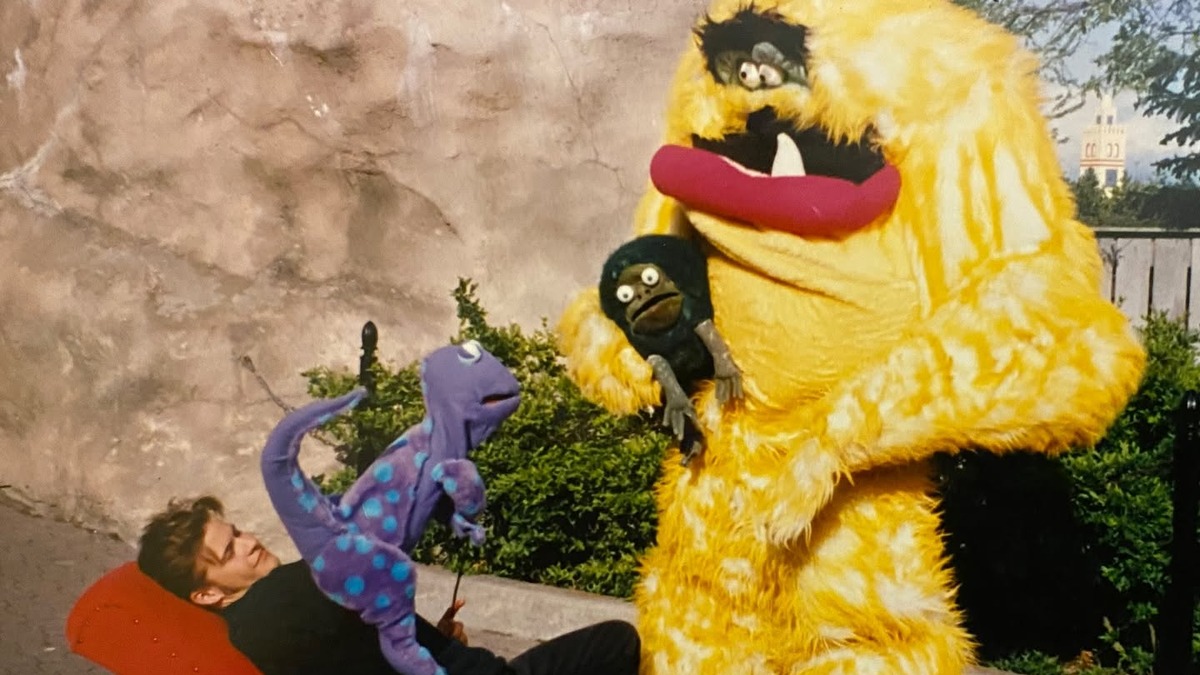
The gambit worked. YTV hired them full-time, and between 1992 and 1994, The Grogs became a defining fixture of the network’s afternoon and evening blocks. Unlike traditional children’s puppets designed to look cuddly and educational, The Grogs were lumpy, asymmetrical, and proudly cynical.
The breakout star was Warren Chester Grog, a gravelly-voiced hybrid of frog, turtle, and moss who treated the human PJs with weary sarcasm. Surrounding Warren was a cast of equally strange misfits—Gidian, Chigonk, Rosencrantz, Jasper, Filth, Sorbet, and Iffer—who interacted with the hosts from behind a news-style desk and began drawing as much fan mail from Canadian kids as the human presenters.
The troupe’s anarchic streak peaked on January 1, 1994. After weeks of on-air teasing and a promotional tie-in printed in the Christmas edition of TV Guide, Warren Chester Grog staged a scripted New Year’s Day “hijacking” of YTV. For the special broadcast, the network was rebranded WTV—Warren TV—complete with Warren locking down the studio and installing Filth as his chief engineer before PJ Fresh Phil and PJ Jenn finally reclaimed the airwaves.
Yet behind the scenes, the WTV special marked the end of an era.
As The Grogs’ popularity surged, YTV sought to merchandise the characters and produce a line of toys. Shannon and Hopley pushed back, insisting on retaining creative and ownership control over the characters they had designed and built by hand. When the network and the puppeteers could not reach an agreement, Shannon and Hopley walked away from YTV.
Walking away from a steady broadcast gig at twenty-two years old was a financial risk—for a stretch, the duo even performed at children’s birthday parties to keep their workshop running—but the principle they established in 1994 became the bedrock of their company. They would not become hired hands surrendering their intellectual property to broadcasters.
Instead, they kept building, developing new characters like the deadpan guru Swami Jeff—who appeared on YTV’s variety series It’s Alive! between 1993 and 1997—and refining a visual language that belonged entirely to them.
The Radical Slowness of a Grandmother’s Backyard
By the late 1990s, children’s television across North America was accelerating. Brightly coloured animated series and hyper-edited live-action shows competed for young viewers’ attention with rapid cuts, loud sound effects, and relentless kinetic energy.
When Shannon and Hopley began developing their next major project through The Grogs in association with Lenz Entertainment, they decided to move in the exact opposite direction.
The result was Nanalan’, which debuted as a series of three-minute shorts in 1998 before expanding into a half-hour broadcast series on CBC Television and Nickelodeon’s sister channel Noggin in 2003 and 2004. The premise could barely be called a plot: a three-year-old girl named Mona spends her weekdays at the home of her grandmother, Nana, while her mother is at work, exploring the backyard alongside Nana’s Jack Russell Terrier, Russell.
Visually, Nanalan’ looked like a handmade storybook brought to three-dimensional life. The sets combined traditional hand-and-rod puppetry with painted cardboard cutouts that visibly bobbed and shifted on wires, refusing to hide the mechanics of how the world was constructed. At the centre of that world was Mona, performed and voiced by Shannon.
With her round green head, tiny pigtails, and expressive eyes, Mona didn’t speak in the precocious, scripted banter typical of television toddlers. Instead, Shannon gave her a halting, authentic three-year-old lexicon—turning “pea pod” into “peepo,” “mushroom” into “shoosh,” “Russell” into “Russer,” and Nana’s cat Alice into “Ally”.
“The love of being free and going to our nana’s house was sort of the beginning of inspiration,” Hopley later recalled in a 2023 interview with Tom Power on CBC’s Q, describing the show as rooted in “the magic of everyday things”.
Shannon echoed that philosophy, pointing out how deliberately stripped-back the series was: “There’s no special effects. There’s nothing magical. You know, frogs don’t fly and birds don’t talk. And then one of our rules was: when in doubt, slow it down — which is totally the opposite of kids’ TV today”.
Slowing down allowed Nanalan’ to capture emotional truths that faster shows routinely trampled over. In one episode, Mona discovers a sunburn after playing outside; in another, she becomes transfixed by the simple miracle of splitting open a pea pod in the garden, or watches her elderly next-door neighbour Mr. Wooka (performed by Todd Doldersum) stage tiny puppet shows over the fence.
Hopley’s performance as Nana provided an anchor of unhurried patience—an adult who never talked down to Mona, never rushed her curiosity, and treated a backyard dandelion with the same gravity as a major expedition.
Critics quickly recognized that Shannon and Hopley had tapped into something rare.
The Toronto Star noted that the series’ “surprising sweetness, simplicity and humour strike a universal chord with both young adults and kids,” while the Windsor Star praised its surreal fidelity to early childhood, writing that “the creators have captured the essence of what it is to be three”.
In 2004, the television industry validated that acclaim at the Gemini Awards, where Nanalan’ earned three nominations and won both Best Writing in a Children’s or Youth Program or Series and Best Performance in a Pre-School Program or Series.
Entering the Deep Fryer: The Cult Shock of Mr. Meaty
If Nanalan’ proved that Shannon could distill tenderness down to its purest form, his next project demonstrated that he had no intention of being typecast as a gentle preschool entertainer. Almost immediately after Nanalan’ wrapped its original television run in 2004, Shannon and Hopley pivoted toward a demographic at the opposite end of the youth spectrum: bored, cynical teenagers.
Mr. Meaty began as a collection of interstitial shorts for CBC Television and Nickelodeon’s online platform TurboNick before Nickelodeon greenlit it as a full half-hour sitcom that aired across Canada and the United States between 2005 and 2009.
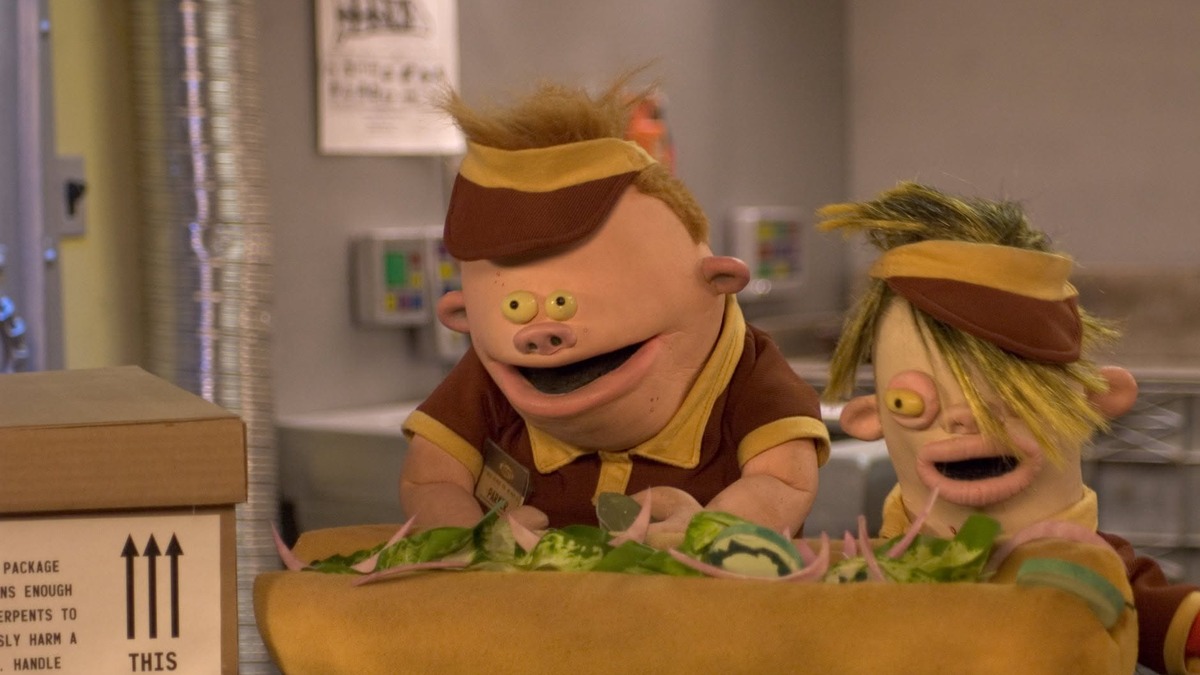
Set inside a dingy, grease-stained fast-food restaurant in the food court of the fictional Scaunchboro Mall, the series followed two sixteen-year-old slackers: Josh Redgrove, a vain, girl-obsessed aspiring filmmaker performed by Shannon, and Parker Dinkleman, a dim-witted, food-obsessed romantic performed by Hopley.
Where Nanalan’ had been pastel, quiet, and reassuring, Mr. Meaty was loud, grotesque, and gleefully repulsive. Shannon and Hopley designed and fabricated every puppet in the series themselves, deliberately rejecting smooth, appealing textures in favour of asymmetrical faces, visible seams, blotchy skin, bulgy eyes, and exaggerated dental work.
The plots matched the aesthetic. Over 21 episodes, Josh and Parker contended with tapeworms living inside their bodies, deep-fried hands, flesh-eating zombies, possessed fryers, and corporate fast-food mascots with sinister agendas.
For young viewers tuning into Nickelodeon expecting conventional Saturday-morning slapstick, Mr. Meaty landed like a shockwave. The tactile physicality of puppetry made the show’s body-horror gags feel far more visceral than traditional 2D animation ever could. A cartoon character losing a nose or eating a mutant burger registers as an abstraction; a foam-and-latex puppet oozing grease under harsh fluorescent lighting triggers an immediate, squirming physical reaction.
That visceral quality turned Mr. Meaty into a polarizing cult sensation. While parents and squeamish viewers sometimes recoiled, a dedicated audience embraced its punk-rock subversion of teen sitcom tropes. In the decades since it left the air, Mr. Meaty has enjoyed a long afterlife in internet video essays, retrospectives, and fan forums—a legacy Shannon has leaned into with self-aware humour, acknowledging how a puppet show about minimum-wage mall workers ended up lodging itself permanently in the collective memory of millions of former kids.
Hollywood Calls and the End of a 17-Year Partnership
The mid-2000s marked the busiest stretch of Shannon’s career, a period in which The Grogs’ Toronto workshop simultaneously serviced Canadian public television, American cable giants, and international co-productions.
While Mr. Meaty was in production, Shannon and Hopley also created Ooh, Aah & You, a series of educational shorts featuring two expressive monkey puppets—calm blue older brother Ooh (voiced by Marty Stelnick) and hyperactive red younger brother Aah (voiced by Hopley). Initially launched in 2005, the characters proved so popular with young viewers that in March and April 2007, Disney tapped Ooh and Aah to become the official on-air hosts of Playhouse Disney across the United States, replacing Clay and Page.
During this same era, Shannon expanded his range across formats and roles:
- Directing and Voice Work on *Big & Small* (2008–2011): Shannon directed 78 episodes of the hit British-Canadian puppet series and voiced Ruby and Twiba for the Canadian broadcast dub.
- Reviving Classic Characters: He returned to his YTV roots to write, direct, produce, and voice the title character in Swami Jeff’s Temple of Wisdom (2008).
- Animation and Live-Action Hosting: He co-created and executive-produced the animated family series Weird Years (2006) and stepped out from behind the puppet curtain to host Canadian Geographic Kids! (2003–2005).
- Adult Sketch Comedy: He brought his puppets to the Comedy Network’s edgy sketch series Hotbox in 2009.
Yet working side-by-side at breakneck speed for nearly two decades carried a quiet creative toll. Since their early twenties, Shannon and Hopley had spent almost every waking hour together—writing, sculpting foam, shooting pilots, and navigating network notes.
By 2009, after a 17-year run that transformed them from York University dropouts into internationally recognized showrunners, Shannon and Hopley formally dissolved The Grogs.
“We made a lot of shows together from the age of 20 to 37,” Shannon later reflected candidly on CBC’s Q. “We were beside each other every day, all the time, making ideas, creating, puppeteering. I think at some point we were like, ‘OK, enough'”.
The split was not born of animosity, but of creative exhaustion and the need for individual breathing room. Both men moved forward into distinct chapters—Hopley creating characters like Gary the Unicorn for CBC Kids, and Shannon establishing his own independent banner, first as Jamie Shannon Productions and later rebranded as Puppet Island Inc., operating out of his studio on the Toronto Islands.
Monsters, Mystics, and Prestige Television
Freed from the relentless schedule of running a multi-series production house, Shannon spent the 2010s and early 2020s exploring two parallel tracks: lending his physical puppeteering and fabrication expertise to major film and television productions, and pursuing personal, adult-oriented projects that no children’s network would ever air.
On the production side, directors and showrunners seeking tactile, on-set creature work repeatedly turned to Shannon’s studio. In 2010, he performed in Higglety Pigglety Pop! or There Must Be More to Life, Spike Jonze and Chris Lavis & Maciek Szczerbowski’s acclaimed adaptation of Maurice Sendak’s story featuring Meryl Streep.
That same year, he designed, fabricated, and performed the demonic puppet Mischievio on the Canadian cult horror-comedy series Todd & the Book of Pure Evil. He also directed nine episodes of TVOKids’ community-building series GIVER in 2013 and contributed puppet building to Odd Squad.
Even as streaming television leaned heavily on computer-generated imagery, Shannon’s practical craft remained in high demand for moments that required physical presence and comedic weight.
In 2019, he served as a puppeteer on Amazon Prime Video’s superhero satire The Boys—bringing to life the surreal aquatic hallucinations experienced by the character “the Deep”—followed by puppeteering credits on Eli Roth’s The Haunted Museum (2021), Nickelodeon’s fantasy series The Barbarian and the Troll, and Netflix’s hybrid live-action/animated miniseries Lost Ollie (2022).
At the same time, Shannon began scratching an itch he had suppressed since his earliest days on YTV: making unapologetically adult, historically strange puppet cinema.
In 2018, twenty-seven years into his career, he unveiled The Legend of Rasputin, a darkly comic, racy short film recounting the rise and turbulent demise of the Russian mystic during the Russian Revolution—cast entirely with expressive, hand-built puppets.
Premiering at the Art Gallery of Ontario as part of the Toronto Shorts International Film Festival in March 2018, Rasputin showcased Shannon’s sculptural sophistication unbound by broadcast standards. In a behind-the-scenes feature with CBC Arts, Shannon stood in his workshop surrounded by Mona, a caricature puppet of Donald Trump, and his bearded Rasputin figure, explaining why the project felt essential. “Rasputin is an evolution of me being able to do more adult themes,” Shannon said, “which I’ve always wanted to do”.
He carried that same unfiltered spirit onto live festival stages, performing in late-night adult puppet cabarets at events like Ontario’s Puppets Up! International Puppet Festival.
The “Nanalution” and a Reunion Nobody Planned
For fifteen years, Shannon and Hopley largely went their separate ways, rarely speaking as they pursued independent projects. Neither man expected that a quiet, cardboard-and-felt show they had finished making in 2004 was about to erupt into a global internet phenomenon.
In late 2023, short clips from Nanalan’ began circulating on TikTok. At first, the algorithms latched onto Mona’s idiosyncratic speech patterns and expressions—her wide-eyed awe at discovering peas in a garden pod, her dramatic reactions to minor toddler setbacks, and the soothing, unhurried cadence of Nana’s voice.
Within weeks, what fans dubbed the “Nanalution” had generated tens of millions of views. When Shannon and Hopley launched an official TikTok account and posted a 10-second clip of Mona exclaiming, “There’s peas in there!”, it racked up a million views almost immediately.
More striking than the view counts was the emotional tenor of the comments. Gen Z and millennial viewers weren’t sharing Nanalan’ ironically; they were treating it as a genuine therapeutic refuge from the anxiety of modern life. Commenters wrote about how Mona and Nana unlocked forgotten childhood memories—or offered a glimpse of the patient, unconditional care they wished they had experienced growing up.
For Shannon, watching a new generation embrace Mona brought a profound personal revelation. The viral surge prompted him and Hopley to pick up the phone, reconnect after fifteen years apart, and pull Mona and Nana out of storage for live interviews and new online sketches.
“And it’s weird because I thought to myself, ‘Maybe one day when we’re 50, we’ll work together again,'” Shannon told Tom Power during their December 2023 reunion on Q. “That’s what I was really excited about today, is to try to reunite with that feeling of the creative joy that we always had. It was pure. It was pure and awesome”.
Reflecting on why the show resonated so deeply in an anxious era, Shannon added: “It’s beautiful! It is what people need and people are just so scared right now. It’s such a scary world…. We all have to just heal our own little birdy inside, and that’s going to make it a better world”.
That dual inheritance—a fanbase split between people whose “inner child” was healed by Mona and people whose childhood sleep was haunted by Mr. Meaty—forms the comedic and emotional core of Shannon’s live stage work.
See Jamie Shannon Live in Toronto This December
After spending more than three decades hidden below camera frames, behind studio desks, and inside foam monsters, Jamie Shannon is stepping directly onto the stage in Toronto to reckon with his own bizarre cultural footprint.
Presented by Puppet Island Inc., Shannon’s live solo show—How I Accidentally Traumatized Millions Of Children: Jamie Shannon explains himself—runs for five intimate performances from Wednesday, December 9 through Sunday, December 13, 2026, at Eldritch Theatre’s Red Sandcastle Theatre* (922 Queen Street East, Toronto, ON).
Blending stand-up storytelling, behind-the-scenes confessions, and live puppetry, the 80-minute all-ages show unpacks thirty years of creating television’s strangest and most beloved characters—from the backyard gentleness of Nanalan’ to the unhinged mall horrors of Mr. Meaty—and explores why handmade creatures still hold a unique power over our imaginations.
Get your tickets here for a rare, up-close evening with one of Canada’s most original puppeteers.
- Wednesday December 9
- Thursday December 10
- Friday December 11
- Saturday December 12
- Sunday December 13