He is five years old, and his parents take him to see Oliver! for his birthday. He will remember almost nothing about the orphans. What he remembers is Bill Sykes dragging what looks like Nancy to the top of the Tower Bridge set — and dropping her. The body is a mannequin, though the boy doesn’t know that. The whole theatre screams at once.
The five-year-old doesn’t scream. He turns to his mother and announces what he wants to do when he grows up: that. Make rooms full of people scream.
He had always loved horror — since age three, when he caught Abbott and Costello Meet Frankenstein on the Sir Graves Ghastly Show. The birthday matinee just gave the love a job description.
A few years later he was one of thousands of Ontario kids setting an alarm for six in the morning, switching on CHCH, waiting for the static to clear so he could watch The Hilarious House of Frightenstein with Billy Van: a Wolfman DJ, a vampire, a witch, puppets teaching grammar between sketches. Monsters and lessons, side by side, before school. The Frightenstein mornings taught him the other half of the formula: horror with a wink. Scare the kids, then make them laugh, then teach them something before the bus comes.
Every show he has made since is a version of that birthday afternoon — a room full of strangers, a gasp timed to the frame, a kid in the dark deciding what he wants to be.
Fifty-odd years later, walk into a blood-red room on Queen Street East on a Friday night, and you can watch what that five-year-old grew into.
A Night at the Red Sandcastle: Witnessing the Charm of Eldritch Theatre
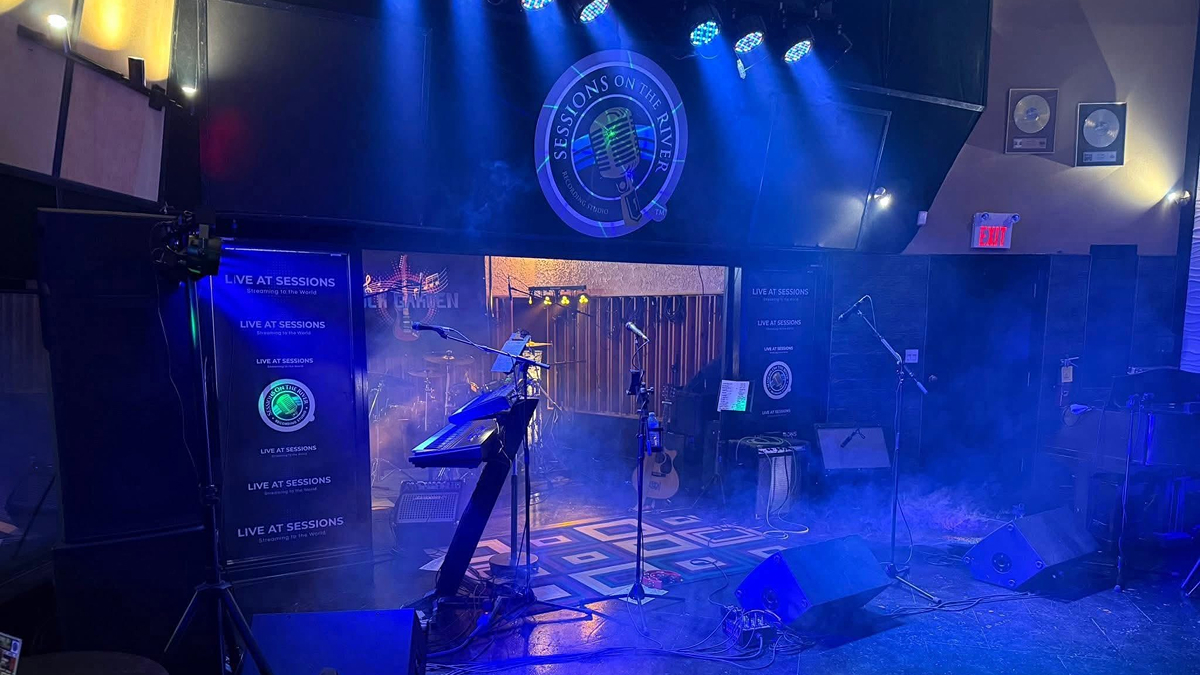
The room sits at 922 Queen Street East, between an ice cream shop and a Value Village, east of the Don. Fifty seats.
On opening night, Eric Woolfe himself works the door — and the show starts before it starts, with the company’s founder pressing small tasks and jokes on incoming patrons until they’re laughing before they’ve sat down.
Inside: a shadowy little theatre, velvet curtains framing the proscenium, some props visible and others covered — every object already telling a story. Producer Adrianna Prosser greets the crowd in character, though she’s not in the show. Then the lights go down, and the room does what it does: screams reverberate off the walls.
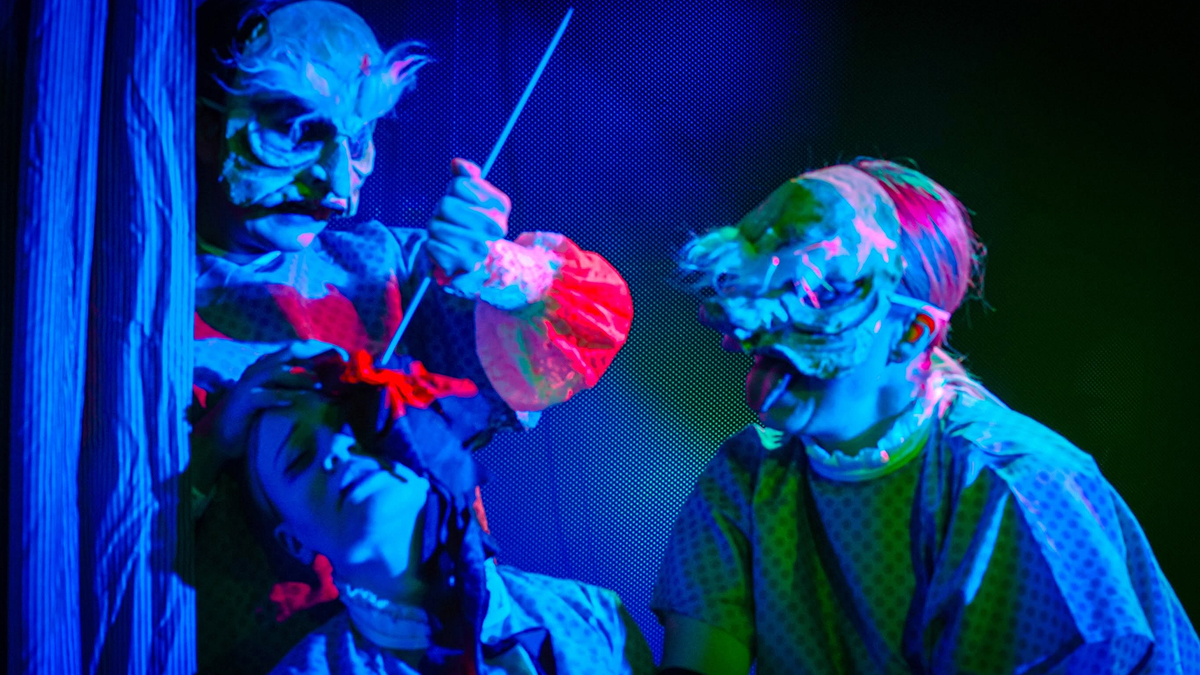
The effects are tiny and feel enormous. Silhouettes. Flash paper. Projections. In a fifty-seat room, a shadow is a special effect and a gasp is surround sound. The strings are visible if you look for them. That’s not a flaw in the illusion — it is the illusion. Even the bathroom is spooky.
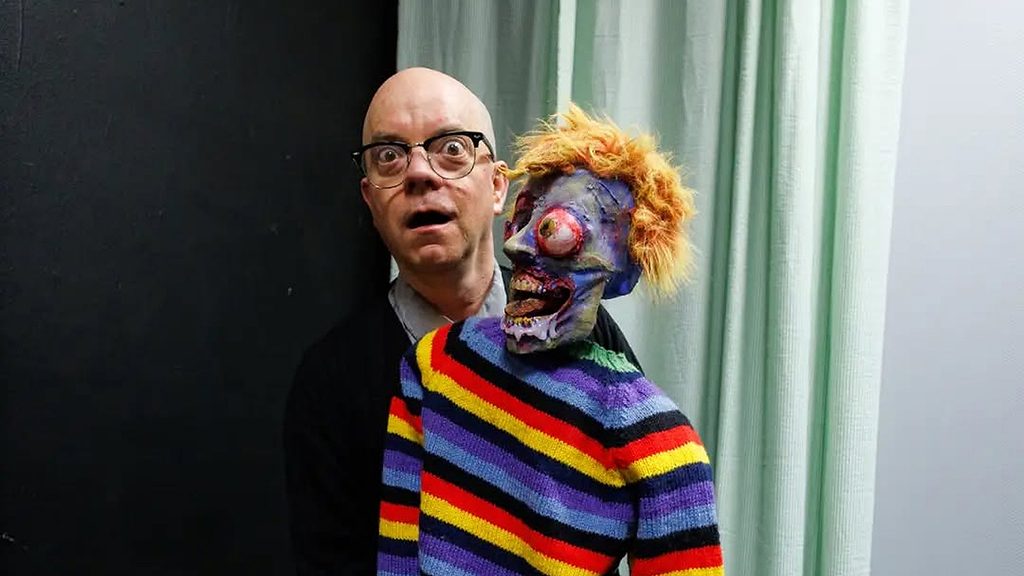
This is Eldritch Theatre: twenty-six years of horror, puppets, and parlour magic in a storefront black box, founded and run by Woolfe. The five-year-old from the birthday matinee, all grown up and still chasing the scream.
The coziness is the point. The work is built for the room it lives in — small-scale spectacle designed for fifty people at a time, the kind of show that would lose its charge in a bigger house.
Here’s the open secret of the fifty-seat room: scarcity is the business model and the magic trick at once. Fifty seats means every night is an event and every ticket feels like a secret handshake. Every scare lands because there’s nowhere for it to miss.
Rooms like this don’t happen by accident. To understand how it got here, go back to a kid in Ontario with a television at six in the morning.
The Making of a Horror Auteur: Meet Eric Woolfe
The six-in-the-morning Frightensteins were only the beginning.
On a March Break school bus to Manhattan — already a working actor, already being groomed for the Stratford young company — the teenage Woolfe stumbled into Charles Busch‘s Psycho Beach Party: Gidget crossed with Hitchcock’s Marnie crossed with Mommie Dearest. Camp, horror, and heartbreak sharing a single stage. Something clicked.
He was broke, spending his money on Velvet Underground records and black punk-rock jackets — but his teacher Art Fidler paid for the kids to see the show again, and brought a cake for the artists.
That night handed him the permission slip: you could love the genre sincerely and send it up at the same time, for an audience that got the joke and felt the scare in the same breath.
He had serious craft to bring to the joke, too. He learned it on the lap of Martha Henry. Bernard Hopkins took him aside to teach him iambic pentameter. He watched Bill Hutt demonstrate exactly how long to hold a pause to get a laugh. Stratford royalty, up close, handing him the instrument.
He was already a professional actor — being groomed for the Stratford young company — with a screen career spanning Timon in Disney’s The Lion King, George Romero‘s Survival of the Dead, Murdoch Mysteries, Due South, and the voice of AJ Topper in Beyblade.
Then he took that instrument and pointed it at puppets. The tension is the whole act: a performer trained by the high priests of Canadian classical theatre, spending his career making monsters out of garbage. Not rejection — inheritance with a wink. Martha Henry taught him how to hold a pause; he uses it to hold a scream.
And he did it on purpose. Theatre pays badly, he figures, so you might as well build it out of things you love. He saw too much of the art form obsessing over tasteful still-lifes of fruit, and decided his work would be the opposite of that.
He even has a theory for why puppets work on grown-ups: they exist entirely in the audience’s mind, so a viewer’s childlike imagination and adult rationality run at the same time. However cartoonish the puppets look, they hit deeper than you’d expect — silly one moment, then frightening or heartbreaking at the drop of a hat. A play about Cronus devouring his children is about abusive fathers — while a play about an abusive father is only about an abusive father.
He never planned to become Toronto’s underground horror-puppet-magic auteur. The career happened to him while he was busy trying to go mainstream — which is his favourite joke about himself.
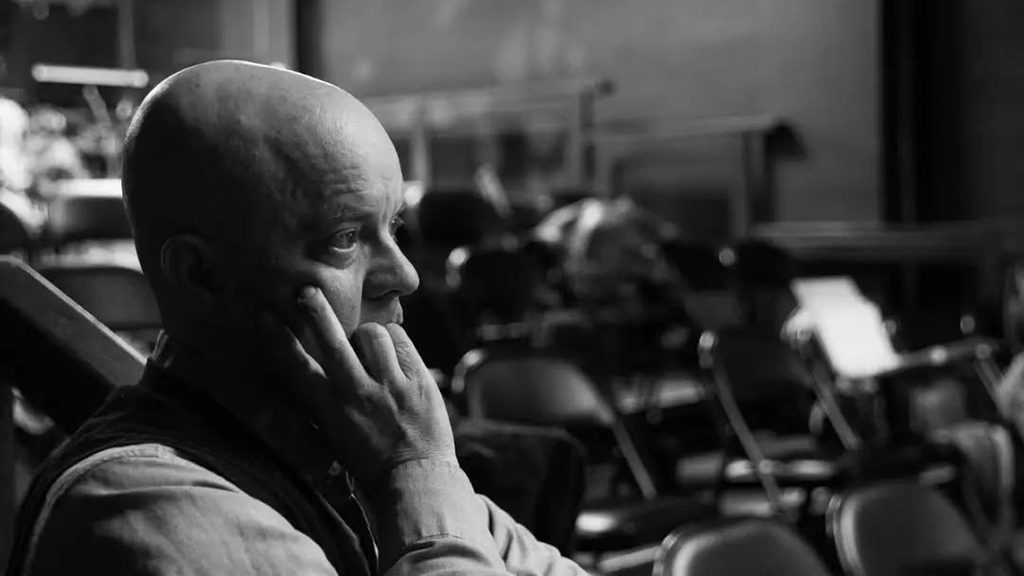
Building Eldritch Theatre A Production At A Time
The break came the way these things always do — with garbage and papier-mâché.
He wanted a horror play about puberty, built like Billy Bishop Goes to War — one actor, one story, the stage stripped bare.
But the solo route terrified him: he’d watched Rod Beattie perform Wingfield and thought the man looked like he was going to die.
So he built himself a cast — out of garbage and papier-mâché, with no training in any of it. And just like that, after twenty-odd years as an actor, he became the horror puppet guy.
There’s a beautiful logic to it. A kid raised on Frightenstein mornings doesn’t need a budget — he needs a glue gun and nerve. He admits he never spends more than ten minutes building a puppet: the sketch is the finished puppet.
The company’s official biography says he formed Eldritch Theatre after losing a bar bet, and that he is a noted spiritualist huckster haunted by the ghost of his miniature schnauzer. The mythology writes itself, because he writes it.
The show was The Strange and Eerie Memoirs of Billy Wuthergloom, around 2000 — the first entry in a theatrical universe stuffed with Necronomicons, asylums for the mentally deranged, mad Arabs, and Old Ones forever trying to reclaim their place.
Twenty-five years later, the company revived Billy Wuthergloom for its 25th Abominaversary, January 29 to February 9, 2025 — the first show, resurrected for the milestone.
Then came the magic. It started with Tom in The Glass Menagerie doing cigarette tricks; by forty, Woolfe was making coins disappear and learning to levitate a potato. He still remembers the exact chair he was sitting in — his second son just born — when the idea landed: magic could support a narrative the way songs support a musical. It felt like deciding at forty to become a prima ballerina.
The first attempt overloaded the act — his first solo magic show took an hour just to load his pockets.
So he refined the philosophy instead: he distrusts magic built to impress other magicians, and prefers the lost art of magic for people who don’t know how tricks work. His written manifesto lays down the rule: the method and the presentation both matter less than how the trick serves the story.
Underneath it all, the engine: well-built jokes and well-built scares run on the same machinery — anticipation, setup, release.
He builds his horror plays like roller-coaster rides for people who get motion sick: all the thrill, staged so everyone can ride. That’s why an Eldritch audience laughs and screams in the same minute.
The fans found him anyway. People drive in from North Bay. People see the same shows over and over — some have caught Doc Wuthergloom five times. After one opening night, his director Dylan Trowbridge marvelled at a packed house with barely a theatre insider in it.
And the Halloween holdouts write the best mail: skip an October and the angry emails arrive, including one from a mortician who brings the whole family every year and wants to know what they’re supposed to do on Halloween without the creepy puppet thing. His rule for earning that loyalty: a night out has to offer something the audience wouldn’t have thought to search for.
And then there was Halloween. The Babysitter in 2006 started the annual tradition, and NOW Magazine eventually declared it wouldn’t be Halloween without another Eldritch show.
Woolfe’s response: fine, then it’s a tradition. Twenty years of Octobers. The city treats the Eldritch Halloween show the way it treats the Santa Claus parade — non-negotiable.
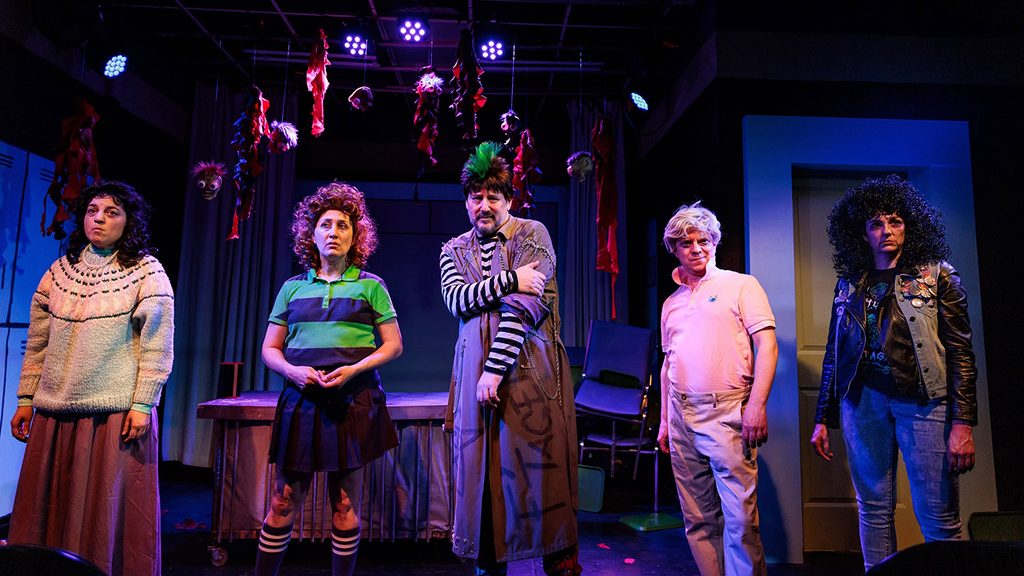
The Castle on Queen East: How the Eldritch Theatre Met A Fine Partner
For two decades the company wandered Toronto’s venues. Then, in 2021, it stopped wandering.
The handover came with a love letter. In July 2021, Rosemary Doyle — who had opened the Red Sandcastle a decade earlier to give theatre artists a canvas, under the motto Anything is Possible — announced that Eldritch Theatre would take over the room. She praised the company for always taking the best care of the little black box and bringing it pizazz.
Woolfe’s answer: the Sandcastle had always been the company’s favourite place to brew its creepily uncanny theatricals, and now they’d invite other companies to come create their own fantastical work inside its walls. Woolfe likes to joke that the papers now call the Sandcastle chiefly known for Eldritch’s puppet-magic shows — never mind the dozens of other companies’ productions in the room each year.
They took over in 2021 — which meant keeping the doors open through the pandemic.
Producer Adrianna Prosser remembers the absurd math: grant money pouring in that couldn’t be spent on rent, leaving her laughing in despair and wondering, curled in the fetal position, whether she’d be able to keep the lights on. They kept them on. The pandemic killed rooms across the city; the Sandcastle survived because two people decided the lights staying on was non-negotiable.
There’s a difference between renting a room and keeping one. A tenant performs; a caretaker tends. Under Eldritch, the Sandcastle became the rare venue with a repertory soul — programmed by the people who love it most, open to anyone with the nerve. The room now hosts dozens of other companies’ shows a year.
And the audience keeps getting younger. Woolfe has always been quietly proud that the Eldritch crowd skews young — and he’s made a point of welcoming younger companies with their own twist on the macabre into the Sandcastle. The castle has heirs.
With a permanent home, the work got bigger — and the awards followed.
The Incredible, Combustible Catalogue of the Eldritch Theatre: Twenty-Five Years of Shows
The catalogue tells the story of the build.
The early 2000s were experiments in the form: Grendelmaus in 2003, Dear Boss in 2004, Sideshow of the Damned around 2004-05 — new plays, new puppets, Dora nominations stacking up for performance, new play, direction, and costume.
The Babysitter arrived in 2006 and accidentally founded the Halloween tradition.
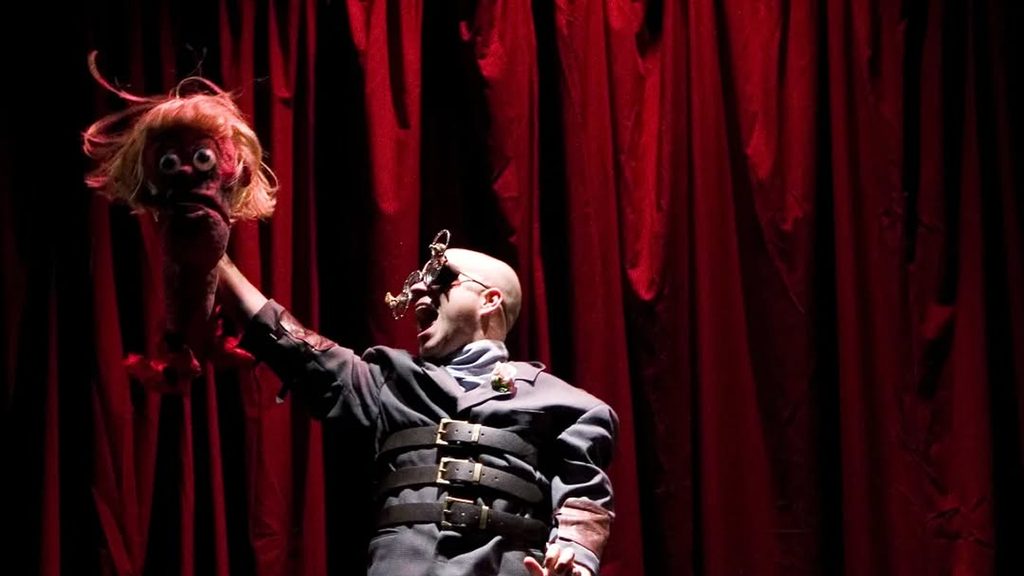
Madhouse Variations in 2010 sent more than twenty puppets to their gory ends onstage — red ribbons for entrails — behind a life-size ventriloquist professor, and won the 2011 Dora for costume design.
The 2010s kept the machine running. Doc Wuthergloom’s Haunted Medicine Show around 2012. Buster Canfield and His Amazing Fleas in 2014 — the carnival-magician character who would become a company mascot — and Frankenstein’s Boy the same year.
The House at Poe Corner in 2015 mashed the Hundred Acre Wood with Edgar Allan Poe: a doom-laden opening warble from two gaunt Poes, a raven stepping in for Owl to croak Nevermore to gleeful applause, and a cute little piglet announcing that life is a dark and empty abyss.
The Harrowing of Brimstone McReedy in 2016: a Klondike con man, the Devil, cursed gold — told with puppets, con games, and dark parlour magic, the con games played for real on a cheerfully fleeced audience, the puppets charming at first and genuinely unnerving by the end.
Space Opera Zero! in 2018 launched Middleton’s Changeling into 1930s pulp science fiction and won the 2019 Dora for costume design.
Two Weird Tales in 2022 — a show so thoroughly haunted that even the bathroom was spooky. Requiem for a Gumshoe later that year: a 1930s hardboiled detective story swallowed whole by an apocalyptic, infinitely large space worm. Doc Wuthergloom’s Here There Be Monsters in 2023.
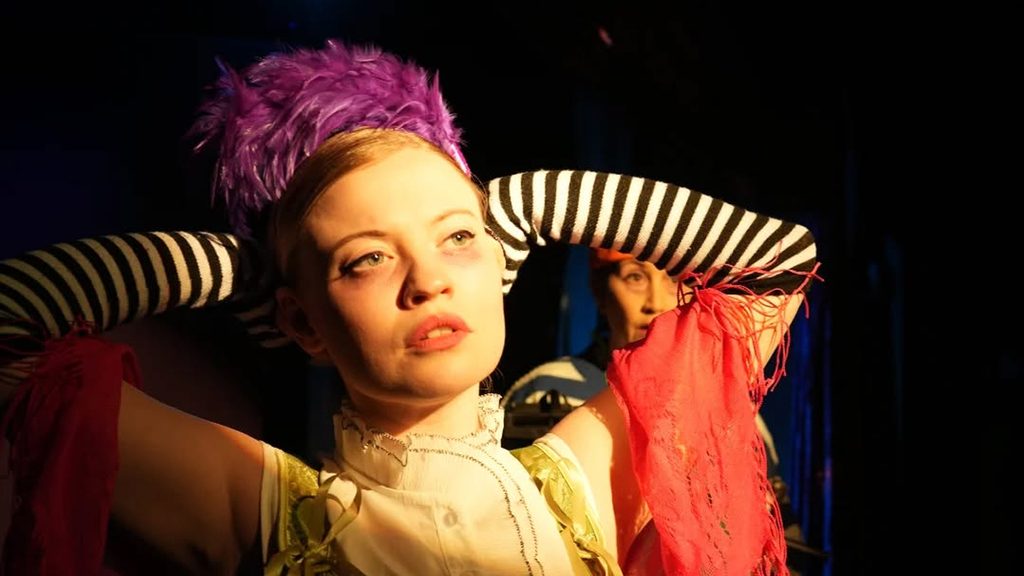
Phantasmagoria 3D in 2024, handing every patron red-and-blue 3D glasses while skeletons, demons, and Godzilla reached toward the seats — the middle of the house being the sweet spot.
MacBeth: A Tale Told by an Idiot! in 2024 gave Toronto three witches as stacked-head puppets cackling in different pitches, Lady Macbeth perched on Woolfe’s hidden head with blood-soaked hands, a coin trick fused with a rite for the dead, and a floating dagger nobody could explain. The run sold out and added a week. Glenn Sumi gave it five stars, and Front Mezz Junkies named it one of 2025’s top theatrical treats.
Doc Wuthergloom’s Little Lib’ary of the Damned followed in 2025 to four-star reviews, and Buster Canfield returned that December with a Yuletide edition of his industrious fleas.
Night at the Grand Guignol ran February 18 to March 1, 2026: four classic French horror plays reimagined as a horror-comedy anthology.
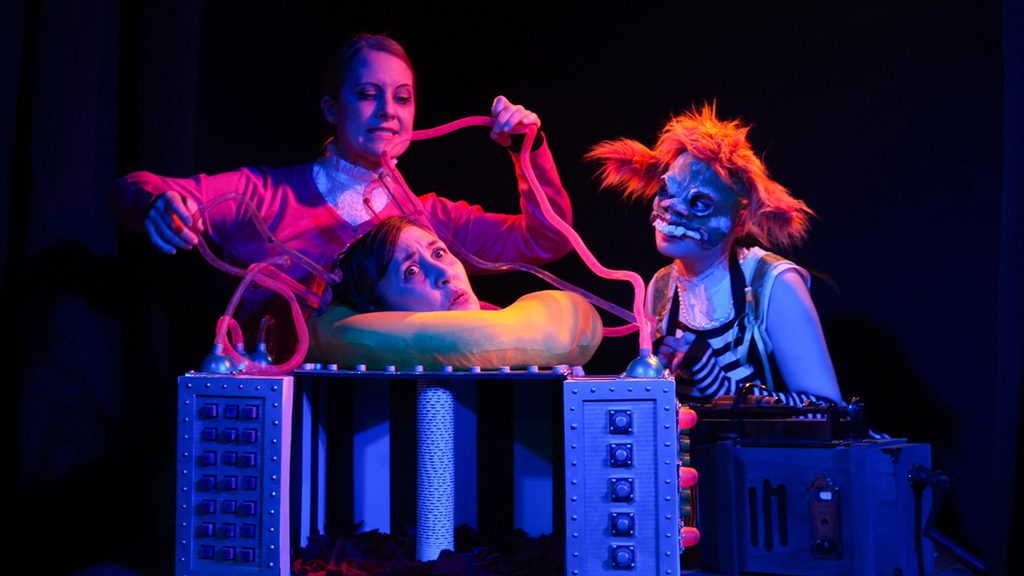
The tin-can-telephone murder stretched one agonizing pause past all reason before the squishy-splattery-sputtery payoff. The finale gave the audience a pink-sweatered mad-scientist mother and her torture device, ending on a disembodied head wired to a ludicrous contraption — funny and genuinely baleful at once. A lighthouse immolation played through scrim and projection: fire you can see through.
The awards followed the work: the 2026 Dora for costume design and the 2026 Toronto Theatre Critics’ Award for costume design, both for Melanie McNeill — another Dora for the company’s resident designer — plus a May 2026 special citation honoring Woolfe’s dedication to his vision and the way he’s grown the company into bigger projects with larger teams.
Zombocalypse! in the spring of 2026 armed five performers with sporks against the undead — sporks being, as the company well knows, barely adequate for their intended purpose — plus an escape illusion nobody saw coming.
Aye Caesar closed out September 2026 as a co-production with Stakes and Embers and Carolyn Fe.
Across the decades, the Dora record reads like a parallel history of the company: nominations for new plays and performances in the early years, design and ensemble recognition lately, costume-design wins in 2011, 2019, and 2026 — all for Melanie McNeill — and that 2026 special citation for Wolfe.
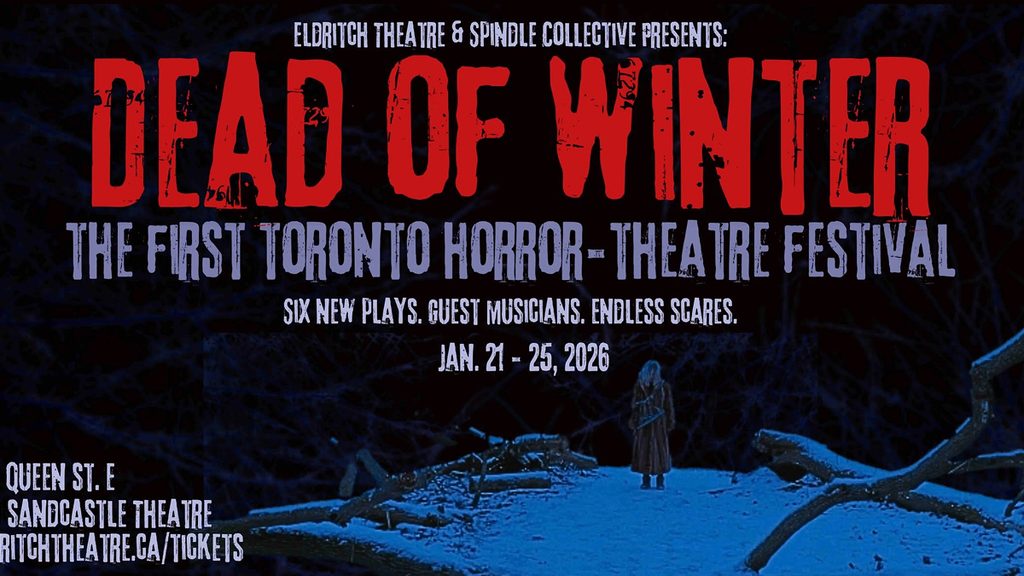
Dead of Winter: Toronto’s First Horror Theatre Festival Lives!
But the most important thing Eldritch built in that little room wasn’t a show. It was a scene.
It was twenty-five below. A reviewer for A View From The Box bundled up on one of the coldest nights in memory, the frigid air piercing every layer straight to the bone, on the way to a favourite haunt: the Red Sandcastle Theatre.
Inside, fifty people were choosing to be scared on purpose.
That was Dead of Winter, January 21 to 25, 2026: Toronto’s first horror theatre festival.
Six original short works across two alternating 90-minute lineups — a Night of Terror and an Evening of Fear — co-produced with the Spindle Collective‘s Kathleen Welch and Natalia Bushnik. Horror people trekking through snow for horror theatre. One critic argued that October may wear horror’s conventional costume, but a minus-twenty-five January night, with a sold-out crowd huddled against the dark, deserves the mantle more.
On the coldest nights of the year, in a city with a thousand warm rooms, people chose the blood-red one on Queen Street East — to sit shoulder to shoulder with strangers and be frightened on purpose. That’s not an audience. That’s a congregation.
Doc Wuthergloom hosted — Woolfe’s raspy-voiced alter ego, a sarcastic chalk-faced skeptic of pumpkin spice, who explained why the festival had to exist and then gave the evening its shape, wit, and bite. The programming was deliberately economical: nobody ever leaves saying the show was brilliant but too short.
The nights stacked moments like cordwood.
- A young revenant in a Davy Crockett cap, teeth-earrings, and a shredded bustier-skirt delivered guitar-backed folklore songs that built to a singing-saw solo and stopped the room dead.
- A tarot-card psychic bullied a client’s true desires into the open, argued that true love is like an infestation, and landed a surprise ending.
- A vampire story lit by only two hand-held lanterns felt cinematic — and hid a perfect final jump scare.
- A witch-weaver mother and her daughter worked a relentless onstage spinning wheel in a primal folk-horror piece that got under the skin — and later won first place at the Grand River Arts Festival.
Sold-out houses, in the dead of January — plus craft beer on the final night, the little haunted theatre licensed for one evening only: come for the scares, stay for the beer.
The verdict that stuck: a city iced over by habit had its blood warmed by being chilled first. Midwinter, it turns out, is when horror belongs — and a cozy theatre is where.
Eldritch Theatre’s Season Ahead: What You Can See Across 2026-2027
And the calendar from here is the busiest it’s ever been.
Call Centre of Cthulhu runs October 28 to November 8, 2026.
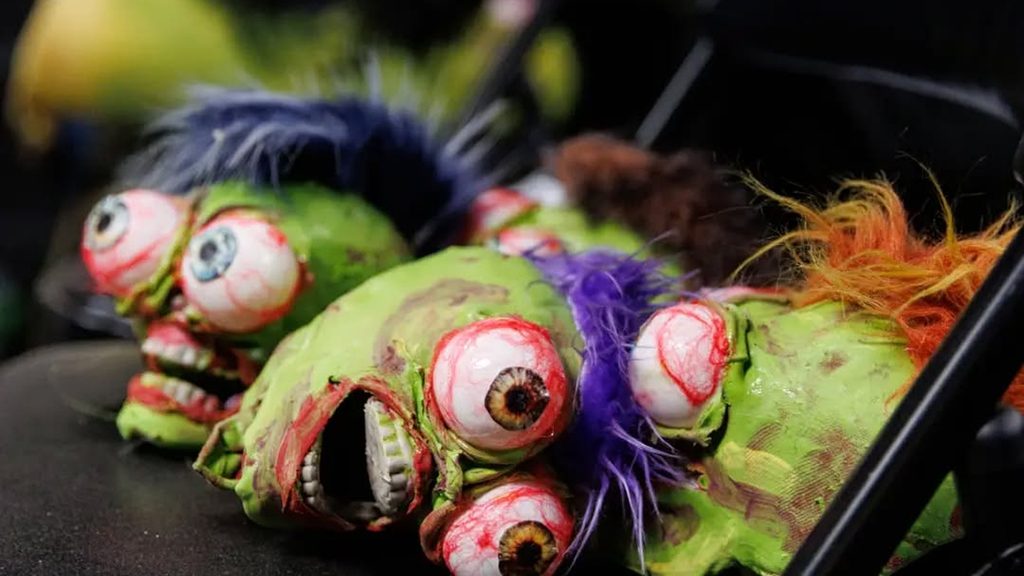
The premise: a dumpy middle-aged call-centre worker pieces together an ancient apocalyptic prophecy and becomes humanity’s only hope as a dread Elder God awakens to end the world — staged, in the company’s words, as a ghoulishly giddy blend of creepy puppets, dark parlour magic, and horrific high camp, created and performed by Woolfe with additional dialogue by H.P. Lovecraft himself. An elder god, a headset, and hold music.
December belongs to the family crowd: Buster Canfield’s Nutcracker Prince vs the Rat King, December 17 to 20.
Buster Canfield — world-renowned carnival magician and mystical soap pitchman — presents the mostly true, actually sort of accurate story of the Nutcracker Prince, re-imagined as an old-time medicine show and filled with yuletide parlour magic, bizarre puppets, and brazen holiday chicanery, all brought to you by Buster Canfield’s Thaumaturgical Wonder Soap.
Whether you’re four or four hundred and forty-four, Buster’s fleas will earn your smile — alongside the theatrical debut of Jimothy the Raccoon.
Then January 2027 brings Dead of Winter Season II. After last year’s sold-out premiere, the festival returns bigger: nine new horror plays and three musical acts rotating nightly, hosted once more by the ghoulish Doc Wuthergloom.
Three lineups — Night of Terror, Evening of Fear, Dusk of Dread — with commissioned artists earning $500 honoraria.
Spring holds Unholy Ground — co-created with Air Farce veteran Craig Lauzon, staged in live 3D — and The Ghoul of Green Gables, an Anne Shirley-meets-Lovecraft mashup.
Tickets run $30 general admission, $25 on Tight Wad Tuesdays and Wednesdays, $35 at the door; Sundays are pay-what-you-please, and Inner Sanctum members take 25% off — plus a secret arcane word of power and access to the Forbidden Lib’ary of blood-sopped scripts, for fifty dollars and possibly your soul.
Ninety minutes, no intermission, at 922 Queen Street East. Fifty seats — which has never been a limitation and never will be.
Check upcoming Eldritch Theatre shows and get tickets on Ticketscene.