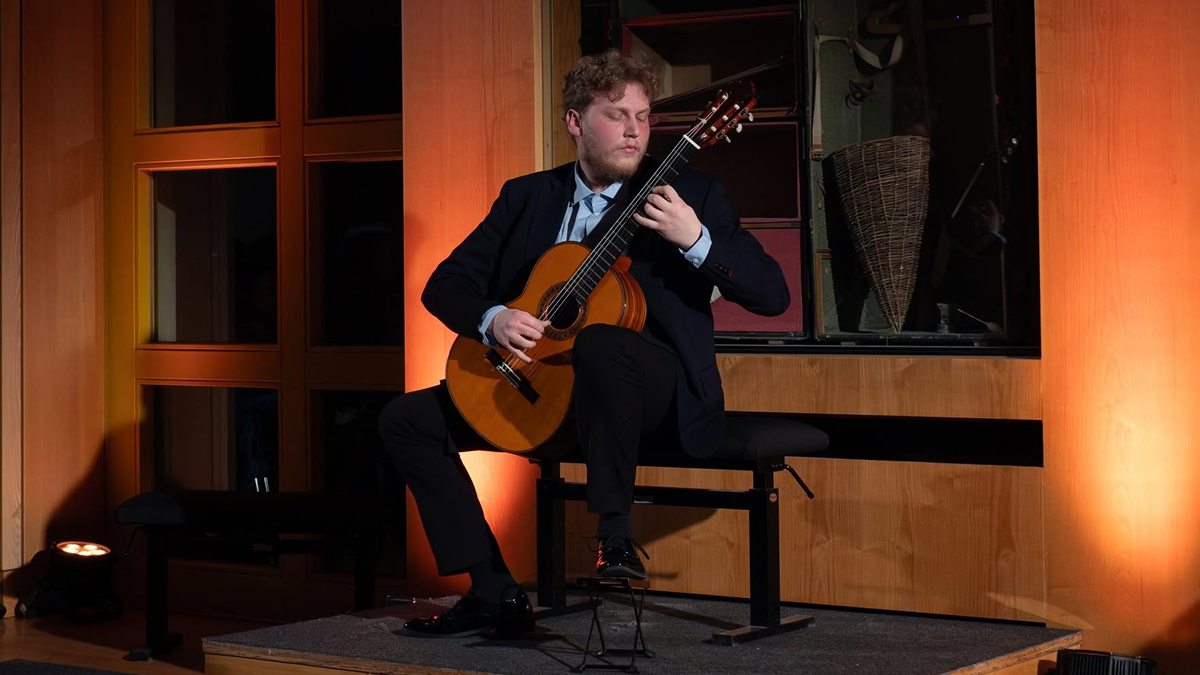
Flavius Wagner has not finished his bachelor’s degree, and his résumé already reads like that of a working professional. Since 2023 he has placed fourth at the Guitar Foundation of America‘s youth competition, won first prizes in Sarajevo, Chicago and Gainesville, and taken second prize in Dallas.
He is a German guitarist from Baden-Baden who has spent most of his life inside a single conservatory studio in Stuttgart. That unbroken course of study explains how a current undergraduate can arrive in Canada with a veteran’s repertoire.
Presenters in Germany, Denmark, Canada and the United States now book him for recitals, masterclasses and series built around rising talent. What follows traces how he got here, what he plays, and why the guitar world has started to pay attention.
A Childhood in Baden-Baden and Early Lessons at the Local Music School
Baden-Baden is a spa town on the edge of the Black Forest in Germany’s Baden-Württemberg region, and it is where Wagner was born and raised. He began guitar lessons there at the age of four, at the town’s music school.
He stayed at that school for about ten years. His teachers included Professor Boris Bagger, a name that still appears in the biography presenters use to introduce him in Canada.
Ten years of lessons is a long runway for a child. By the time Wagner turned fourteen, he had spent a full decade learning the instrument in a formal setting.
His first national recognition came through Jugend Musiziert, which the Baden-Württemberg government describes as the largest youth music competition in the world. Competitors climb through regional, state and federal rounds, and the federal round is the top.
Wagner won several first prizes at that federal level, according to the organizers of his recent Hamburg appearance. In November 2018 the state’s science and arts ministry listed him, of Baden-Baden, among 145 federal prizewinners it honored at an official reception.
Baden-Württemberg treats the competition as a point of regional pride. The state’s arts minister has noted that in a recent year more than a quarter of all first federal prizes went to young musicians from the state.
Wagner grew up inside that system, and the early prizes pointed him toward his next step. It came at fourteen.
Moving to Stuttgart and Studying Under Johannes Monno Since the Age of Fourteen
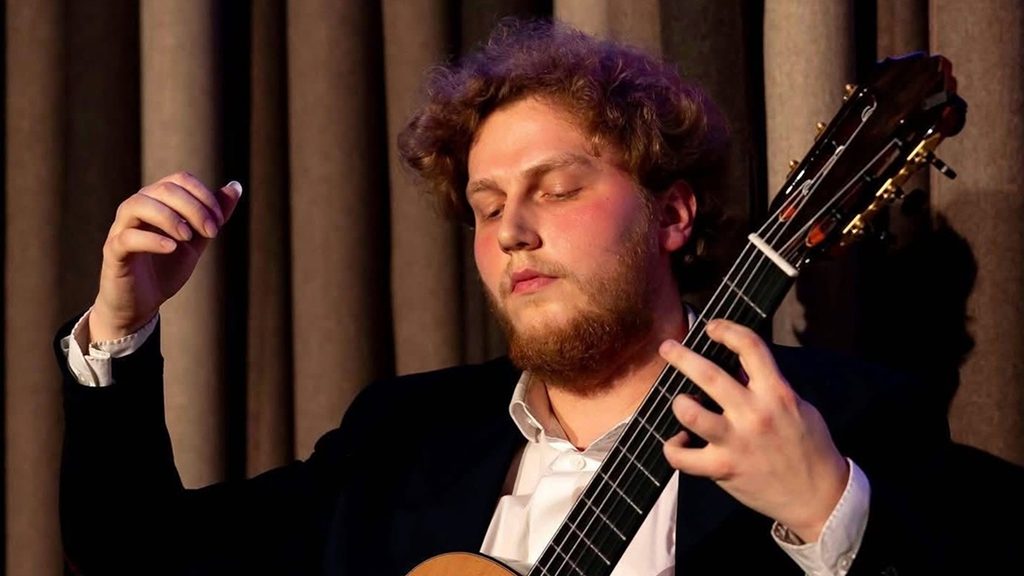
At fourteen, Wagner became a junior student at the University of Music and Performing Arts Stuttgart, known in Germany as the HMDK. He entered the class of Professor Johannes Monno, and he has stayed in that studio ever since.
The junior-student track is how German conservatories train exceptional teenagers alongside their regular schooling. Wagner began his bachelor of music degree at the school in 2022, so by then he had already spent years inside the building.
Monno was born in 1968 and discovered the guitar at six. His own teachers read like a map of European guitar playing: José Tomás in Alicante, Hubert Käppel and Konrad Junghänel at the Cologne conservatory, and Costas Cotsiolis in Athens.
He has toured Spain, Portugal, Austria, Iceland, Italy, Japan and New Zealand, and he has recorded for several German radio networks. Since 2004 he has taught in Stuttgart, where he leads the guitar department and teaches guitar history.
Monno is also a scholar of older plucked instruments. He has studied the vihuela, the baroque guitar and the chitarrone in depth, and that research has produced publications, recordings, lecture series and radio programs.
He co-edits the New Karl Scheit Series for Universal Edition with Thomas Müller-Pering and Olaf Van Gonnissen. He also serves as artistic director of the SICG festival.
His recordings include J.S. Bach: Works for Lute, on which he plays both lute and classical guitar. Bach’s lute music is the same corner of the repertoire Wagner draws on when he opens his Waterloo program with BWV 995.
Junghänel, who once taught Monno, has praised the way his former student gives every tone a meaning and a place, in Bach and in Spanish music of the twentieth century alike. Those two repertoires happen to anchor Wagner’s own programs.
Staying with one teacher from the pre-college years through the bachelor’s degree is a deliberate kind of training. It shows in the coherence of Wagner’s programming, where a span from Bach to Rodrigo feels like the product of one long course rather than a patchwork of short ones.
Teaching, Masterclasses, and a Life Spent Inside Ensembles Instead of Only Solo Programs
Wagner has been teaching since he was still a teenager. He teaches at the youth music school in Gerlingen, near Stuttgart, and he works as an instructor on courses commissioned by the Baden-Württemberg State Music Council.
Since 2022 he has also coached the guitar section of the JZO-BaWü, a youth orchestra of plucked-string players, according to presenter biographies. Few undergraduates hold a coaching post in a national-caliber youth ensemble while still finishing their own degree.
Festivals have started to hire the teacher as well as the player. His touring biography lists masterclasses at international festivals among his regular work.
His August 2026 stop in Copenhagen is a good example. It paired a five-hour masterclass at the Copenhagen Guitar School, during the city’s Guitarens Weekend, with a concert at Kvarterhuset the following day.
Wagner has also been a student in masterclasses with Judicaël Perroy, Andrea De Vitis, Zoran Krivokapić and Professor Reichenbach. Together the names read as a cross-section of the modern European teaching scene.
Chamber music runs through his life as steadily as solo playing does. He plays in a guitar quartet, and he performs in duos with violin, with clarinet and with voice.
He also plays in a guitar duo with fellow Stuttgart student Henrik Pfeffer. In November 2023 the pair gave an evening of classical works at the Bareiss hotel, whose events calendar billed it as an evening of classical sounds.
Ensemble habits shape a soloist. Players who spend part of their lives in quartets and duos learn to listen across the stage, and that attentiveness carries over when Wagner sits down with music written for one pair of hands.
How a Young Guitarist Builds a Competition Record Across Europe, Asia, and North America
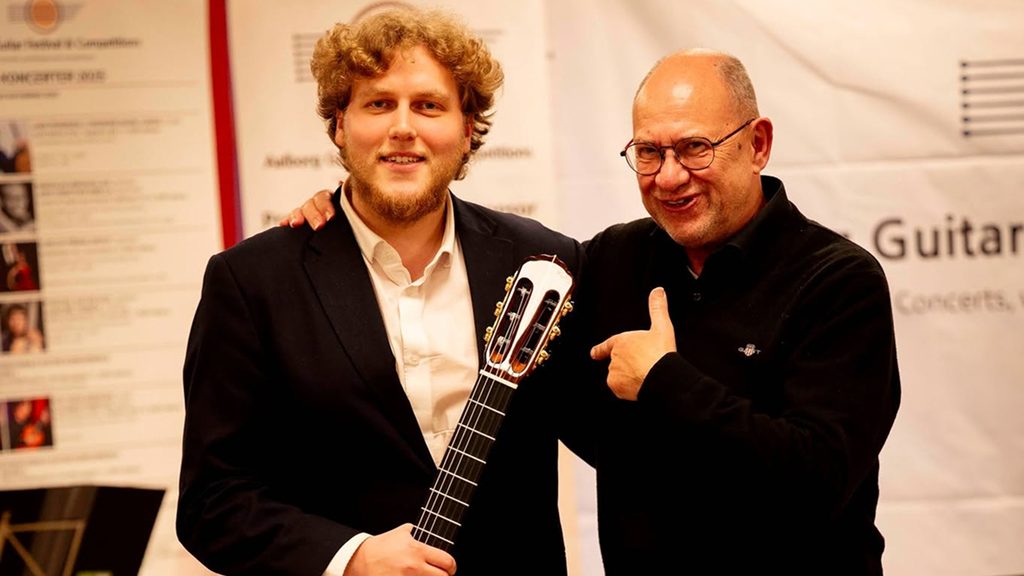
In classical guitar, competitions are the closest thing the field has to a hiring hall. There is no orchestra-audition ladder to climb, so presenters tend to book the players whom a jury has already vetted.
Wagner’s record reads like that mechanism working in fast motion. His early results came at home in Germany, where beyond his Jugend Musiziert prizes he won first prize at the Gitarrophilia competition and fourth prize at the Andrés Segovia competition.
Then the results began arriving from abroad. He took third prize at the Visegrad Guitar Competition in Bratislava in 2021 and reached the finals of the International Hannabach Prize in Augsburg in 2022.
In 2023 he was a finalist at the Anna Amalia Competition in Weimar. That same year he won first prize at the International Guitar Festival Sarajevo, a title his presenter biography also records under the Ubuntu Guitar Festival banner in Bosnia.
In 2024 he took third prize at the HASPA Cup, the competition held during the Hamburg Guitar Festival. Asia entered his record through a third prize at the Hanika Guitar Competition in Bangkok.
North America came next, and it began with the Guitar Foundation of America. The foundation’s convention is the largest annual gathering of classical guitarists on the continent.
In the 2023 International Youth Competition, in the senior division for ages 15 to 18, Wagner placed fourth. Only Muxin Li of China, Hwanhee Cha of South Korea and Penelope Shvarts of the United States finished ahead of him.
The senior division is the youth competition’s oldest category, and it sits one step below the open circuit where he would start winning two years later.
The year that changed the shape of his career was 2025. He took second prize in Dallas, and first prizes followed at the Chicago guitar competition and at the University of Florida’s guitar festival in Gainesville.
Presenter biographies add a first prize at the Aalborg guitar competition in Denmark. The American results had stopped being placements and started being wins.
The Texas Breakthrough: Second Prize and the Audience Award in Dallas
The Dallas result deserves a closer look, because it came with a detail that rarely appears in a biography: the listeners’ vote. The event was the Texas Guitar Competition and Festival, hosted by the guitar studies program at the University of Texas at Dallas.
In 2025 it ran March 6 to 8 and marked its 23rd annual edition. The festival awards more than $8,200 in cash prizes, and its adult competition is open to college-level players.
Competitors submit a video for the first round and then play a semifinal and a final live on campus. The finals took place on the evening of Friday, March 7, in the University Theatre.
Kyle Khembunjong took first place, Wagner second, and Hayoung Lee third. Alejandro Rodriguez Ruiz, a past medalist at the same festival, finished fourth.
Wagner also won the Martha and John Nye Audience Choice Award. That prize goes to the performer the listeners in the hall liked best, which is a different measure from a juror’s scorecard.
An audience prize suggests that he reached the room as well as the panel. For a recital artist, that is the quality presenters are looking for.
The weekend carried extra weight for the host school. It was the first festival since the death of co-founder Enric Madriguera, a longtime UT Dallas faculty member, and it included a tribute to him.
The headline concert came from GRAMMY-winning guitarist David Russell. Winners were announced at the end of his concert on Saturday, March 8.
The competition’s own schedule shows how the festival treats its winners. Khembunjong, who took first place that year, was invited back to open the 2026 festival with a concert on March 5.
Fort Worth and the Race for Classical Guitar’s Richest First Prize
Ten months after Dallas, Wagner entered the richest new competition in the field. The inaugural Guitar Studio International Festival and Competition ran January 16 to 18, 2026, at the Van Cliburn Concert Hall on the Texas Christian University campus in Fort Worth.
It was founded by Will Douglas, a Fort Worth guitarist and teacher who owns The Guitar Studio, together with the Chinese instrument maker Altamira Guitars. According to Fort Worth Weekly, its $15,000 first prize is more cash than any other active classical guitar competition pays.
The package also included a $10,000 Altamira guitar and an invitation to the 2027 festival. Second place carried $5,000 and third place $2,000.
The format was demanding. Contestants up to age 30 first submitted a ten-minute performance video, and fifteen semifinalists then played ten minutes live on the stage of the 715-seat hall.
Three players advanced to the final, where each played for thirty minutes. Wagner was one of them.
Douglas said the judges would weigh the difficulty of the repertoire alongside skill, musicianship and stage presence. He also asked a question that goes beyond notes: would a finalist make a good ambassador for the classical guitar to the public?
The panel included the festival’s featured performers along with composers and educators. The stated ambition was to do for the guitar what the Van Cliburn piano competition did for Fort Worth, a comparison Douglas called a deep compliment.
The weekend was more than a contest. Every night brought a full-length concert, with Cuban-born virtuoso Rene Izquierdo, China’s Tengyue Zheng, a 2017 Guitar Foundation of America winner, France’s Gabriel Bianco and Korean-born Bokyung Byun among the featured artists.
Smaller prizes rounded out the field. Attendees voted on a $500 audience-favorite award, and a $500 Michael Dailey award went to the best performer of a piece drawn from Segovia’s recordings. Dailey was the founder of The Guitar Studio, and he died in 2021.
The comparison to the piano world has its limits, and the paper noted them. The Cliburn pays its winner $125,000 and runs every four years, so Fort Worth’s guitar prize is a first step rather than an equivalent.
Wagner’s fellow finalists were Davide Picci and Italy’s Cristina Galietto, a Naples-born guitarist who won the EuroStrings Guitar Competition in 2021. Reaching a three-player final at an inaugural event says as much about Wagner’s standing as any single prize.
A Sound Shaped by Chamber Music, Patience, and a Taste for Range
The first thing presenters say about Wagner is how much of the guitar’s history fits inside one of his programs. The Hamburg Guitar Festival’s own billing describes his repertoire as running from Bach to contemporary composers.
That span is his calling card. It lets a presenter build a whole evening around one guitarist and six strings.
He also thinks about the listener’s side of the concert. In video from a spring 2026 appearance in the Junge Interpreten young artists series in Esslingen, Wagner introduces the program himself before playing a note.
He speaks to the audience about offering them a varied palette of sounds, and then he sits down to deliver exactly that. The gesture says something about how he sees a recital: as a conversation, not a display.
His recordings show the patience that runs through his playing. The lines are long, the phrasing is unhurried, and the tone stays warm even in the quietest passages.
That patience is the product of the chamber musician in him. A guitarist who spends part of his life in a quartet and in duos learns to listen while he plays, and the habit carries into solo performance.
Presenter biographies describe a player whose work combines technical precision with emotional depth and natural stage presence. They also point to his interest in new repertoire, and his programs regularly make room for contemporary and lesser-known works alongside the canon.
The Waterloo recital includes one such piece, Strawhead by J. Khalil. Little about it circulates in print, which makes it the evening’s genuine unknown.
The Repertoire He Returns To: Bach, Ponce, and the Guitar’s Long Memory
Two works sit at the center of Wagner’s programs, and both were already on his first Waterloo recital last December. They are Bach’s Sonata No. 2 in A minor, BWV 1003, and Manuel Ponce‘s Sonata No. 3.
Bach wrote BWV 1003 for solo violin, as part of his Sonatas and Partitas for Solo Violin. Wagner plays its first three movements: the Grave, the fugue and the Andante.
The fugue is one of the sternest tests in the guitar’s repertoire. It asks one pair of hands to keep several independent voices clear at once.
The three movements form a complete emotional circuit. The Grave broods, the fugue argues, and the Andante sings with a sustained line that violinists themselves envy.
Ponce’s Sonata No. 3 was written in Paris in 1927, when the Mexican composer was studying with Paul Dukas. Ponce wrote his guitar music in close orbit around Andrés Segovia, who was premiering new works across Europe and effectively commissioning a modern repertoire into existence.
The sonata has three movements: a dramatic Allegro moderato, the songlike Chanson, and a restless Allegro non troppo finale. Of the works Ponce wrote for Segovia, it is among the most substantial and the most often played.
Wagner has made it a signature, the sonata he returns to on his biggest programs. Bringing the same two major works back to the same city a year later is a confident move.
It also gives returning listeners something rare. Anyone who heard him last December can hear directly how a young player’s Bach and Ponce have grown through a year of competitions, masterclasses and touring.
From Sor to Rodrigo: How His Programs Stretch Across Three Centuries
The rest of the Waterloo program shows the same player’s range in miniature. It opens with the Prelude and Allemande from Bach’s Suite in G minor, BWV 995, the lute version Bach made of his own cello suite in C minor.
Fernando Sor‘s Variations on a Theme by Mozart, Op. 9, is the early-Romantic showpiece. Sor built it on the tune Das klinget so herrlich from Mozart’s The Magic Flute, the happy music that sounds when Papageno’s magic bells set his pursuers dancing against their will.
Sor wrote the piece during his London years, when he was one of the most celebrated guitarists in Europe’s concert rooms. The variations dress a simple melody in increasingly brilliant figuration without ever turning into an empty finger exercise.
Villa-Lobos‘s Prelude No. 1 in E minor brings the evening to Brazil. It is the first of his Five Preludes of 1940, among the last pieces he wrote for solo guitar.
Villa-Lobos came to the instrument from the inside, playing it as a young man with the choro street ensembles of Rio de Janeiro. The prelude’s long, singing melody rides over rippling arpeggios, with a quicker, more urgent middle section before the opening returns.
Rodrigo closes the night with Tres Piezas Españolas, written in 1954, a Fandango, a Passacaglia and a Zapateado. The composer of the Concierto de Aranjuez wrote these dances as a concentrated dose of rhythm and color.
Each piece works the guitar differently, from the Fandango‘s strummed fire to the Passacaglia‘s slow build over a repeating bass line. Ending a recital with the Zapateado, after opening with the stillness of Bach, is a statement about how far one instrument can stretch.
Programs from other stops show the same appetite. His New York debut in February 2026 included Lennox Berkeley‘s Sonatina for solo guitar, and his first Waterloo recital paired the Berkeley with the Argentine composer Carlos Guastavino‘s Sonata No. 1.
Touring Canada, Playing New York, and Stepping Into Europe’s Emerging-Artist Series
The touring has grown the way the prizes said it would. Wagner performs solo recitals across Germany, and his concert biographies list Venice among his international stops.
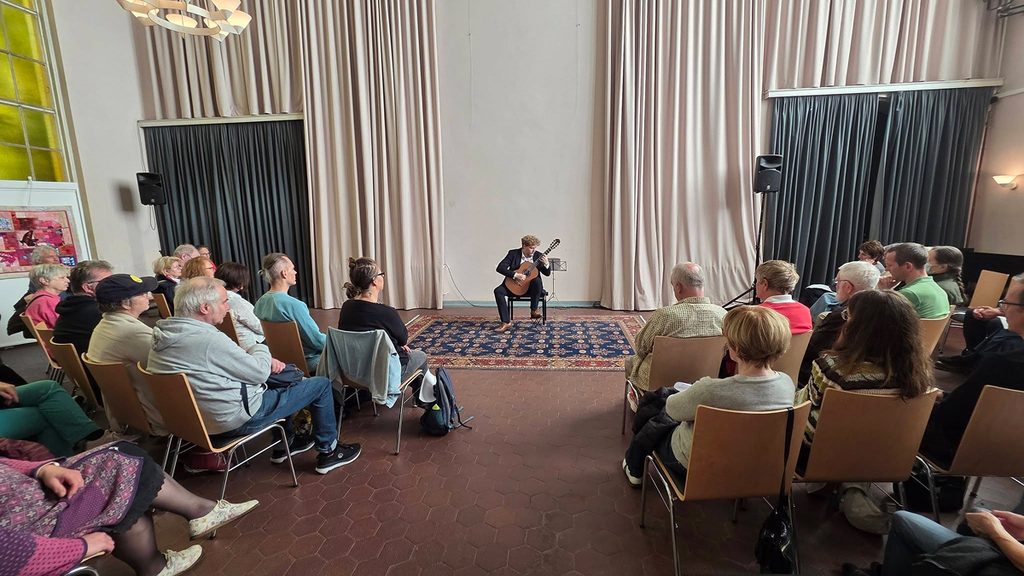
His first Canadian trip came in December 2025, built around the Niagara Classics Concert Series. It took him to Hamilton, to Toronto’s Tranzac Club, where he shared the bill with Toronto guitarist Sam Mason, to Silence in Guelph, and to Waterloo for the society’s recital at Laurier‘s Keffer Memorial Chapel.
The Guelph listing capped attendance at sixty, a reminder of how intimate these rooms are. Tickets there ran from $25 in advance to $30 at the door.
On February 13, 2026, he made his New York debut at a church in Cobble Hill, Brooklyn. The Brooklyn Classical Guitar Society presented it through the Groupmuse concert network as part of its 2026 “Artists to Watch” series, which showcases rising stars of the classical guitar.
The room held fifty people, and reservations cost $5, with a $20 suggested payment at the door. It is a small stage by festival standards, but a New York debut is a milestone for any visiting soloist.
His 2026 calendar shows presenters using him in two roles at once. He played the Junge Interpreten series in Esslingen in the spring, and Copenhagen in August paired a masterclass with a concert.
In October 2026 the Hamburger Gitarrentage billed him in its Neue Szene series at Kapelle 6, a former cemetery chapel in Hamburg’s Ohlsdorf district. Since 2025 the venue has hosted two Neue Szene concerts a year for professional young guitarists, in cooperation with the Gitarre Hamburg initiative.
The series name translates as “new scene,” and it is how German presenters are filing him: not as a student act, but as one of the emerging players worth hearing early. It also closed a circle, because the Hamburg Guitar Festival had given him third prize at the HASPA Cup two years before.
The clearest sign of where this is heading is that presenters have started building around him. The Niagara Classics Concert Series heard him in December 2025 and brought him back within a year.
The Guitar Makers, Showrooms, and Films Documenting His Playing Online
His sound circulates mainly on film at this stage of his career. The people who make and sell concert guitars have put him in front of their cameras more than once, which is its own kind of review.
At the Galerie des Luthiers, a Lyon showroom that operates by appointment, he plays the Chanson movement from Ponce’s Sonata No. 3 on a guitar by the Italian maker Enrico Bottelli. The gallery posts filmed performances of players on specific instruments, so the recording doubles as a demonstration of the guitar.
Bottelli was born in Milan in 1961 and began learning the craft in 1981 under the Milanese luthier Carlo Raspagni. He has built his own classical guitars since 1988.
His models draw on the traditions of Antonio de Torres, Hermann Hauser and José Romanillos, and he has studied with Romanillos. In 2020 the Milan international guitar convention gave him its luthiery prize.
Siccas Guitars, another showroom, features Wagner in its directory of guitarists and credits a photograph of him on the Niagara Classics poster. Between that showroom’s filmed sessions and the Galerie des Luthiers recordings, he has been heard on instruments chosen to show off a maker’s work.
For a young player, that kind of exposure is useful in two ways. It puts his tone in front of listeners who may never attend a recital, and it ties his name to the people who equip the profession.
Saturday, November 28: Flavius Wagner at First United Church in Waterloo
Wagner returns to Waterloo on Saturday, November 28, 2026, for a second recital presented by the Kitchener-Waterloo Chamber Music Society. It takes place at First United Church, 16 William Street West, in the uptown core.
Doors open at 6:30 p.m., and the music begins at 7:00 p.m. Tickets run from $10 to $40.
The society’s Superticket season pass covers this concert as part of the 2026-27 season. Single tickets are sold through Ticketscene and at the door.
The presenter has been bringing chamber music to the twin cities since 1974. Philosophy professor Jan Narveson founded it, and its concerts have long taken place in the Music Room of the Narveson home, a space that seats about 85.
When a concert outgrows the living room, it moves to a church or another venue around Kitchener-Waterloo. The society says about 85 per cent of its budget goes directly to the musicians.
The program opens with Bach’s Prelude and Allemande from the Suite in G minor, BWV 995, and closes with Rodrigo’s Tres Piezas Españolas. In between come Bach’s Sonata No. 2 in A minor, Sor’s Variations on a Theme by Mozart, Ponce’s Sonata No. 3, Khalil’s Strawhead and Villa-Lobos’s Prelude No. 1 in E minor.
Bach’s sonata movements and Ponce’s Third Sonata return from last December. The Berkeley Sonatina and Guastavino’s Sonata No. 1 make way for five new pieces.
The Waterloo date is the middle of a three-night Ontario run. Wagner plays St. Thomas Church in St. Catharines on Friday, November 27, at 7:00 p.m., then Waterloo, then Arraymusic in Toronto on Sunday, November 29, at 2:00 p.m.
Why Flavius Wagner Is a Guitarist Worth Hearing Before the Degree Ends
Wagner completes his bachelor’s studies in Stuttgart with prizes on three continents, a teaching practice of his own and return invitations stacking up on both sides of the Atlantic. That is the profile of a guitarist at the start of a long career, not the end of a promising one.
A church recital in a room where every seat is close is the best way to hear what the prizes and recordings only suggest. The patience, the range and the chamber musician’s listening all show up in the first few minutes.