You bought the tickets months ago. Then the pregnancy test came back positive, and now the show is six weeks away and you are doing frantic math about trimesters, decibels, and whether a bass drop can reach a fetus.
The short answer is that a single concert is not automatically off-limits — but pregnancy changes the equation in specific, measurable ways, and the smart move is understanding exactly what those are before you decide.
This guide lays out what researchers and public health agencies actually say about loud music and pregnancy, how loud concerts really get, what matters in each trimester, and the practical steps that make a show safer if you go. It is practical information, not medical advice: your obstetrician or midwife knows your pregnancy, and their word overrules everything here.
What Science Says About Loud Noise and Pregnancy
A fetus does not hear the way you do, and the womb is not silent.
The building blocks of the fetal ear are in place by about the 20th week ofx pregnancy, and fetuses begin responding to outsidesounds around the 24th week, according to the U.S. Centers for Disease Control and Prevention. Before that point, the auditory system is still under construction; after it, the baby can startle at sudden loud sounds and react with increased movement.
Sound reaches the fetus muffled. The tissues of the mother’s abdomen and uterus filter out most high-frequency sound and reduce overall loudness by roughly 20 to 35 decibels.
But the filtering is uneven. Low-frequency sound — the bass you feel in your chest at a concert, anything below about 500 hertz — passes through the body with far less attenuation than higher frequencies. That matters because concert sound is dominated by exactly those low frequencies.
Public health guidance draws a clear line. The CDC advises pregnant women to avoid areas louder than 115 decibels (roughly as loud as a chainsaw), even while wearing hearing protection.
For context, workplace noise at or above 85 decibels sustained over time is the threshold where hearing damage begins for adults — and research has linked chronic occupational noise exposure above 85 decibels during pregnancy with higher rates of hearing dysfunction in children, as well as increased risk of low birth weight and premature delivery. Those studies concern daily, hours-long exposure in industrial settings, not a single evening out — but they establish that sustained loud noise is not neutral during pregnancy.
A separate line of research, from the Sound Study Group whose recommendations are cited internationally, advises pregnant women to avoid prolonged exposure to low-frequency sound below 250 hertz above 65 decibels. Concert sub-bass routinely exceeds that by a wide margin, which is why duration and distance matter as much as the headline volume number.
One reassuring note from the same body of research: the maternal voice and the ordinary sounds of the mother’s body are sufficient for normal fetal auditory development. The fetus does not need supplemental stimulation, and there is no evidence that a single loud event causes the kind of developmental harm associated with chronic exposure. The concern with concerts is dose — how loud, how long, how close, and how often.

How Loud Concerts Actually Get
Concert volume is not a single number. It varies by genre, venue, and — most importantly — where you stand. But measured data gives a reliable picture of the range you are walking into.
Most concerts average 95 to 115 decibels at floor level. Rock concerts typically run 100 to 115 decibels. Metal shows push 110 to 120 decibels or higher.
Electronic dance music events land in the 100 to 120 range. Open-air concerts sit in the same band near the stage, because distance from the speakers determines exposure far more than whether there is a roof overhead.
To translate those numbers into risk, the U.S. National Institute for Occupational Safety and Health sets safe unprotected exposure limits that shrink fast as volume rises. At 100 decibels, safe exposure is under 15 minutes.
At 110 decibels, it drops to about 2 minutes. A typical headlining set runs 90 minutes or more, which means an unprotected listener near the front of a loud show exceeds safe exposure before the second song ends.
Distance is the single most powerful variable you control. Sound intensity falls off rapidly as you move away from the source — doubling your distance from the speakers cuts the intensity substantially.
The front rows and the pit sit in the loudest zone; the back of the floor, the sides, and especially elevated or seated sections can measure 10 to 20 decibels lower than the front. That difference is enormous on a logarithmic scale: 10 fewer decibels means roughly half the perceived loudness and a fraction of the sound energy reaching the womb.
Indoor venues add another factor. Enclosed rooms reflect and concentrate sound, and concrete or metal surfaces bounce low frequencies around the space.
Outdoor venues let sound dissipate, though the area directly in front of the stage stacks remains intense. If you are choosing between two shows, the same band in an open-air amphitheater with a seat on the lawn will expose you to meaningfully less sound energy than the same band in a low-ceilinged club where you are standing twenty feet from the PA.

Trimester by Trimester: When It Matters Most
Pregnancy is not one uniform condition across nine months, and the concert calculus shifts with it. What matters in April at eight weeks is different from what matters in October at thirty-two.
In the first trimester, the fetus cannot hear yet — the auditory system is still forming — so noise-induced hearing effects are not the primary concern.
What is real in these weeks is how you feel. Nausea, exhaustion, heightened sensitivity to smells, and dizziness peak for many women between weeks six and twelve. A crowded, hot, loud venue with beer spilled on the floor is a gauntlet for a sensitive stomach.
Fainting is also more likely in early pregnancy because blood vessels dilate and blood pressure runs lower; a packed, overheated room with nowhere to sit is exactly the environment where that happens. Many women in the first trimester simply do not enjoy the show they would have loved three months earlier, and that is a legitimate reason to sell the tickets.
The second trimester is widely considered the most comfortable stretch of pregnancy, and it is also the window when most obstetricians are least concerned about a single concert. Energy typically rebounds, nausea fades, and the bump is not yet large enough to throw off balance.
The noise precautions in this guide apply with full force from the midpoint of the second trimester onward, as fetal hearing comes online. This is the trimester where a well-planned show, with a seat, earplugs, and distance from the speakers, is most straightforward.
The third trimester brings the most constraints. Balance changes as the center of gravity shifts forward; the hormone relaxin loosens ligaments, making ankles less stable on uneven floors, stairs, and crowded concourses. Swelling in the feet and legs worsens with prolonged standing — obstetric guidance specifically advises against standing in one place for long periods.
The fetus now hears low frequencies clearly and startles at sudden loud sounds, so the noise guidance carries its full weight.
And as the due date approaches, the practical risks multiply: Braxton Hicks contractions can be triggered by dehydration and exertion, and being far from home or stuck in festival traffic when real symptoms start is a scenario worth planning against. None of this makes concerts forbidden in the third trimester, but it narrows the margin for the wrong kind of show.
Beyond the Noise: Crowds, Heat, and Smoke
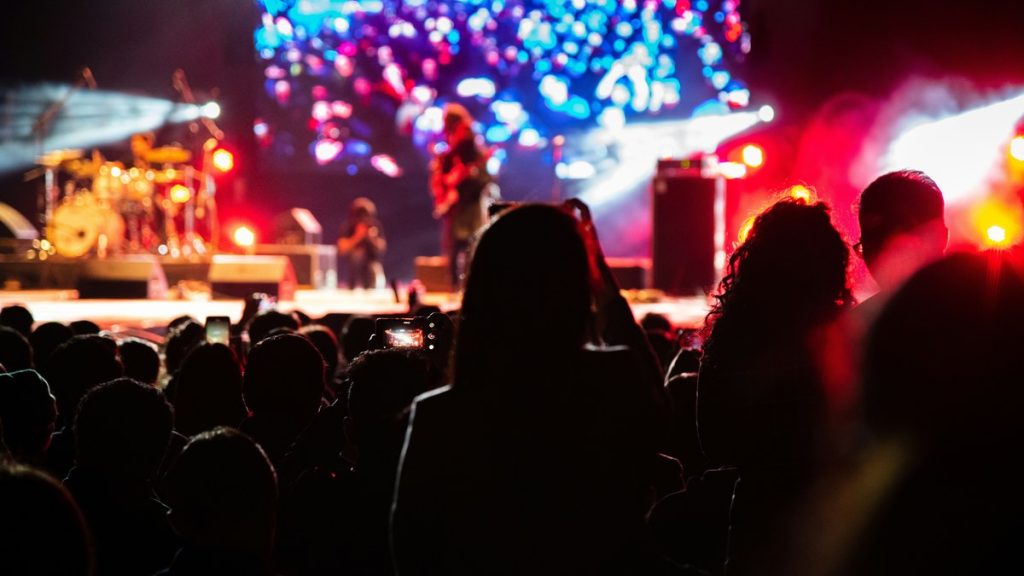
Volume gets the headlines, but for most pregnant concert-goers the more immediate hazards are physical. A concert is a dense crowd of moving bodies, often in heat, sometimes in smoke — and pregnancy amplifies every one of those factors.
Crowd movement is the bluntest risk. General-admission floors surge, pits form without warning, and a shove that a non-pregnant person absorbs without thinking can knock someone with a shifted center of gravity off balance. Falls are a genuine concern in late pregnancy: the abdomen is unprotected and the instinct to break a fall with outstretched arms does not guard the bump.
The fix is positional — the back and sides of a venue, seated sections, and raised platforms remove you from the surge zone entirely. If the only tickets available are standing-room floor, that is useful information about whether this particular show is the right one.
Heat is the second factor, and it operates on two levels. For the mother, pregnancy raises baseline body temperature and blood volume while reducing heat tolerance; overheating brings on dizziness, nausea, and fainting faster than it would otherwise. For the fetus, sustained maternal overheating is associated with developmental risks in the first trimester and with preterm birth risk in later pregnancy.
Outdoor summer festivals — hours in direct sun, limited shade, long walks between stages — concentrate this risk. Signs of heat exhaustion include headache, heavy sweating with pale clammy skin, muscle cramps, fast pulse, and extreme thirst; at the first sign, the correct move is shade, water, and rest, not toughing it out for the headliner.
Dehydration deserves its own mention because it is both common at concerts and specifically risky in pregnancy. The American Pregnancy Association advises pregnant women to drink at least 8 to 12 glasses of water daily — more in heat or with exertion — and dehydration is linked to reduced amniotic fluid, dizziness, and contractions.
Concert venues are dehydration machines: alcohol is everywhere, water is expensive or hard to find, bathrooms have lines, and people deliberately under-drink to avoid those lines. Planning your water intake is not a minor detail; it is one of the highest-leverage safety steps available.
Then there is smoke. Secondhand tobacco smoke contains thousands of chemicals, and exposure during pregnancy is associated with miscarriage, premature birth, and low birth weight. Cannabis smoke carries similar concerns.
Many jurisdictions ban smoking inside venues, but outdoor festivals, venue patios, and parking lots are often thick with it. You cannot control what strangers do, but you can choose upwind positions, avoid designated smoking areas, and favor indoor non-smoking venues when smoke exposure is a concern.
Earplugs and Where to Stand
Earplugs are the single most effective piece of concert equipment a pregnant woman can bring — with one critical caveat. The CDC is explicit: hearing protection on the mother does not fully protect the fetus, because low-frequency sound travels through the body’s tissues regardless of what is in the ear canal.
Earplugs protect your hearing and reduce your body’s stress response to loud noise, which has its own value. They do not make a 115-decibel front-row position safe for the baby. Think of earplugs as necessary but not sufficient.
Foam earplugs are the cheapest effective option, with Noise Reduction Ratings of 29 to 33 decibels when inserted correctly — roll them tight, pull the ear up and back, insert deep, and hold until they expand. High-fidelity musician’s earplugs, which attenuate sound evenly across frequencies instead of muffling it, typically offer 12 to 25 decibels of reduction and preserve music quality far better; they cost more but are reusable and far more pleasant for a full evening. Either type is vastly better than nothing, and both fit in a pocket.
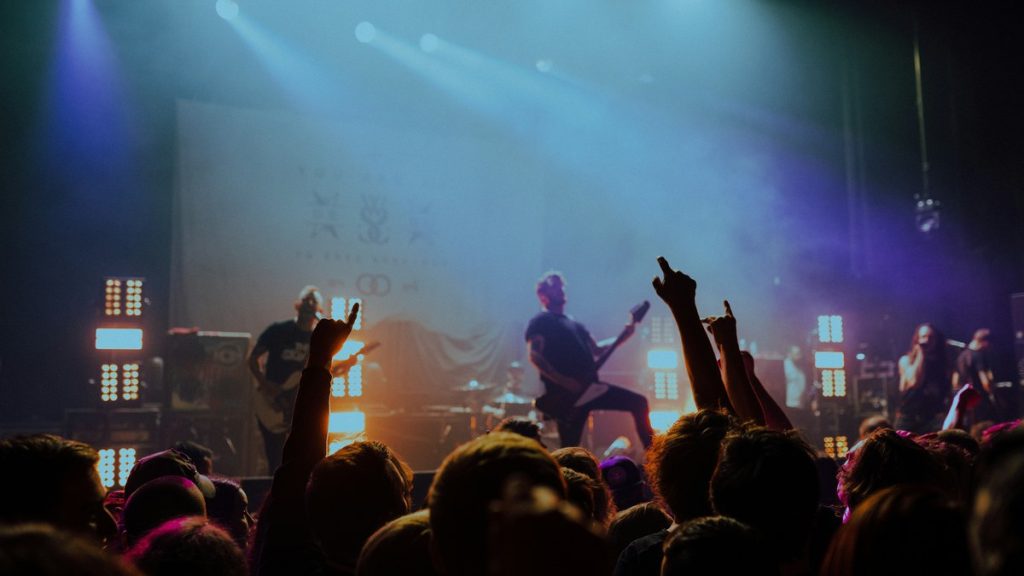
Where you stand matters at least as much as what is in your ears. The hierarchy of exposure at a typical show runs from highest to lowest: the pit and front rows, the main floor, the sides of the floor, the back of the floor, elevated seating, and finally the concourse and lobby areas.
Moving from the front of the floor to the back can cut exposure by 10 decibels or more. Balcony and mezzanine seats put vertical distance between you and the PA stacks, which disproportionately reduces the low-frequency energy that reaches the womb most easily.
A few positional rules cover most situations. Never stand directly in front of or lean against speaker stacks — low-frequency vibration transmits through the body most efficiently at close range, and the CDC specifically warns against leaning on noise sources.
Avoid the area under balconies and overhangs where bass can pool and concentrate. Keep an exit route in mind: the ability to step out for ten minutes of quiet between sets does more for your total sound dose than any single other tactic, because dose is volume multiplied by time.
Picking the Right Show
Not all concerts present the same proposition. Choosing the right show — the right artist, venue, and format — does more for safety than any amount of in-venue improvisation.
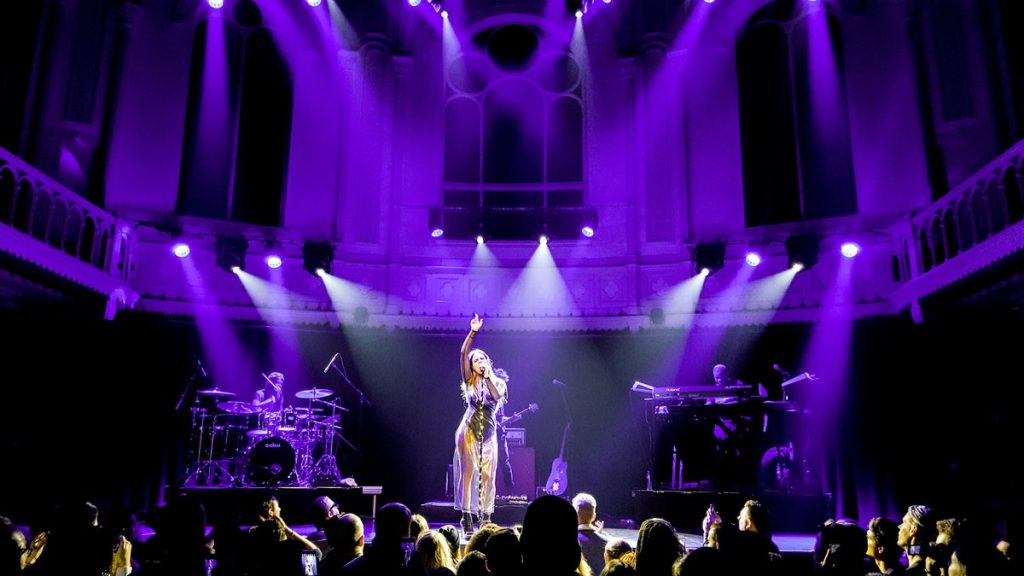
Seated venues are the clear winner for pregnancy. Theaters, performing arts centers, amphitheaters with reserved seating, and arena shows with actual seats all solve the three biggest problems at once: no crowd surge, no prolonged standing, and meaningful distance from the speakers.
An acoustic or orchestral performance in a concert hall sits at the quiet end of the spectrum and is about as low-risk as live music gets. At the other extreme, a general-admission metal show in a small club combines maximum volume, maximum crowd density, and zero seating — the hardest format to make work at any stage of pregnancy.
Genre is a useful proxy for volume. Classical, jazz, folk, and acoustic sets typically run far quieter than amplified rock, and many such shows publish no warnings because none are needed.
Rock, pop, hip-hop, and country arena shows sit in the middle — loud, but manageable from a seated section with earplugs. Metal, hard rock, and EDM events are the loudest mainstream formats and deserve the most caution, particularly in the third trimester.
Format details matter too. A single-evening theater show with a 7:30 start and a 10:00 end is a different commitment than a multi-day outdoor festival involving sun, walking, camping, and portable toilets.
Matinee and early-evening performances beat late nights for fatigue. Shorter sets beat marathon shows for total sound dose. And consider the opener question honestly: arriving for the headliner and skipping the opening act can cut your exposure time nearly in half, which is the simplest dose reduction available.
If you are choosing between shows, apply a simple filter: seated, not too loud, not too long, not too hot, and close to home. The more of those boxes a show checks, the less you need to engineer around it.
The Pregnant Concert-Goer’s Kit
What you bring determines how the night goes. Pack for the specific vulnerabilities of pregnancy — hydration, footing, rest, and sound — rather than for the concert you would have attended before.
- Water is the foundation. Bring a sealed bottle where the venue allows it, and plan to buy more inside regardless of price; the daily intake guidance does not pause for encores.
- Eat a real meal before the show and pack snacks — low blood sugar plus heat plus standing is the classic fainting recipe, and venue food lines are longest exactly when you need them most. Granola bars, fruit, and crackers travel well and need no refrigeration.
- Footwear decides how your legs feel at midnight. Wear broken-in, supportive, flat shoes with room for swelling — not the heels or fashion sneakers you might have chosen before.
- Feet swell over the course of an evening, especially in heat, and an unstable platform on a sticky venue floor is a fall waiting to happen. Compression socks, widely recommended for pregnancy-related swelling, earn their place on concert night.
- Pack earplugs even if you expect a quiet show; expectations about volume are frequently wrong.
- Bring a small portable fan or cooling towel for warm venues — evaporative cooling on the neck meaningfully extends comfort in heat.
Tissues and hand sanitizer handle venue bathrooms. Keep your phone charged and your route home planned before the encore: the worst time to be problem-solving is when you are tired, the crowd is surging toward the exits, and rideshare surge pricing has tripled.
One more item for the kit: your obstetrician’s after-hours number saved in your phone.
The odds you will need it are low, but the one scenario where minutes matter — regular contractions, fluid leaking, bleeding — is exactly the scenario where you do not want to be searching.
Asking the Venue for a Seat
Pregnancy changes what you need from a venue, and venues are more accommodating than most people assume — if you ask before the night of the show.
Start with the venue, not the ticketing company. Call or email the venue’s guest services or accessibility office a few days ahead, explain that you are pregnant and hold general-admission or standing tickets, and ask what seating options exist. Many venues maintain a limited number of accessible seats, companion seats, or staff-held chairs precisely for patrons who cannot stand for long periods.
House staff would almost always rather seat you at 7:00 p.m. than manage a medical incident at 9:30.
Be specific about what you need: a chair rather than a bench, placement near an aisle for bathroom access, and a location away from the speakers. Aisle seats near the back of a seated section are the sweet spot — easy exit, easy bathroom runs, lower sound levels. If the venue offers an accessible viewing platform, take it; these are typically elevated, uncrowded, and positioned for sightlines rather than sound pressure.
For festivals, the same principle applies at larger scale. Contact the festival’s accessibility team in advance about accessible viewing areas, which most major festivals now provide, and ask about their medical tent location when you arrive.
Tell the medics how many weeks pregnant you are if you check in — it changes how they assess dizziness, cramping, or nausea. And if camping is the only lodging option, seriously consider a hotel instead: clean bathrooms, a real bed, and climate control are not luxuries in the third trimester.
If a venue refuses any accommodation, that tells you something about the venue. A room that cannot produce a single chair for a pregnant patron is a room whose crowd management you probably should not trust with your safety anyway.
When to Skip the Show
Some pregnancies and some shows do not mix, and recognizing that in advance is better than discovering it mid-set. This section is about clear red lines, not anxiety.
High-risk pregnancies come first. If your obstetrician has diagnosed placenta previa, preeclampsia, cervical insufficiency, a history of preterm labor, or has placed you on activity restriction or bed rest, a concert is not the occasion to test those boundaries — ask your doctor directly rather than reasoning from a general guide.
Timing matters independently of risk status. Most clinicians grow cautious about unnecessary exertion and travel as the due date approaches; a show three weeks before your due date, an hour from the nearest hospital, with no easy exit, is a different proposition than the same show at twenty weeks.
If you are close enough to your due date that labor would not be shocking, weigh whether you want your water breaking in a venue parking lot.
Learn the warning signs that mean leave and call your provider, because they can appear at any show. Call your doctor or go to labor and delivery if you experience regular contractions — roughly every ten minutes or more often, or four or more in an hour — that do not ease with rest and position changes; fluid gushing or leaking from the vagina; vaginal bleeding; a constant dull lower backache that does not ease; strong menstrual-like cramps; or a significant increase in pelvic pressure.
The National Institute of Child Health and Human Development advises calling specifically if you have more than six contractions in an hour or any fluid or blood leaking. Braxton Hicks contractions — irregular, easing with rest and hydration — are common and usually benign, but when in doubt, call. Triage nurses answer these questions all day; a false alarm costs nothing.
Finally, trust acute symptoms over plans. Dizziness that does not resolve with sitting and water, a headache that will not quit, visual disturbances, or sudden swelling of the face and hands are reasons to leave and seek care regardless of what the tickets cost. No show is worth a medical emergency you saw coming.
What to Ask Your Doctor
The single highest-value step in this entire guide takes ten minutes at your next prenatal appointment. Your obstetrician or midwife knows your blood pressure, your cervix, your history, and your due date — no article can substitute for that. Bring the concert up early, before you buy non-refundable tickets if possible, and ask concrete questions rather than a general “is it safe.”
Start with the show itself: the artist, the venue, whether it is seated or standing, indoor or outdoor, and how far along you will be. Then ask about your specific situation: given your pregnancy so far, are there restrictions on prolonged standing, heat exposure, or crowds?
Is there any reason — blood pressure, placental position, prior preterm labor — that makes a loud, crowded event inadvisable for you? What symptoms should prompt you to leave and call?
Ask about the practicalities too. Is there a point in your pregnancy after which they would prefer you stay close to home or your delivery hospital?
If you are Rh-negative, have gestational diabetes, or take prescribed medication, does any of that change the calculus? And get the after-hours contact procedure clear — which number to call, and what to say — before you need it.
Write down the answers. Pregnancy brain is real, the appointment is short, and “my doctor said it was fine” is only useful if you remember what “it” covered. If your provider clears you with conditions — seated tickets, earplugs, a time limit — treat those conditions as the plan, not as suggestions.

The Bottom Line on Concerts and Pregnancy
A concert while pregnant is not a yes-or-no question.
It is a set of variables — how loud, how long, how close, how crowded, how hot, how far along — and most of them are within your control.
Pick a seated show over a standing floor. Sit far from the speakers. Wear earplugs. Drink water like it is your job. Know the warning signs that mean leave. And run the specific plan past your doctor, because their knowledge of your pregnancy outweighs any guide.
The music will still be there after the baby comes. But if the show matters to you and the circumstances are right, pregnancy does not have to mean missing it.