

If you live in the small town of Kincardine, Ontario, chances are you have been in attendance for at least a few of the Kincardine Scottish Festival events that come ‘round every summer and that take over the region.
But few know the full history behind the festival and the Highland Games that accompany it.
To understand the Kincardine Scottish Festival & Highland Games, one must first understand the town that gave rise to it, a lakeside community whose very soul has been shaped by the Scottish diaspora for more than 170 years.
Kincardine’s Close Early History with Scotland
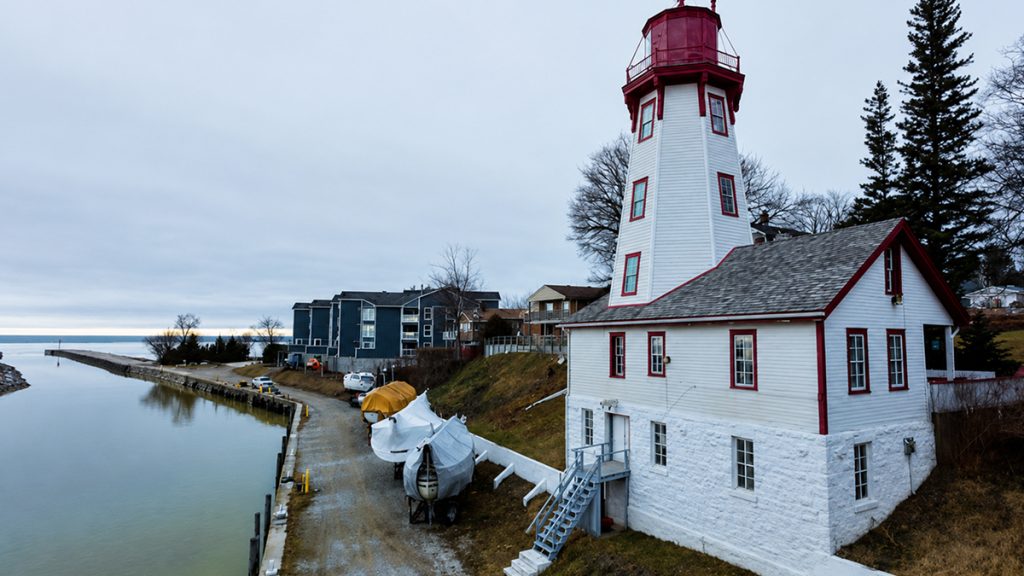
Kincardine sits on the eastern shore of Lake Huron in Bruce County, Ontario.
Its earliest European settlers arrived on March 5, 1848, when William Withers and Allan Cameron stepped ashore at the mouth of the Penetangore River. The settlement was initially known as Penetangore, but its identity as a Scottish enclave was sealed in 1851 when the community was renamed in honour of James Bruce, the 8th Earl of Elgin and the 12th Earl of Kincardine, who served as Governor General of the Province of Canada from 1847 to 1854. Both Bruce County itself and the town took his name, a quiet but powerful declaration of the cultural loyalties of the people building this place from the ground up.
Those loyalties were anything but accidental. The mid-nineteenth century was a period of dramatic upheaval in Scotland. The Highland Clearances had been displacing Gaelic-speaking communities from the Highlands and islands for generations, as landlords converted arable crofting lands to sheep pasture. Simultaneously, the Highland Potato Famine, which devastated crops across the western Highlands and Hebrides between 1846 and approximately 1856, pushed roughly one-third of the inhabitants of those areas to emigrate. Canada – and in particular, the newly opening lands of Bruce County along Lake Huron – was one of the destinations those displaced Scots chose.
Among the arrivals were communities from the Isle of Tiree, from Kincardineshire, and from across the Gaelic-speaking west of Scotland, bringing their language, their music, their clans, and their customs with them.
Scottish place names spread across the region: Inverhuron, Lucknow, Paisley, Tara, and Kincardine itself. The heritage was so deliberately preserved that even Kincardine’s fire hydrants would eventually be painted in tartan colours, and the town would come to market itself as “Ontario’s Scottish Destination.”
The Legend of the Phantom Piper Embedded in the Fabric of Kincardine
No element of Kincardine’s Scottish identity is more evocative than the legend of the Phantom Piper.
According to the story, passed down through generations by word of mouth and now commemorated on a plaque at Walker’s Lookout, on a cold October evening in 1856, a small boat departed Goderich carrying Donald Sinclair and his family, emigrants from the Isle of Skye. As the vessel neared Kincardine, it became lost in a fierce storm, with night falling fast and the rocky shoreline hidden by darkness and rain.
Facing what seemed like certain disaster, Sinclair took up his bagpipes and began to play a lament from the deck of the ship. It was not a distress signal in any formal sense, but a Scotsman’s instinctive recourse to music in extremis. The sound carried across the water to shore, where an unknown piper heard it and responded in kind. The ship’s captain followed the sound of the pipes like a foghorn, navigating safely through the storm to land.
The identity of the piper on shore was never discovered, and so the legend of the Phantom Piper was born.
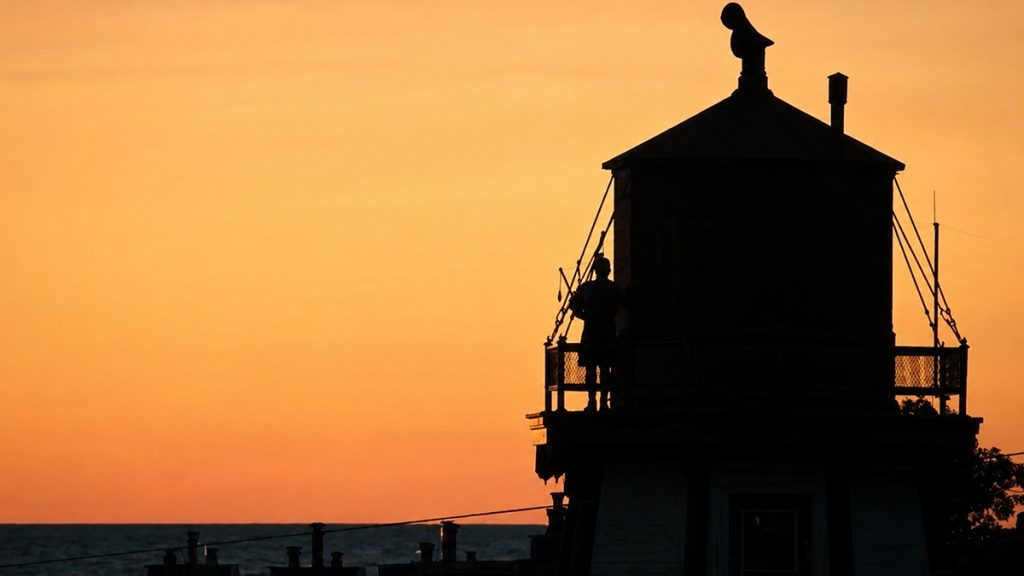
Since at least the 1970s, Kincardine has honoured this legend each evening during July and August (minus Saturdays) with a volunteer from the Kincardine Scottish Pipe Band playing a lament from atop the Kincardine Lighthouse at sunset.
The haunting sound of the bagpipes drifting across the waters of Lake Huron as the sun disappears below the horizon has become one of the most distinctive rituals in all of rural Ontario, a living connection to the immigrant experience and to the courage of those who built the community.
The Kincardine Scottish Pipe Band: The Heartbeat of the Tradition
If the Phantom Piper is the town’s spiritual ancestor, the Kincardine Scottish Pipe Band is its living embodiment.
Founded in 1908 by Pipe Major William Young, who held the band’s first practices in his barber shop on Kincardine’s main street, the band first took to the streets in late 1909, originally wearing the McKenzie Tartan with a modest membership of five pipers, four drummers, and a drum major.
In its earliest years, the roster fluctuated between nine and twenty members, and the band was in high demand across Ontario, playing garden parties, reunions, fall fairs, opening ceremonies, weddings, and funerals.
The band made history in its very first decade. One of its early members, the renowned drummer Albert Tucker, was selected as the lead drummer for the funeral of King Edward VII in 1910, an honour that brought international recognition to this small-town Ontario ensemble.
In 1922, the band adopted the Gordon Tartan, which it wore for more than seventy years. Under successive pipe majors, the band played on radio broadcasts from London, Ontario, and in 1935 led the parade when Prime Minister R.B. Bennett visited Kincardine, undeterred it is said, by the heavy rain that fell that day.
When the Second World War broke out in 1939, Pipe Major James Irvine struggled to hold the band together as members enlisted and community resources contracted.
But the war’s end brought renewal. In 1947, the band elected its first formal executive, with Paul MacKay as president and Ernie Fisher as secretary. The Royal Canadian Legion stepped in as a sponsor, providing equipment and uniforms.
By 1950, Kincardine’s merchants had outfitted the band in new Gordon Tartans, and a new chapter began under Pipe Major Henry Lamont, who commissioned band member Mac Webster to design their distinctive cap badge.
It was in the postwar years that the Saturday Night Pipe Band Parade was born, a tradition that would prove to be one of the most important precursors to the Scottish Festival itself.
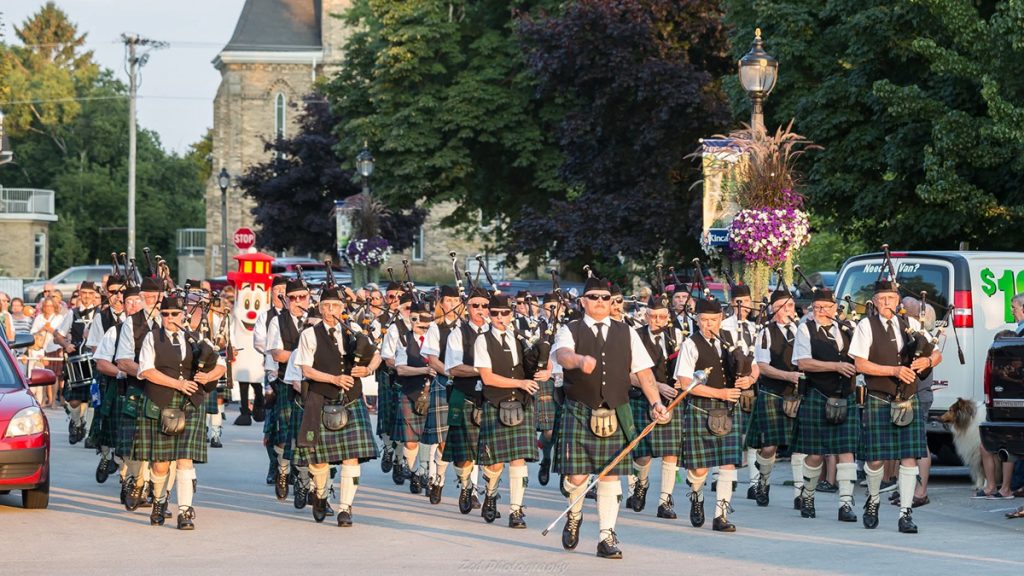
Since 1948, every summer Saturday evening at precisely 8 p.m., the Kincardine Scottish Pipe Band has formed up at Victoria Park on Durham Market North and paraded down Queen Street, with locals and visitors alike falling in behind. Rain or shine, the parade has never missed a summer, making it a symbol of the community’s resilience and continuity. Visiting pipers and drummers from around the world are welcome to join, provided they observe proper dress. The procession moves north up Queen Street to Quinn Plaza, takes a short rest, then returns to Victoria Park for a short outdoor concert.
In 1957, the band was officially renamed the Kincardine Scottish Pipe Band, the name it carries today.
It celebrated its centennial in 2008 and is widely regarded as the oldest street pipe band with unbroken service in Ontario, a distinction that places it among the great institutions of Scottish-Canadian culture.

A Tartan for the Town of Kincardine
In 1987, Kincardine took its Scottish identity one step further by commissioning its own registered tartan.
Produced by Strathmore Woolens and registered with the Scottish Tartan Society on August 27, 1987, the Kincardine tartan was designed with colours that reflect the natural and civic character of the town, drawing in particular on the blue of Lake Huron’s waterfront.
The tartan became the official dress of the Kincardine Scottish Pipe Band, replacing the Gordon Tartan that members had worn since 1922, and its presence spread throughout the municipality.
Today, Kincardine’s tartan colours appear on fire hydrants, on bunting, on signage, and in the wardrobes of residents who take pride in displaying their community’s identity. The registration of the tartan in 1987 represents a formal declaration of Kincardine’s Scottish heritage as a living, recognized cultural identity and one that merited the same institutional standing as the tartans of Scottish clans and regions.
For a town in rural Ontario to possess its own registered tartan was, and remains, an unusual distinction that speaks to the depth of the community’s commitment to its roots.
The Birth of the Kincardine Scottish Festival in 1999
The Kincardine Scottish Pipe Band had, by the 1990s, established a tradition of travelling to pipe band competitions and Highland games events across North America and even as far as Scotland.
It was these travels – and the experience of attending and participating in full-scale Scottish festivals – that planted the seed for what would become the Kincardine Scottish Festival & Highland Games. As the band encountered the scale and pageantry of major Highland gatherings, the idea grew among its members and supporters that Kincardine, with its deep Scottish roots, its registered tartan, its Saturday Night Parade tradition, and its extraordinarily rich cultural landscape, deserved a festival of its own.
That idea became reality in 1999, the same year that the Town of Kincardine, the Township of Kincardine, and the Township of Bruce were amalgamated to form the Municipality of Kincardine.
Among the founding figures of the festival was Gord Rogers, a community leader whose passion for Kincardine’s Scottish heritage and whose organizational energy helped bring the event to life. Rogers would go on to serve as a past president and long-standing board member of the festival until his death, and was eulogized by his colleagues as someone whose words of wisdom, expertise, and guidance in all things Scottish were instrumental in making the festival the institution it became.
The Kincardine Scottish Festival was conceived from the outset as a three-day celebration held each July in Victoria Park, in the heart of Kincardine.
Its mandate was to preserve, enhance, and celebrate the town’s Scottish roots, and to honour the contributions of Scottish culture within the Canadian multicultural mosaic while simultaneously presenting a vibrant, welcoming, and family-oriented event that would draw visitors from across North America.
From its very first year, the festival positioned Kincardine not merely as a pleasant summer destination but as a genuine cultural landmark.

The Kincardine Scottish Festival Grew Into an Award-Winning Institution
In its first decade, the Kincardine Scottish Festival grew steadily in size, reputation, and ambition.
By its tenth anniversary it had established itself as one of the premier Scottish festivals in Canada, receiving a Tourism Recognition Certificate from the Municipality of Kincardine and earning a reputation that drew visitors from across Ontario and beyond.
The festival’s structure evolved into a distinctive format.
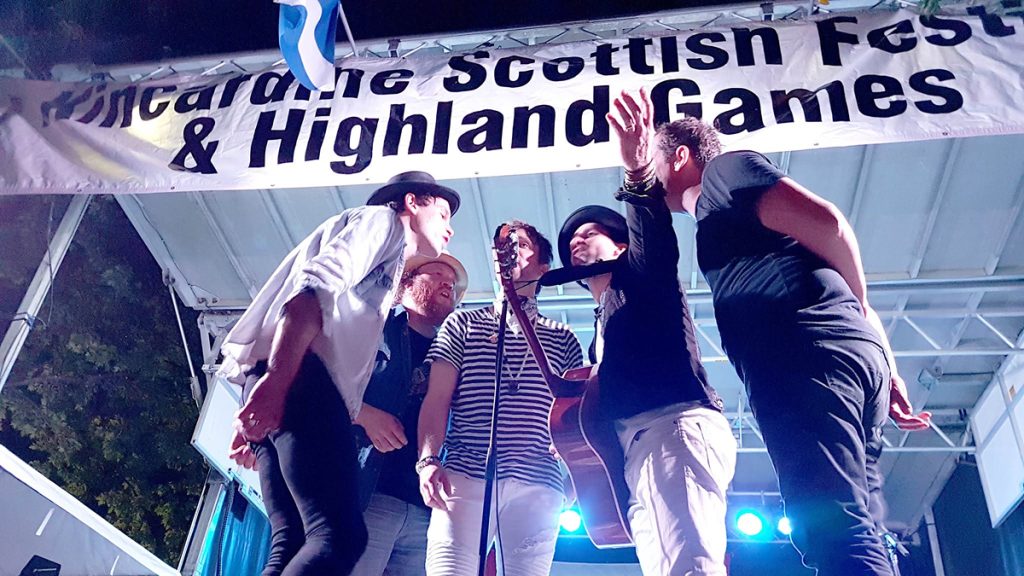
Friday evenings became the occasion for opening ceremonies, featuring the historic Kincardine Scottish Pipe Band and setting the cultural tone for the weekend with live Celtic and rock music acts.
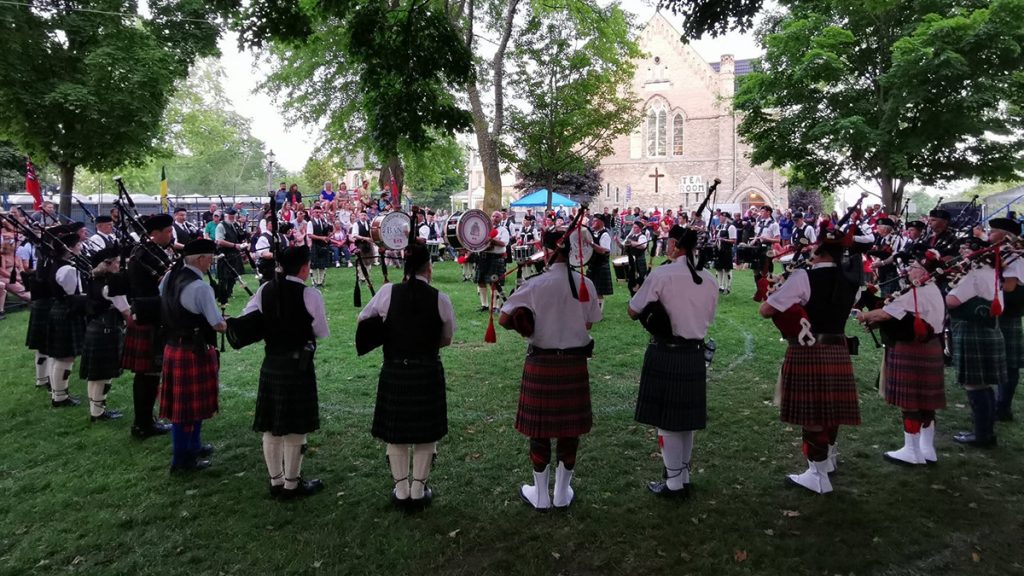
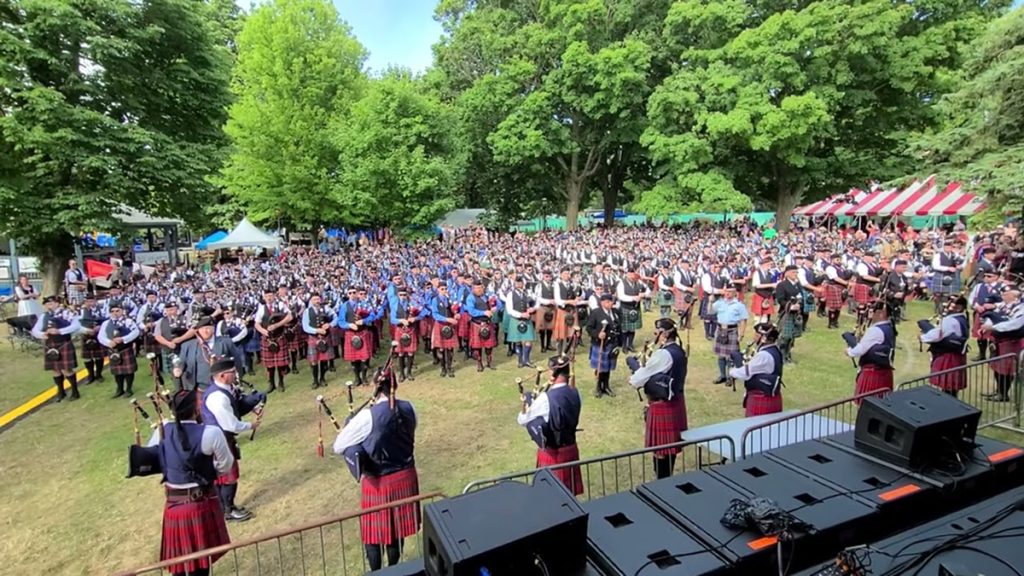
Saturday transformed into the heart of the competitive programme, with pipe band competitions drawing upwards of thirty bands from across Canada and the United States, representing all grades from 1 through 5. Solo piping competitions take place along the neighbouring streets of Victoria Park, with competitors stationed at intervals along the route, a format that takes advantage of the neighbourhood’s Victorian homes and lush gardens.
The Saturday programme also features the Piobaireachd Competition, in which pipers perform the Great Music – that is, extended classical compositions of the Scottish Highland tradition, characterized by a melodic theme and elaborate formal variations.
This competition, held in Kincardine United Church, adds a dimension of musical depth and historical seriousness that distinguishes the festival from more purely entertainment-oriented events.
The Highland Dancing Competition brings together competitors in the morning and continues into the afternoon, adjudicated under the standards of the Highland Dancers’ Association of Ontario.
The Parade of Clans marches pipe bands and clan representatives through downtown Kincardine in a procession that thousands of spectators line the streets to watch, recreating in a small Ontario lakeside town something of the pageantry of the great Highland gatherings of Scotland itself.
The Heavy Events competition at Robinson Park presents the athletic heritage of the Highlands: the tossing of the caber, the throwing of the hammer, the sheaf toss, and the stone put – disciplines whose roots in Highland tradition predate modern track and field, which itself drew on these ancient contests. Athletes throw weights of 28 and 56 pounds with chain and ring handles, requiring a 9-foot run-up and single-handed release, a test of raw strength and technique that connects the modern competitor to medieval Highland warriors.
Clan Avenue provides a space for Scottish clan societies from across North America to gather, display their histories, and welcome visitors seeking to trace their ancestry.
Clans including the MacDougalls, MacPhersons, Fergussons, Camerons, and many others bring stories, genealogical records, and cultural knowledge that help visitors forge a deeper connection with their heritage.
By its nineteenth anniversary in 2017, the festival was drawing thousands of visitors annually, generating significant economic activity for Kincardine’s businesses, and earning coverage in tourism publications and regional media as one of the signature Scottish cultural events in English Canada.
Arriving in Style for the Kincardine Scottish Festival’s 20th Anniversary
The 20th anniversary in 2019 represented a milestone that called for special recognition.
The festival welcomed Lord Bruce – Charles Bruce, the direct hereditary head of Clan Bruce – from Scotland to serve as Grand Chieftain for the celebrations, a gesture that underscored the festival’s genuine connection to Scottish cultural institutions rather than mere nostalgic performance. Lord Bruce’s presence connected Kincardine’s festival to the very lineage that had given both the county and the town their names nearly two centuries before.
By this point, the festival had assembled a format that was both deeply traditional and dynamically entertaining.
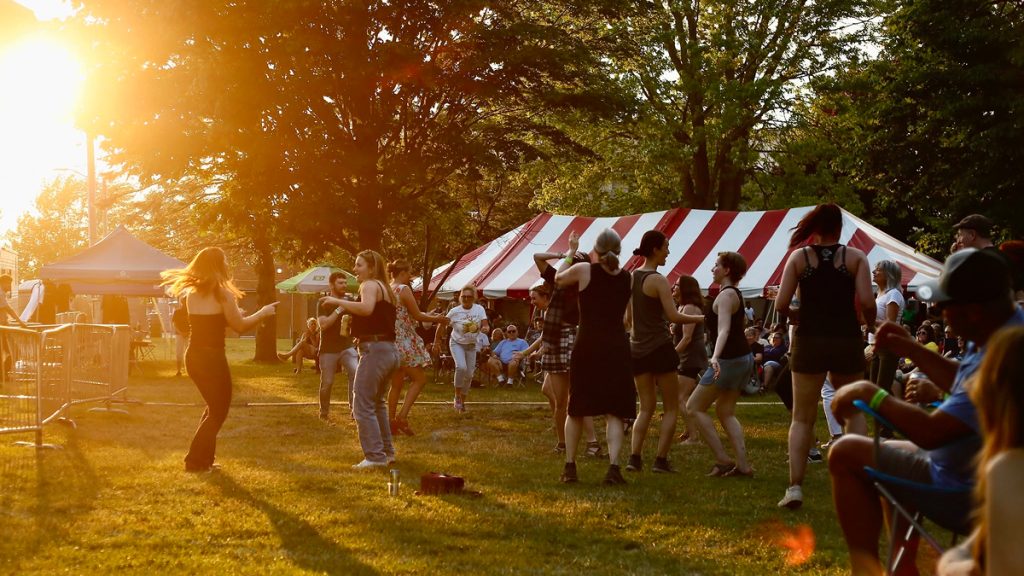
Evening concerts featured headline acts from the Celtic rock and folk worlds. Bands like the Glengarry Bhoys, the Mudmen, and Abbamania shared stages with traditional piping and dancing. The Clachan Highland pub tent provided a social hub where the atmosphere of a Scottish country pub could be experienced in the heart of Ontario. Food vendors, Celtic regalia merchants, and craft sellers lined the festival grounds.
Needless to say, in over twenty years of history, the Kincardine Scottish Festival proved to be a major success.
Resilience During the COVID-19 Pandemic and in a Post-Pandemic World
Like all community festivals, the Kincardine Scottish Festival has not been without its challenges.
The COVID-19 pandemic forced cancellations and significant disruptions to the festival’s run during 2020 and 2021.
When the festival returned in 2022, it did so to great enthusiasm from the community and visitors alike, demonstrating the deep appetite that existed for the gathering, somewhat bring it back on the same track that it was prior to its pause.
In 2023, a different kind of challenge presented itself, however.
The reconstruction of Queen Street in downtown Kincardine – a necessary infrastructure project – forced organizers to pause the pipe band competition and the Clan Parade for that year, as the heart of the traditional parade route was inaccessible.
Rather than cancel the event, the festival team adapted, presenting an afternoon concert in Victoria Park anchored by fan-favourite Madison Violet and featuring a special performance by the Guelph Pipe Band marking its own 100th anniversary.
A mass pipe band performance brought together Grade 3 and 4 Guelph bands with the Teeswater Highlanders and local pipers from Kincardine, Hanover, and surrounding counties, demonstrating that the spirit of the festival could survive and even thrive under constraint.
The episode also produced an unexpected insight: as organizers noted, the festival and its location had become a “competition tour favourite” among pipe bands from across the continent, a reflection of how thoroughly Kincardine had established itself as a place where Scottish musical tradition is taken seriously and celebrated.
Celebrating and Supporting the Community of Kincardine
From its founding, the Kincardine Scottish Festival has been oriented toward community benefit as much as cultural celebration.
The festival has consistently supported local charities and youth programmes, and has maintained close ties with the Pipers and Pipe Band Society of Ontario (PPBSO), which sanctions and administers the competitive elements of the Highland Games.
The relationship between the festival and the PPBSO reflects a commitment to maintaining the integrity of Scottish competitive traditions rather than reducing them to spectacle.
The festival also serves as an economic anchor for Kincardine’s summer season.
Thousands of visitors from across Canada and the United States book accommodation in Kincardine and the surrounding Bruce County region each July, spending at local restaurants, inns, shops, and attractions.
The Municipality of Kincardine’s Tourism Recognition Certificate acknowledged this economic dimension explicitly, recognizing the festival as a significant driver of visitor activity.
Discover A Living Heritage in the Kincardine Scottish Festival
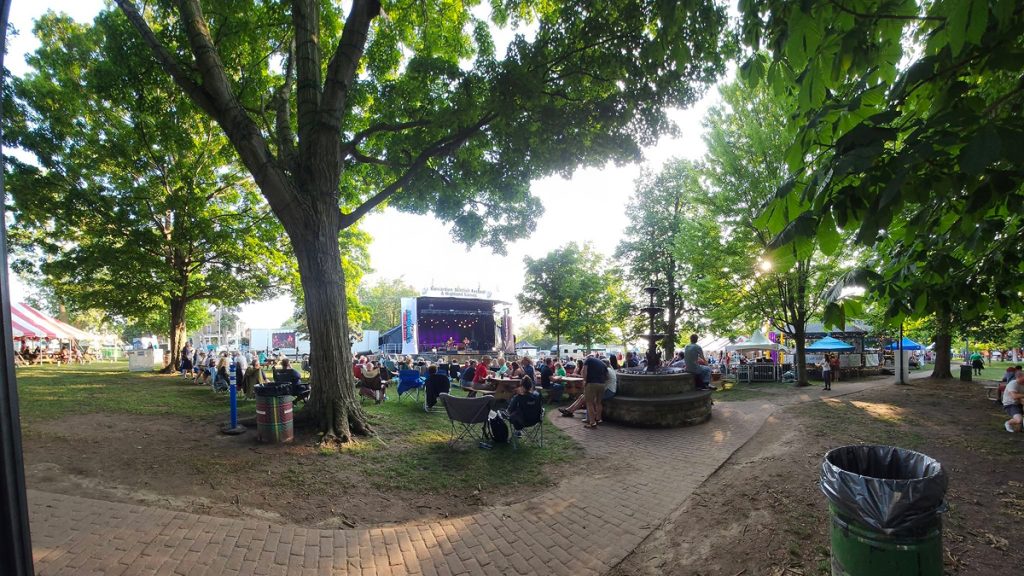
More than 25 years after its founding, the Kincardine Scottish Festival & Highland Games has become what its founders envisioned: an annual gathering that gives living expression to a cultural identity stretching back through the pipe band’s unbroken century of Saturday parades, through the registered tartan and the sunset lament of the Phantom Piper, through the Clearance-era emigration that brought Gaelic-speaking families from Tiree and Skye and Kincardineshire to the shores of Lake Huron in the middle of the nineteenth century.
The Kincardine Scottish Festival is a continuation of Scottish tradition by a community that has maintained it without interruption, adapting it to new circumstances while preserving its essential character.
When thirty pipe bands from across North America converge on Victoria Park each July, when Highland dancers compete on the same ground where Kincardine residents have gathered for community events since the town was first settled, when a Grand Chieftain from Scotland walks in procession with the clan societies of the New World, something genuinely historic is taking place.
Kincardine calls itself Ontario’s Scottish Destination, and the festival is the fullest expression of that identity: a celebration of who these people are, where they came from, and what they have built on the shores of a great inland lake in the heart of Canada.
This year’s Kincardine Scottish Festival & Highland Games will be held on July 3rd to July 5th this year at Victoria Park in Kincardine, Ontario. Purchase your tickets here for either Friday, Saturday, or Sunday or pick up a weekend pass for the entire event.



